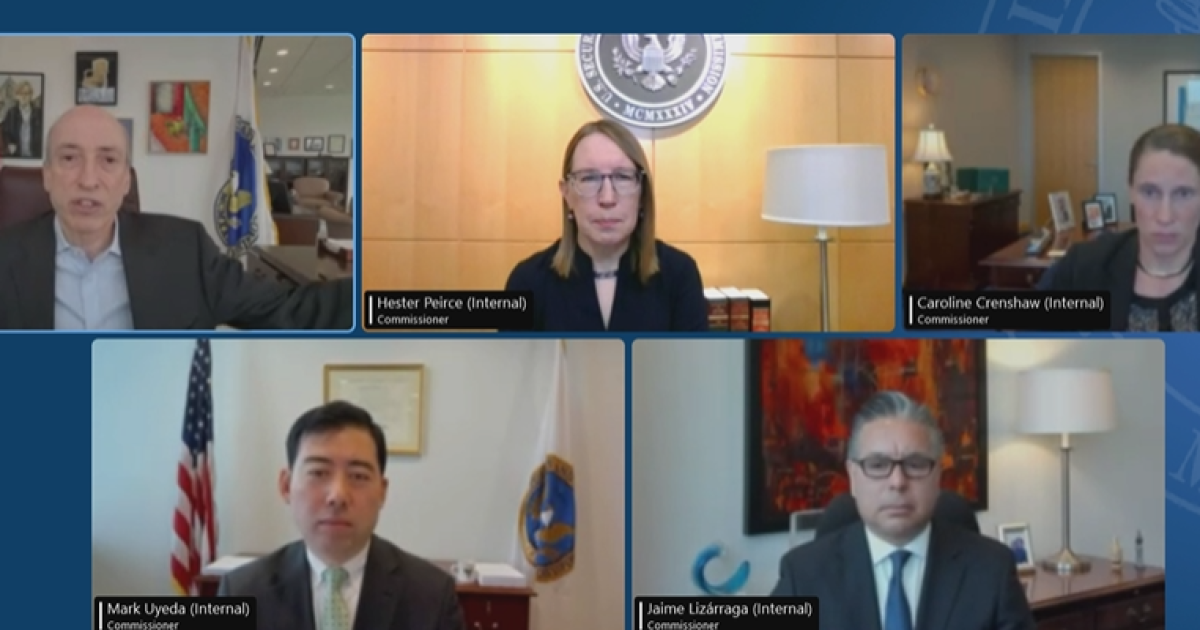
A divided Securities and Exchange Commission voted three to two Wednesday to approve a new rule that would require companies to provide climate-related disclosures to investors, but scaled back the original proposal to exclude disclosure of so-called Scope 3 emissions from their supply chains, and exempt many smaller companies.
The
“Today’s rules enhance the consistency, comparability and reliability of disclosures,” said SEC chair Gary Gensler. “The final rules provide specificity on what must be disclosed, which will produce more useful information than what investors see today. Further, the final rules require that climate risk disclosures be included in a company’s SEC filings, such as annual reports and registration statements. Bringing them into the filings will help make them more reliable. There are standard controls and procedures for filings unlike for sustainability reports.”
The final rules would require SEC registrants to disclose climate-related risks that have had or are reasonably likely to have a material impact on the registrant’s business strategy, results of operations, or financial condition, along with the actual and potential material impacts of any identified climate-related risks on the registrant’s strategy, business model and outlook.
If, as part of its strategy, a company has undertaken activities to mitigate or adapt to a material climate-related risk, it would provide a quantitative and qualitative description of material expenditures incurred and material impacts on financial estimates and assumptions that directly result from such mitigation or adaptation activities.
The rule also includes specified disclosures regarding a registrant’s activities, if any, to mitigate or adapt to a material climate-related risk including the use, if any, of transition plans, scenario analysis, or internal carbon prices. SEC registrants would also need to disclose any oversight by the board of directors of climate-related risks and any role by management in assessing and managing the registrant’s material climate-related risks.
They would also disclose any processes they have for identifying, assessing and managing material climate-related risks and, if the registrant is managing those risks, whether and how any such processes are integrated into the registrant’s overall risk management system or processes.
The rule would require disclosure of information about a registrant’s climate-related targets or goals, if any, that have materially affected or are reasonably likely to materially affect the registrant’s business, results of operations, or financial condition. Those disclosures would include material expenditures and material impacts on financial estimates and assumptions as a direct result of the target or goal or actions taken to make progress toward meeting such target or goal.
For large accelerated filers and accelerated filers that are not otherwise exempted, companies would need to disclose information about material Scope 1 emissions and/or Scope 2 emissions from their supply chain. They would also be required to disclose Scope 1 and/or Scope 2 emissions, an assurance report at the limited assurance level, which, for a large accelerated filer, following an additional transition period, will be at the reasonable assurance level;
Companies would also disclose their capitalized costs, expenditures expensed, charges and losses incurred as a result of severe weather events and other natural conditions, such as hurricanes, tornadoes, flooding, drought, wildfires, extreme temperatures, and sea level rise, subject to applicable one percent and de minimis disclosure thresholds, disclosed in a note to the financial statements;
SEC registrants would disclose the capitalized costs, expenditures expensed and losses related to carbon offsets and renewable energy credits or certificates if they’re used as a material component of a registrant’s plans to achieve its disclosed climate-related targets or goals, disclosed in a note to the financial statements; and
If the estimates and assumptions a registrant uses to produce the financial statements were materially impacted by risks and uncertainties associated with severe weather events and other natural conditions or any disclosed climate-related targets or transition plans, companies would provide a qualitative description of how the development of such estimates and assumptions was impacted, disclosed in a note to the financial statements.
Two of the SEC commissioners objected to the proposal. “The final rule is different from the proposal, but it still promises to spam investors with details about the Commission’s pet topic of the day — climate,” said commissioner Hester Peirce. “As we have heard already, the recommendation before us eliminates the Scope 3 reporting requirements, reworks the financial statement disclosures, and removes some of the other overly granular disclosures. But these changes do not alter the rule’s fundamental flaw — its insistence that climate issues deserve special treatment and disproportionate space in Commission disclosures and managers’ and directors’ brain space. Because the Commission fails to justify that disparate treatment, I dissent.”
Another commissioner, Mark Uyeda, also objected to the rule. “Today’s rule is the culmination of efforts by various interests to hijack and use the federal securities laws for their climate-related goals,” he said. “In doing so, they have created a roadmap for others to abuse the Commission’s disclosure regime to achieve their own political and social goals. First, they purchase shares in public companies under the guise of becoming “investors,” but not with the primary intention of seeking financial return. Rather, they use their holdings as a means to force companies to disclose information related to political and social issues important to them but that may not be relevant to those companies’ business or shareholders generally. After some companies capitulate to their demands, they ask the Commission to adopt rules requiring the disclosure from all companies. Citing such ‘investor demand’ for the information and the need to have ‘consistent and comparable’ disclosure, a politically oriented Commission might pursue such a rulemaking. If it does, then the result is using disclosure not as a tool to aid investors, but to bypass Congress to achieve political and social change without the corresponding accountability to the electorate.”
However, two of the other commissioners joined Gensler in supporting the rule, giving the Commission a majority to pass it. SEC commissioner Caroline Crenshaw voted in favor of the rule, but added that it didn’t go far enough after it had been scaled back. “Investors made clear to my colleagues and me that these provisions are of key importance,” she said. “Investors need insight into a company’s business, its results and its financial condition, including material risks it faces. To be crystal clear, though, this is not the rule I would have written. While these are important steps forward, they are the bare minimum. Ultimately today’s rule is better for investors than no rule at all, and that is why it has my vote. But, while it has my vote, it does not have my unencumbered support. And, although I am loath to leave for future Commissions those obligations that I see as our responsibilities today, I’m afraid that is precisely what we are doing.”
She suggested that the SEC should allow companies to use standards from the International Sustainability Standards Board for their reporting.
“Commenters noted that standard-setters for other regulatory bodies, such as the International Sustainability Standards Board, are implementing their own climate-risk reporting regimes,” she said. “An order recognizing such a regime would not only respond to investors, but also to the many corporate commenters who favored such an approach. Although we leave it to the future, it would be an easy and meaningful step for the Commission to take in order to avoid a patchwork of reporting obligations and potentially conflicting demands. This idea was overwhelmingly popular in the comment file and mirrors other areas of the securities laws where there are comparable cross-border regimes.”
Back in 2007, the SEC allowed use of International Financial Reporting Standards by foreign companies, and the ISSB climate standard is now overseen by the IFRS Foundation.
Commissioner Jaime Lizárraga also expressed his support and pointed out that many companies already provide investors with climate-related information. “Investors view this information as relevant to a company’s bottom line and as material to their investment and voting decisions,” he said. “They can also assist with investors’ analysis as to whether hedging or diversifying your portfolio is warranted. The connection between climate-related risks and a company’s fundamental value is well established, as highlighted by studies cited in the Commission’s release. These risks play out for differences in revenues, operating income and expenses, cash flows, capital structures, asset prices, debt performance and investment policies. Investor demand for climate risk disclosures has already had an impact on the market.”
He noted that in the past few years, roughly 60% of Russell 3000 companies and 90% of Russell 1000 companies provide some form of climate-related information and nearly 60% of Russell 1000 companies disclose Scopes 1 and 2 greenhouse gas emissions. “Under the status quo, investors will continue to face a patchwork of disclosures with a limited ability to conduct apples-to-apples comparisons,” he added.
Reactions
Outside observers from some accounting firms agreed. “Regardless of whether it marks a watershed moment or a watered-down rule, companies are now facing a wave of global requirements,” said KPMG U.S. ESG leader Rob Fisher in a statement. “Amidst these disclosure requirements, the organizations that view new reporting requirements as an integral part of their broader strategy will find themselves in a better position to realize the full value sustainability initiatives can bring to their business.”
The SEC rule will provide U.S. companies with an alternative to the patchwork of standards now out there, although like many of those standards it builds on existing frameworks like the one from the Financial Stability Board’s Taskforce on Climate-related Financial Disclosures, which is now overseen by the ISSB, as well as the Greenhouse Gas Protocol.
“The alphabet soup of voluntary climate and sustainability reporting frameworks of several years ago has become the patchwork quilt of climate and sustainability reporting requirements of today,” said KPMG U.S. ESG audit leader Maura Hodge in a statement. “Companies have real work to do to understand their various reporting mandates, while navigating dual challenges of continued policy uncertainty and heightened compliance risks.”
Companies will now have to face requirements from the SEC for reporting. “We’ve entered the next wave of ESG which requires institutional-grade reporting: companies now face compliance risk in what they disclose,” said Anthony DeCandido, ESG and sustainability assurance co-leader with RSM US LLP. “The same rigor required (historically) around financial reporting, now, too, is required for climate reporting. Where the SEC is landing with their guidance will help companies navigate through requirements that are more manageable, sooner. Although many, typically larger, companies have increased their level of reporting of sustainability information in recent years, there remains a broad spectrum of preparedness across the middle market for the coming mandatory era.”
The Center for Audit Quality expressed its support for the new rule. “While we are still digesting the final rules, the SEC took a step forward today in providing much needed clarity on the reporting of climate-related information by public companies,” said CAQ CEO Julie Bell Lindsay in a statement. “Whether greenhouse gas emissions or the impact of climate issues in company financial statements, audit firms — with their deep understanding of company financial records, operations, business strategies and internal controls — stand ready to bring their independence and objectivity in providing assurance on this information.”
The audit provider AuditBoard also weighed in with its reaction. “Today’s climate risk disclosure ruling by the SEC promises to bring a new era of corporate transparency,” said Judson Aiken, senior director of risk and ESG solutions at AuditBoard, in a statement. “These rules come in response to increasing demand from investors and public filers for more consistent, comparable and reliable climate risk reporting. They will require public companies to begin disclosing the material impacts of climate risks and transition activities on their operations and financial statements. In addition, while Scope 3 requirements were ultimately removed from the final ruling, Scope 1 and 2 greenhouse gas emission disclosures will be required for some filers, with limited and reasonable assurance requirements coming in a phased approach.”
States such as California are already requiring climate-related disclosures. “While the SEC’s rules have been the most highly anticipated in the United States, it’s important to remember that they are not the only regulator in the game,” said Bill Harter, principal ESG solutions advisor at the technology company Visual Lease, in a statement. “California’s recent legislation (SB-256, SB-261 and AB-1305) already impacts many public and private companies within the U.S., including those operating in California with over $1B in revenue, those operating in California with over $500M revenue, as well as those operating in California that sell or use voluntary carbon offsets to make green claims. European climate disclosure laws and the ISSB Standards (IFRS S1 & S2), also apply not just to companies based in those jurisdictions, but those that are operating there, as well. If those that operate internationally are putting Scope 3 emissions on their disclosures, they need to be able to back up their claims with actual data. The biggest mistake that these organizations can make is to assume that they can pump the brakes on their environmental reporting efforts just because the SEC is pulling back on Scope 3.”
Environmental groups had mixed reactions. “Thanks to the SEC’s actions, companies will finally be required to provide reliable and comparable information to investors and the market about some of their climate-related financial risks,” said Ben Jealous, executive director of the Sierra Club, in a statement. “While a positive step, this rule falls significantly short of what’s needed. Greenhouse gas emissions are a critical measure of a company’s handling of climate risk and Scope 3 emissions represent the vast majority of emissions from most companies. Allowing companies to continue hiding a full accounting of their climate pollution keeps investors, including the Sierra Club and our members, in the dark about critical information needed to make informed choices about companies’ financial risks, including risks stemming from the failure to invest in the transition to a decarbonized economy.”
Other reactions were more negative. “The SEC gutting its final climate disclosure rule is a massive giveaway to Big Ag and Big Oil, delivering a blow to investors, pensioners and retirement savers,” said Erich Pica, president of Friends of the Earth, in a statement. “Amid escalating climate-related financial risks, these rollbacks signify a profound failure to ensure fair, orderly, and efficient markets. This is a huge miss for the Biden administration. By caving to the Big Ag lobby, the SEC allows some of the world’s biggest, most climate-destructive corporations to conceal their massive greenhouse gas footprints.”
“Investors have been clear: they need mandatory and standardized climate-related financial risk disclosures to determine which companies are taking the financial risks of the climate crisis seriously and which are not. LCV commends the SEC for taking this critical first step to increase transparency and protect investors in the face of the climate crisis,” said League of Conservation Voters senior government affairs advocate David Shadburn in a statement. “At the same time, we are disappointed that corporate special interest groups like the Chamber of Commerce, who represent the very large, public companies whose climate-related financial risk disclosures are most needed, worked to significantly weaken the previously proposed comprehensive greenhouse gas emissions reporting that received overwhelming support during the public comment period. SEC must do more to ensure these companies provide investors a full accounting of their climate financial risks, including supply chain emissions (also known as Scope 3), which often make up the majority of publicly traded companies’ emissions.”
“As an investor, we expect full transparency about a company’s fundamentals, especially climate-related risks that pose serious negative financial consequences,” said Dan Chu, executive director of the Sierra Club Foundation, in a statement. “Without higher accountability standards, companies can withhold critical information that prevents us from making informed investment decisions rooted in full due diligence. Today’s decision lays an important foundation, however, unless the SEC implements stronger climate risk disclosure requirements, the agency is simply falling short of its mission to protect investors.”
An environmental investment group gave its conditional support. “We congratulate the SEC on this important step forward to bring the U.S. closer in line with its global counterparts,” said Ceres president and CEO Mindy Lubber in a statement. “Although this final rule does not go far enough compared to international standards and the SEC’s 2022 proposal, it will start to meet the demand for transparency that investors and companies have long sought. Consistent, comparable information on physical and transition climate-related risks is vital to decision-making around strategy and investments. The SEC’s new rule will now mandate the disclosure of that information, giving investors much-needed insight on how companies are managing the material financial risks and opportunities presented by climate change. For most companies and financial institutions, indirect emissions throughout a company’s value chain represent the largest source of a company’s transition risk. While we are disappointed the rule does not include key provisions from their 2022 proposal, including the mandate of the disclosure of Scope 3 emissions, investor demand for the disclosure of Scope 3 emissions continues to grow and many companies will be required to disclose this data in other jurisdictions.”
An environmental consultancy sees the rule as falling short. “The SEC’s groundbreaking ruling is a historic step toward corporate transparency, mandating U.S.-listed companies to disclose climate-related risks, emissions and environmental strategies,” said EcoAct North America CEO William Theisen in a statement. “While this marks a significant milestone, the omission of mandatory Scope 3 emissions reporting is a disappointment, as this critical component in the climate puzzle remains voluntary. Scope 3 emissions, which covers upstream and downstream emissions in a company’s value chain, is a pivotal aspect of understanding a company’s environmental impact. Despite concerns about the consistency of Scope 3, making Scope 3 mandatory would increase data availability and highlight the importance of value chain emissions. This, in turn, would lead to accelerated improvement in greenhouse has accounting for this pivotal scope. Nevertheless, this ruling underscores a pivotal moment in sustainable finance, fostering accountability and standardized reporting, and urges businesses to comprehensively address their environmental impact for the benefit of investors, stakeholders and the planet. It is crucial for companies to recognize the momentum generated by this ruling and voluntarily embrace Scope 3 reporting, not only to meet growing stakeholder expectations but to actively contribute to global climate mitigation efforts and secure a sustainable future.”
Credit: Source link