Welcome to Creator Columns, where we bring expert HubSpot Creator voices to the Blogs that inspire and help you grow better.
When I lived in Argentina, I didn’t miss out on seeing any of the movies I wanted to see in the theaters. All the shows I wanted to see were playing to packed audiences in Buenos Aires in English with Spanish subtitles.
![Download Now: The Global Marketing Playbook [Free Guide]](https://no-cache.hubspot.com/cta/default/53/1b545c7f-72fe-45bb-b651-30d5f1df6f10.png)
Here in the U.S., my Spanish-speaking husband and I recently went to see a new movie at the theater.
We were able to go because this specific theater had designated showings of the movie with the original English audio, along with Spanish subtitles.
As an inclusive marketing strategist and consultant and founder of Thompson Media Group, I often remind my clients that some people may have different aspects of their identity. But their dreams, desires, fears, and frustrations aren’t any different from the people they’ve grown accustomed to serving.
People with disabilities still like pizza. People with larger body sizes still like to wear cute clothes. And people who speak other languages still need tools and support to grow their businesses.
The entertainment industry has long leaned into the reality that people who speak other languages still want to watch the latest Marvel movie, Bridgerton season, or House of the Dragon episode at the same time as other people around the world.
As such, they bake global audience needs into the budget and development timelines so they can watch the content in their local language.
An increasing number of smart brands are embracing the idea that engaging their ideal customers who speak other languages is an effective way to attract and convert more customers.
If you need guidance on how to build a global marketing strategy, check out this Global Marketing Playbook from HubSpot.
How to Engage Consumers That Don’t Speak Your Brand’s Primary Language
A common misconception about engaging consumers who speak different languages is that all you have to do is translate your existing content.
However, the journeys consumers take to choose which brand to buy from are often more complex than it is for a typical media consumer. There are other factors to consider.
Federico Gagliardone is the co-founder of Mecenas, a media company that works to connect brands with Spanish speakers in the U.S. He told me that a common misconception brands have about engaging Spanish speakers is that all they have to do is translate the content.
Have a listen to this full conversation with Federico on how to effectively reach Spanish speakers in the U.S., including the role of Spanglish on this episode of the Inclusion & Marketing podcast.
Here are key elements to include in an effective multilingual content strategy, beyond translation and localization, that attracts and converts more customers for your brand.
1. Customer Intimacy
In marketing, one-size-fits-all approaches aren’t really effective. I am constantly reminding my clients that business is about belonging. Consumers will feel like they belong with you whenever you demonstrate that you see them, understand them, and have created products, content, and experiences with them in mind.
Taking content that was designed for one market, then plopping it in front of another market rarely yields the stellar results you desire.
Selim Dahmani is a Senior Growth Manager at HubSpot who focuses on the French-speaking market. He told me, “In my experience, native blog posts created with a regional SEO approach bring 4x more traffic on average than localized blog posts.”
This short video clip gives a specific example as to why a simple localization approach didn’t yield stellar results.:
Do this: Start with the customer you want to serve. Let insights about them guide your strategy. Spend time discovering what their dreams, desires, fears, and frustrations are. Uncover common questions they have, versus the ones you may be accustomed to getting in other markets.
Avoid focusing your efforts on figuring out what you need to do to “make it work” with what you already have for people who speak other languages, either in the same or different markets.
Then create inclusive and authentic content that speaks to the audience you want to reach in a manner and format that fits their preferences.
You can hear my full discussion with Selim on this episode of the Inclusion & Marketing podcast, which also has lots of other great in-the-trenches insights about developing and executing a multilingual content strategy.
2. Customer Journeys
Don’t assume that the journey customers take as part of your multilingual content strategy will be the same as it is in the primary language your brand operates in.
What you find about consumers during the customer intimacy phase may lead you to create a different journey.
For instance, while people in one market may be keen to sign up to get a lead magnet to take the next step forward with you, consumers in another market may have a strong preference to sign up for a call with you.
Build your funnel based on the needs and preferences of the people you want to serve, rather than just duplicating what has worked for people in other markets in the past.
Another consideration is that you may find that you need different assets, and possibly in a different order, in your overarching funnel.
Do this: Focus your energy on creating a minimum viable funnel with the content you need to attract and convert consumers first. During the customer intimacy phase, you’ll likely identify relevant keywords your ideal consumer is searching for in their preferred language.
A smart way to get started with that initial funnel is to create content based on those keywords, with the call to action to take the next step forward. This will help you communicate in a way that is most aligned with your consumers’ preferences in that market.
With a baseline funnel in place, you can start to expand outward to create more content and resources that help your desired audience convert.
3. Friction-free Customer Experiences
When it comes to developing your multilingual content strategy, it’s important to think about the customer experience you will deliver to the people you want to serve.
Friction harms conversions. And too often, brands deliver friction-filled experiences to people who have identities that are different from the ones they traditionally serve.
For instance, when one of my clients was trying to reach Spanish speakers in the U.S. I advised them to create separate social media accounts for English and Spanish speakers to deliver a better experience for all.
That way consumers wouldn’t click through an ad in Spanish and land on an English-speaking social media account. Multiple languages on one account are confusing and cause unnecessary friction for consumers.
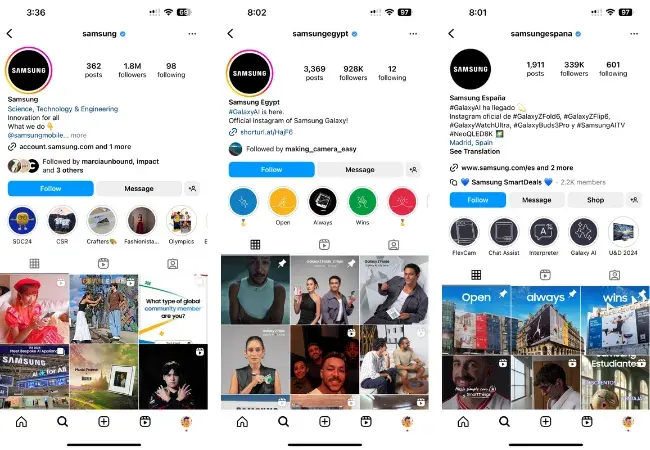
Samsung features separate social media accounts for the different countries it operates in. There’s a main Samsung page, as well as pages for various local markets including Samsung Espana, Ecuador, and Egypt.
Another point of consideration in your multilingual content strategy is creating useful entry points to find your content.
For instance, in this video, a Spanish-speaking consumer typed a brand’s name into Google, and clicked through to the brand’s website (a landing page) from there. He landed on the brand’s English-speaking version of the page, and there weren’t any links that enabled him to translate the content. Friction.
When he went to the same brand’s homepage directly, the website automatically changed the content to the Spanish-language version of the website, which provided much less friction. However, that approach doesn’t come without its challenges either.
For instance, say a Spanish-speaking consumer uses a shared computer where the settings aren’t in Spanish. The automatic change of language wouldn’t happen, so it’s important to provide options in the navigation for consumers to easily choose their preferred language.
Do this: Conduct user testing for the customer experiences you’re designing with people in the markets who speak the language you want to start operating in. That testing will highlight any friction in the customer experience you’re planning.
You can use that feedback to ensure you develop and organize your content. This is a crucial step to make sure that your content meets the needs of the people you want to serve, in a manner that delivers as little friction as possible for them.
It’s Time to Activate a Multilingual Content Strategy for Your Brand
You can attract and convert more of your ideal customers. You just have to start engaging them with a well-thought-out content strategy in their preferred language.
Don’t make the common mistake of trying to convert customers who speak other languages with the least effort possible. Instead, focus your resources on developing a deeper degree of intimacy with the community you want to reach.
Then, use that insight to develop a thoughtful customer journey and friction-free customer experience to win their attention and earn their loyalty.
Credit: Source link
![16 B2B Social Media Marketing Strategies for Any and Every Industry [Social Media Trends Report Data]](https://www.hubspot.com/hubfs/b2b-social-media-marketing-featured.webp "16 B2B Social Media Marketing Strategies for Any and Every Industry [Social Media Trends Report Data]")