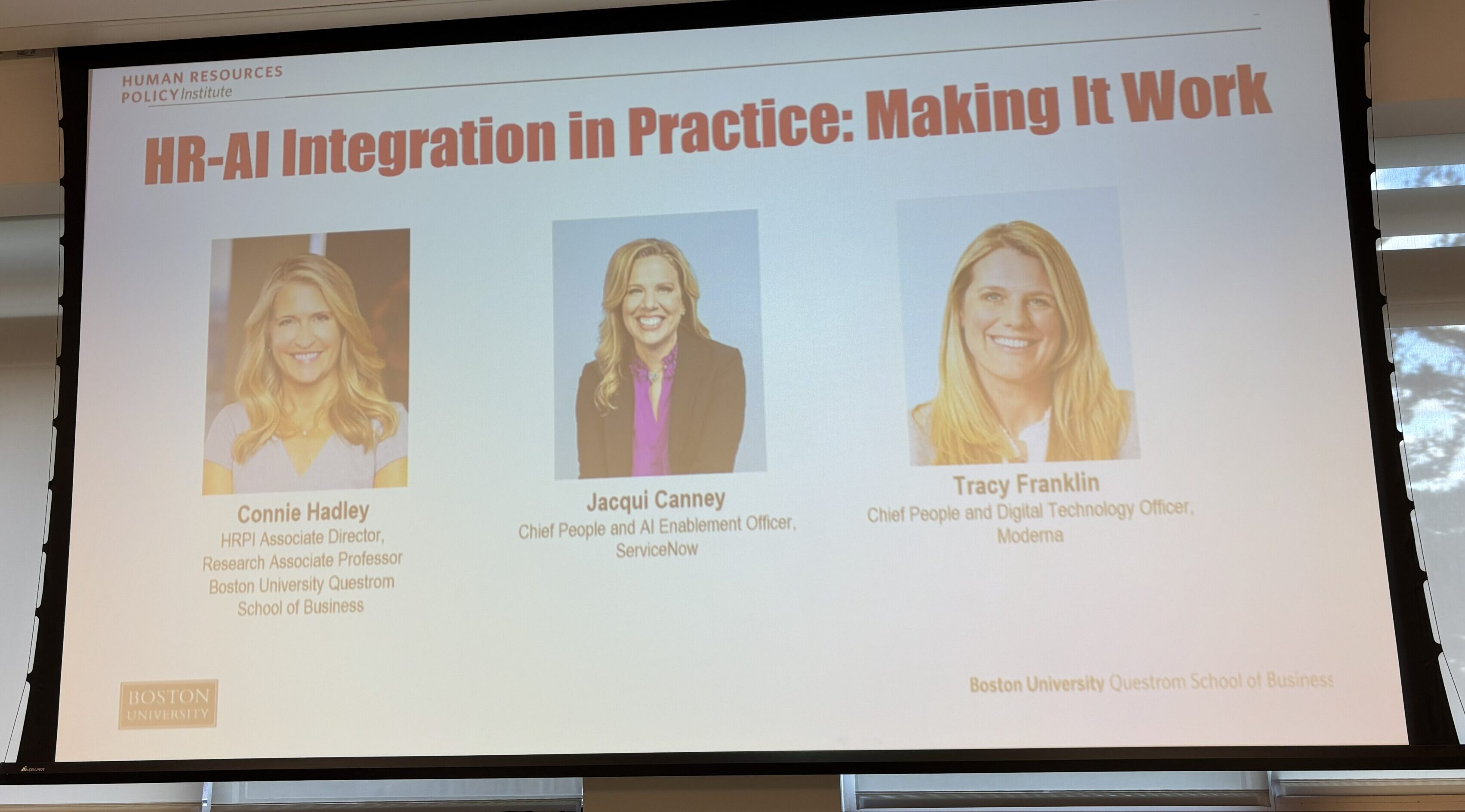
At the Human Resources Policy Institute Fall Summit, two HR leaders made the case to a room of CHROs that HR and IT must build together to drive real impact.
Jacqui Canney, chief people and AI enablement officer at software firm ServiceNow, and Tracey Franklin, chief people and digital technology officer at pharma company Moderna, shared their experiences in integrating people, processes and technology. They discussed how these efforts have helped navigate the AI transformation sweeping their organizations.
Despite taking distinct approaches to aligning IT and HR, ServiceNow and Moderna converged on several critical themes that offer valuable guidance for CHROs exploring similar integrations.
ServiceNow: AI creates an ‘HR moment to grab’
Canney’s journey at ServiceNow began when her role expanded to include AI. She admitted that she had “underestimated” how much time it would require—AI now occupies about half of her work. Reflecting on guidance from ServiceNow CEO Bill McDermott, she noted his belief that “when people think differently, they do differently.” With the rise of AI, she recognized a pivotal “HR moment to grab,” as the technology drives a broader shift in human capital.
To act on this opportunity, Canney drafted an “AI in HR” document and developed an operating model around it. She collected use cases and built a “flywheel”—a self-reinforcing system that accelerated progress, doubling the effectiveness of people operations in a short time. This success gave her team the confidence to expand the transformation across the entire workforce.
“AI is the greatest change management I’ve ever seen in my career,” said Canney, who is also a Top 100 HR Tech Influencer.
Moderna: ‘Scale overnight’
Franklin’s journey at Moderna followed a unique path. She joined in 2019, just before the company experienced rapid growth during the pandemic, as it helped facilitate the rollout of the COVID-19 vaccine.
She recalled that the leadership team “had to scale the company overnight” and later transitioned from a pandemic-focused operating model to a long-term approach to sustain Moderna’s success.
Moderna’s People Processes unit established a technology committee to examine how work gets done and how technology could enhance it. Today, Franklin oversees all IT across the organization, not just workforce AI. She recognizes that IT requires substantial time and resources, which prompted her to reorganize the HR team to better support these efforts.
“Someone needs to grab the AI agenda, and I think it should be HR,” Franklin said.
Through their different journeys, both Franklin and Canney highlighted several key areas where HR must focus to successfully integrate with IT and lead AI-driven transformation.
Read more: Is HR-IT integration right for your org? 4 experts weigh in
Governance: Building trust through control towers
Both leaders emphasized that strong governance is essential for successful AI implementation.
At ServiceNow, governance operates at the enterprise level and includes an AI control tower. The board has also become more engaged in these efforts. “Trust is at the core of what we’re trying to build,” said Canney. “You can’t just say it—you have to show it. People look to leaders for that.”
Moderna has adopted a similar approach, establishing an AI control tower to oversee governance across 5,000 employees and 3,000 GPTs. The company provides open access to AI tools with the directive to “go forth and build,” supported by a governance chatbot that monitors usage and compliance.
Franklin highlighted the importance of data integrity and security. She noted that systems should detect inappropriate data pulled from SharePoint or elsewhere, prompting cleanup and access reviews. The company also monitors abandoned GPTs to ensure ownership and accountability, since some are created and then left unattended.
Both leaders cautioned that AI agents require significant investment of both money and time. They cited cloud storage costs and cultural adaptation as ongoing challenges and encouraged organizations to strengthen their work planning before scaling AI initiatives.
The evolving HRBP role
Canney anticipates a major shift in the HR business partner (HRBP) role across the industry. She suggested deconstructing the role to identify where AI can provide support and to assess how much time HRBPs can devote to communication, strategy and data interpretation.
She also predicted that the traditional boundaries between HR and IT will continue to blur. In her view, a new center of excellence will emerge to deploy workforce tools, but realizing that vision requires imagination and intentional effort.
According to Franklin, the HRBP of the future will need greater technological fluency and new skills to interpret both HR and technology data, essentially becoming a “modern-day architect” within the HR function.
Culture: The secret sauce
“Culture is everything,” Franklin said. Losing culture at scale is like a “reverse merger.”
Values and mindset are the key ingredients for success. She emphasized the importance of honesty about both the positives and negatives of working at the company, noting that realistic job previews are critical. Employees need to balance challenging conventions with following how Moderna wants things done, maintaining a platform mindset, with HR ultimately responsible for culture.
Moderna, a young company at 14 years old, is digitizing across the organization. Franklin screens candidates for agility, experimentation and innovation. She also stressed that the identity of AI agents matters. Autonomous agents must reflect the company’s cultural judgment.
When presenting ideas, Franklin advises never leading with cost-cutting, since it rarely excites people. Instead, frame initiatives as opportunities for organizational growth. She reassures employees that efficiency processes will not cost them their jobs, saying, “If you streamline yourself out of a job, I will give you another job.”
Driving business impact
Canney emphasized that CHROs have a fiduciary responsibility to run the most effective HR department possible. HR teams must first understand how their work drives business growth. People metrics that demonstrate impact on business success are more likely to receive funding, she said, so all HR initiatives should directly support organizational growth.
Franklin stressed the importance of practical leadership. She presented the board with an integrated org chart reflecting her vision for how HR and IT would work together to build a concrete, actionable plan. “You must be able to pull it through; not too much glitz and glam,” she said. She added, “Pull the vision and the practical process together and get the organization focused on the biggest areas of ROI.”
As Moderna moved into individualized cancer therapy, the company needed an operations roadmap for the complex “needle-to-needle” process. Franklin built HR’s role from the ground up to act as an “architect” in supporting this work. She encouraged approaching new opportunities with fresh thinking. Franklin also emphasized that building HR’s capabilities should be an ongoing, dynamic process rather than a stagnant one.
Advice for CHROs: What to learn and where to focus
The moderator asked each leader to share what they consider essential to learn now, along with advice for CHROs in the audience.
Franklin highlighted the importance of continuous learning. She encouraged leaders to “learn to learn,” sharpen problem-solving skills and avoid rigid thinking. Her advice for CHROs was straightforward: take ownership of the AI agenda.
Canney is exploring quantum computing as she looks toward the next wave of technological change. At the same time, she is focused on a more immediate challenge: the impact of AI on mental health, a key concern as organizations scale these tools.
Her guidance for CHROs aligned with Franklin’s sense of urgency. “AI in the workforce is basically a lane created for people like us,” Canney said, urging HR leaders to lead the transformation rather than react to it.
Credit: Source link