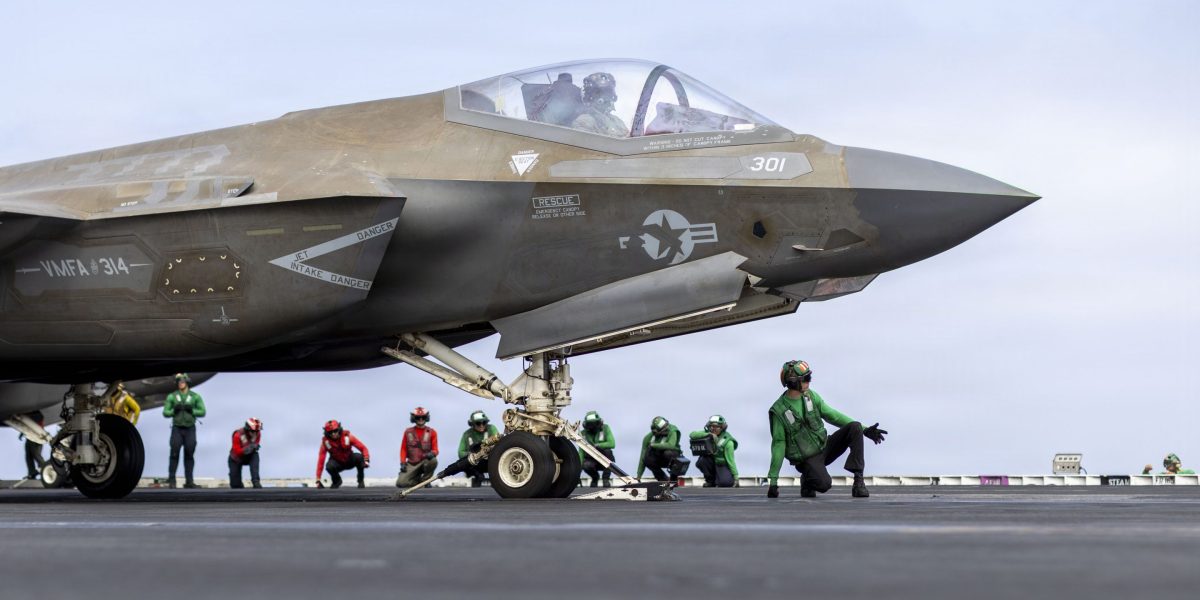
Germany and France are discussing downsizing their €100bn flagship air defence project by dropping plans to jointly build a fighter jet and focusing on development of a command and control system dubbed the “combat cloud”.
Berlin and Paris are racing to salvage their Future Combat Air System (FCAS), Europe’s largest weapons programme that is on the brink of collapse because Airbus and Dassault Aviation disagree over how to build the programme’s next-generation fighter aircraft.
One option discussed ahead of high-level meetings this week is to narrow the collaboration to the joint “combat cloud”, officials in both countries said. The concept of creating a cloud-based interface — which would link fighter jets and their pilots to sensors, radars and drones as well as land and sea-based command systems — is already one FCAS pillar.
If the plan for a jointly built fighter jet is abandoned, focusing on the cloud would enable the countries to continue some form of collaboration, the officials said. They cautioned, however, that no decision had yet been made.
The combat cloud, which aims to enhance the capabilities of EU militaries by using artificial intelligence to rapidly process large volumes of data, is a collaboration between Airbus’s German-based defence unit, France’s Thales and Spain’s Indra.
“We can live with several jets in Europe but we need one cloud system for all of them,” one official close to the matter said.
A second person close to the situation said: “All the other elements [of FCAS] are working well. Why would we stop doing that? There is no need for FCAS to founder completely — there is a need for a combat cloud system.”
A third person close to the project said focusing on the cloud system might imply rethinking some aspects of it, such as “speeding up the timeline to 2030, from 2040”.
FCAS’s future will be discussed in meetings between French defence minister Catherine Vautrin and German counterparts in Paris on Monday, and the following day between Chancellor Friedrich Merz and President Emmanuel Macron in Berlin, according to officials. Other meetings are planned with the industrial partners.
German defence minister Boris Pistorius said on Friday that discussions were ongoing about “whether the project should continue and how it should continue”.
The German chancellery, Airbus, Dassault and the Spanish government declined to comment. The French defence ministry declined to comment on the FCAS options under discussion, but said talks were ongoing to “urgently advance” the programme.
Paris, Berlin and Madrid have to decide by the end of the year whether to begin work on a demonstrator jet, which it is estimated will cost several billions euros. But many involved in the programme believe it is already too late to resolve the long-running dispute between Airbus and Dassault, the French family-owned company that makes the Rafale fighter aircraft.
After Dassault requested taking over more of the work to build the aircraft, Berlin has been weighing replacing France with the UK or Sweden. In turn, Dassault chief executive Éric Trappier claimed the French company could go it alone since it had all the required expertise.
Dassault and Airbus each led some parts of the FCAS programme, but the companies have squabbled over the division of labour, choice of suppliers and control of the jet’s design.
Failure to deliver would undermine EU plans for more defence co-operation in the wake of Russia’s full-scale invasion of Ukraine in 2022. In 2017 when FCAS was announced, Macron and Germany’s then chancellor Angela Merkel hailed it as a landmark.
Merz, who took office in May, has repeatedly said he expected Dassault to respect the initial deal. But Paris has not confronted Dassault, partly because it has grown worried about delays in the project that could jeopardise its nuclear deterrence, according to officials.
In Paris, some industrial groups and officials also have sympathy with Dassault’s view that it needs control of key decisions, including supplier choice, to deliver the plane.
A French banker close to the situation said: “The only salvation for FCAS now is if Macron twists Trappier’s arm . . . Right now the deal is totally immobilised and close to dead.” He added: “There’s no more trust, each side accuses the other of breaching terms. You can’t fix that.”
Another person close to the project said Dassault “simply doesn’t want to engage in a real partnership”.
An official said: “This time the sheer political will may not help overcome the fact that the companies are very different.”
Germany, which has loosened its constitutional debt limit to upgrade its defence capabilities, does not want to be taken hostage by a French company.
“The feeling is ‘we have funds like we’ve never had before on defence’ so if we need to do it without the French let’s just do it,” said a person with knowledge of the thinking in Berlin.
But all sides agree Europe needs to develop its own cloud for air defence. The French banker said: “You need a [command cloud] that’s independent from the American system. A lot of Europeans are thinking there might be situations in which we’ll be alone without the Americans.”
Thomas Pretzl, chair of the Airbus Defence and Space works council, told staff last week he wanted to “end the strained partnership with Dassault without damaging Franco-German relations”.
It was important any decision on the project did not hurt ties between Paris and Berlin, one government official said, “because it has nothing to do with governments — it’s about the companies”.
Additional reporting by Barney Jopson in Madrid
Credit: Source link