The U.S. and Israeli strike on Iran over the weekend has caused traffic disruptions to key trade passages like the Strait of Hormuz, escalating concerns of oil export blockages—and a potential repeat of the oil shock of the 1970s.
Oil prices spiked above $70 per barrel on Monday, while the international standard Brent crude hit $79. A key oil exporter, Iran shipped out an estimated 1.9 million barrels of crude per day, according to International Energy Agency data from December 2025.
But the greater risk to energy markets is if Iran closes the Strait of Hormuz, among the most vital oil export chokepoints through which about 20% of the world’s petroleum liquid flows, amounting to about 20.9 million barrels per day. Though Iran has not officially closed the strait, Iranian missiles have hit some vessels, and major shipping companies have halted operations, effectively shutting down the trade corridor.
Danish shipping giant Maersk said in a statement on Sunday it would suspend vessel crossings in the Strait of Hormuz, as well as pause trans-Suez sailings through the Bab el-Mandeb Strait, through which 8% of liquified natural gas (LNG) and 12% of seaborne oil trade passed in the first six months of 2023.
Mediterranean Shipping Company, the world’s largest shipping firm, made a similar announcement on Sunday, directing all vessels operating in the Gulf region to move to designated safe shelter areas.
Saul Kavonic, head of energy research at MST Marquee, warned prolonged disruptions to oil trade could hike prices to the triple digits.
“If the status quo is maintained, where the majority of volumes from the Strait of Hormuz remain unable to flow, then prices are very low compared to the impact that will have on supply, demand of the market,” Kavonic told CNBC on Sunday. “Every week, you’ll be seeing over 100 million barrels not reach the markets, and that suggests prices should be heading well more than $100 a barrel.”
Even a 20% reduction in traffic through the Strait of Hormuz would send oil prices to $90 to $100 per barrel, he added.
The 1970s oil shock
Kavonic compared the de facto shutdown of the Strait of Hormuz keeping 20% of oil and LNG out of the market to an earlier shock more than 50 years ago, only potentially much worse.
“That is three times the scale of the impact we saw in the energy crisis in the 1970s from the Arab oil embargo and the Iranian revolution,” he continued. “Even if we only see half, for example, or three quarters of the passage to the Strait of Hormuz return, it’s still going to be a global energy crisis.”
In 1973, Arab state members of OPEC declared they would cut oil production and limit exports to some countries in retaliation for the U.S. supporting Israel in the Yom Kippur War. President Richard Nixon responded by implementing a rationing program to protect U.S. oil supplies and keep costs from spiking. Still, gas prices skyrocketed nearly 40%, and Americans waited in long lines by the pump because of limited supply.
The period has a similar economic backdrop to today, with the U.S. economy grappling with both slow growth and high inflation, or a period of stagflation. Some economists have warned of a new era of stagflation, a result of tariffs both driving up prices while also hampering American job growth.
Americans may soon feel the impact of rising prices at the pump. Retail gas prices typically increase about 2.5 cents per each $1 in oil prices, meaning the $5 spike in crude costs could lift retail prices for U.S. consumers by nearly 13 cents per gallon.
According to price-tracker GasBuddy analyst Patrick De Haan, the national average gas price is $2.96 per gallon, but it might soon touch $3 by the end of Monday. Those prices are about 20 cents higher than at the end of January, according to AAA data.
Quelling ‘Hormuz myopia’
To be sure, there are also key differences between today and the 1970s that may prevent a repeat of that era’s crisis. For one, the U.S. is now the world’s largest oil producer, topping even Saudi Arabia.
RSM Chief Economist Joe Brusuelas wrote in a blog post on Monday that the U.S. produced 15.6% of the global oil supply 50 years ago compared to 18.9% now, and that in 1979, oil was responsible for 1.5% of the U.S. GDP versus 0.4% today.
Taken together, “the American economy is far less exposed to economic and inflation disruptions while its overall size has tripled,” he said. Brusuelas does not foresee the conflict having any material impact on inflation or U.S. GDP growth.
Mukesh Sahdev, founder, CEO, and chief oil analyst at XAnalysts, also disagrees with panic over long-term oil price increases.
In an interview with BloombergTV, Sahdev said there’s “Hormuz myopia happening in the market.” He noted the U.S.’s main objective of killing Iran’s Supreme Leader Ayatollah Ali Khamenei was complete, meaning there would be fewer reasons for the U.S. and Israel to sustain continued attacks. Sahdev added that Iran has also yet to close the Strait of Hormuz.
“The main objective of the U.S.-Israel [strike] is done with the neutralization of the leadership in Iran,” Sahdev said. “So in my view, the war is kind of over with the big news. Now I was hearing the news that Trump has probably three names of the future succession.”
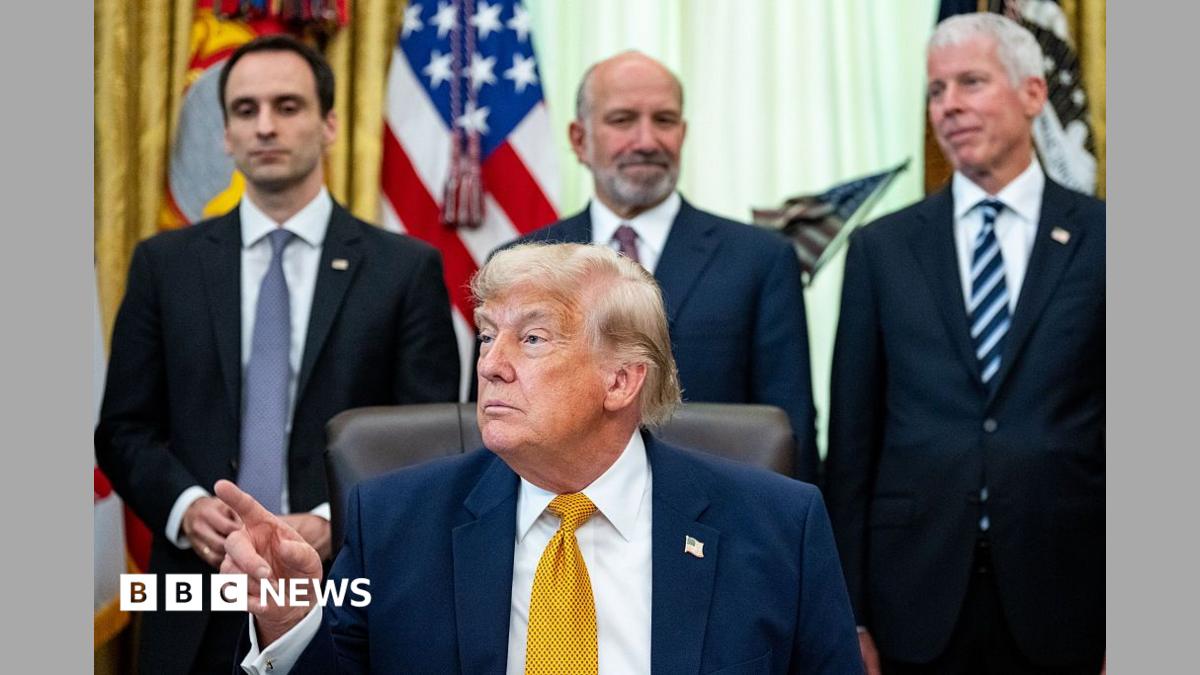
President Donald Trump said on Monday the U.S. campaign could last about four weeks and did not rule out sending ground troops to Iran. He confirmed to reporters the U.S. had picked candidates to lead the country, but many of them died in the initial attack.
“The attack was so successful it knocked out most of the candidates,” Trump told ABC News’ Jonathan Karl. “It’s not going to be anybody that we were thinking of because they are all dead. Second or third place is dead.”
Credit: Source link