As the war in the Middle East strains U.S. missile stocks, Ukraine is hoping it can turn a wartime innovation — low-cost interceptors designed to shoot down Russian attack drones — into geopolitical leverage.
Now one of the world’s leading producers of interceptors, Ukraine is offering that expertise to the United States and its Gulf partners for the war in the Middle East, hoping to receive in return the high-end weaponry it can’t manufacture at home.
When Russia launched its full-scale invasion four years ago, Ukraine’s domestic arms industry was poor. Forced to innovate to survive, it has since built a fast-growing defense sector centered on low-cost drones — some designed specifically to counter Iranian-style Shahed drones of the kind that Russia now launches by the hundreds.
The U.S. recently requested “specific support” against Iranian-designed Shaheds in the Middle East, prompting Zelenskyy to order the deployment of Ukrainian equipment and experts, though details remain classified.
When the war in Ukraine began in 2022, Kyiv banned weapons exports. But now Ukrainian manufacturers of low-cost interceptor drones say they are receiving interest from the United States and Gulf states.
While other countries can build interceptor drones, Ukraine has the only mass-produced system already tested in war, Oleh Katkov, editor-in-chief of Defense Express said. “There is a huge difference between a mass-produced system proven to work in real combat and something others only promise to develop … It’s like selling the house, not just the bricks,” he said.
If cooperation with partners succeeds, Ukraine could emerge as a new player in modern warfare, though it remains unclear whether its industry can scale up to meet that ambition or expand into global markets without compromising its own defense.
The Patriot problem
The surge in interest from the Middle East comes as Gulf states burn through their stocks of expensive Patriot missiles, which they have been using to shoot down significantly cheaper Shaheds from Iran.
An Iranian-designed Shahed drone costs from roughly $30,000, while a single interceptor missile for the U.S.-made Patriot air defense system costs millions.
Lockheed Martin in a statement said it produced a record 600 PAC-3 MSE interceptors for Patriot batteries in all of 2025. Zelenskyy claimed Thursday that Middle Eastern nations expended over 800 such missiles in just three days — more than Ukraine has held in reserve throughout the entire four-year war.
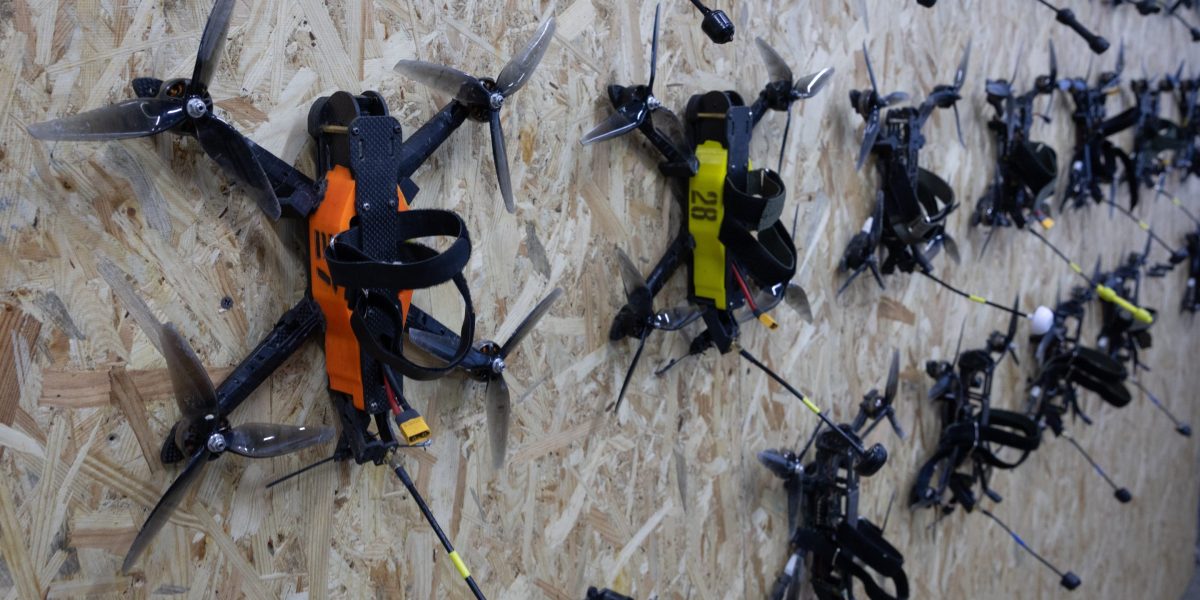
To counter the Shaheds, Kyiv developed low-cost interceptor drones priced at roughly $1,000 to $2,000, moving the systems from prototype to mass production within months in 2025.
But Ukraine never developed a defense against ballistic missiles. That’s why securing Patriot missiles remains a life-or-death challenge for Kyiv.
Against this backdrop, Zelenskyy is pitching a “swap” to partners. “Our message is very simple,” he said. “We’d like to quietly … receive the Patriot missiles we have a deficit of, and give them a corresponding number of interceptors.”
Obstacles to Ukrainian exports
Despite Zelenskyy’s optimism, some analysts warn that entering the global arms market is not as simple as signing a contract.
“Weapon trading is an incredibly subtle and sensitive issue,” said Yevhen Mahda, executive director of the Kyiv-based Institute of World Policy. It’s a market where the U.S. is dominant, he said, cautioning that it is “naive” to expect markets to open simply because Ukraine has a compelling story. “It requires a tough, calculated diplomatic game.”
Ukrainian officials have only recently begun actively discussing a shift from a freeze on wartime weapons exports to a state-regulated market, though it remains unclear when or how such a system would be launched.
“We need more than just presidential statements. We need action,” Mahda said. “How can we talk about exports if we officially aren’t selling anything yet?”
The U.S. and Gulf countries, including the United Arab Emirates, Bahrain, Saudi Arabia, and Qatar, have made repeated requests for Ukraine’s domestically produced interceptor drones, according to three Ukrainian weapons producers.
Neither the U.S. nor the Gulf countries responded immediately to a request for comment from The Associated Press.
“We are ready to share them, and we want to share them,” said Marco Kushnir, a spokesperson for General Cherry, a Ukrainian weapons manufacturer that produces one of the best-performing interceptor drones striking Shaheds in the country.
Kushnir said the decision ultimately depends on the government and Zelenskyy, but the company wants to help partners and could be ready to do so within days. He added they had the capacity to produce “tens of thousands” of interceptors per month.
Ukraine currently has a surplus of interceptor drones, and manufacturers say they could produce tens of thousands more without compromising the country’s defenses. The bigger challenge, they say, is training crews and integrating the drones with radar systems that can detect targets at long range.
Several Ukrainian firms have already fielded effective systems. General Cherry’s “Bullet” interceptor, developed in late 2025, has downed several hundred Shahed drones, according to Kushnir, the spokesperson. Another model, Skyfall’s 3D-printed P1-Sun, costs about $1,000 and can reach speeds of more than 300 kilometers (186 miles) per hour, with production capacity reaching up to 50,000 drones per month, a company spokesperson said.
Human expertise remains essential
But while the legal framework for hardware remains in limbo, Ukraine’s most valuable asset is human expertise. Zelenskyy has many times reiterated that his country is ready to send instructors who can teach how to use the interceptors.
Supplying the drones won’t be a problem, said Andrii Taganskyi, director of the Camera Business at Odd Systems, which supplies cameras for interceptor drones made by another Ukrainian company, Wild Hornets. But training foreign crews to operate the system and adapt tactics will be essential, he said.
Interceptor drones are not a standalone product and must be integrated into a broader system of radars that can detect and track incoming targets, said Taganskyi. While some models are partially automated, manufacturers say crews still require training to use them effectively.
“This is a tool that requires training,” said Oleh Katkov. “And the real, proven expertise — not just on paper — exists only in Ukraine.”
Kyiv’s willingness to send its specialists abroad marks a significant strategic sacrifice because of the impact on Ukraine’s own air defense capabilities. With the constant barrage of drones from Russia, every trained soldier is a vital asset.
“We do not have a surplus of military personnel at the front,” Katkov said. “However, there is a clear understanding that the benefits of such cooperation might far outweigh the risks.”
Credit: Source link