Author
Ahmed Barakat

Author

Share

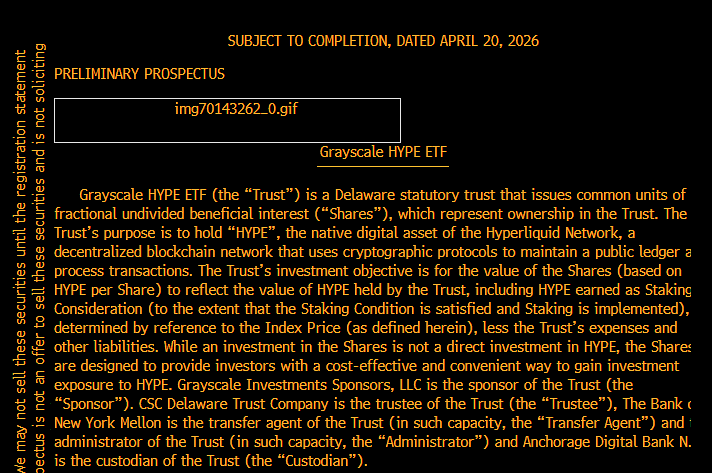
Grayscale amended its Hyperliquid ETF filing on April 20, replacing Coinbase with Anchorage Digital Bank as custodian for the proposed fund, a switch that goes beyond operational logistics.
Coinbase Custody Trust Company is the primary custodian for nearly all U.S.-traded spot bitcoin ETFs, making its removal from this filing a deliberate signal rather than a routine substitution.
The core question: does swapping in a federally chartered bank custodian improve Grayscale’s regulatory positioning with the SEC on a fund tied to an asset whose underlying perps platform is currently ring-fenced from U.S. users?
- Custodian change: Anchorage Digital Bank replaces Coinbase as custodian in Grayscale’s amended HYPE ETF S-1, filed April 20, 2026.
- Anchorage’s regulatory status: First federally chartered crypto bank in the U.S., carrying OCC-granted qualified custodian designation – a distinction Coinbase does not hold.
- Coinbase’s dominance context: Coinbase Custody Trust Company serves as primary custodian for nearly every U.S. spot bitcoin ETF; its absence here is structurally notable.
- Anchorage’s recent valuation: Tether’s $100 million strategic equity investment in February 2026 valued the firm at $4.2 billion, up from $3 billion in its 2021 Series D.
- Open approval question: Staking optionality in the HYPE ETF remains subject to separate regulatory approval; the fund would trade on Nasdaq under ticker GHYP if cleared.
Discover: The best crypto to diversify your portfolio with
What the Anchorage Appointment Actually Signals About Grayscale’s SEC Strategy
Anchorage Digital Bank holds a national trust charter issued by the Office of the Comptroller of the Currency, making it the only federally chartered crypto-native bank in the United States.
That designation carries qualified custodian status under federal banking law, a credential the SEC has increasingly scrutinized in digital asset custody arrangements.
Choosing Anchorage over Coinbase signals that Grayscale is prioritizing regulatory architecture over the operational convenience of using its existing ETF custody infrastructure.
Coinbase’s exchange-affiliated model, while dominant across the bitcoin ETF landscape, raises questions about conflicts of interest in its custody arrangements, a concern regulators have raised in broader crypto market structure discussions.
Anchorage operates purely as a custodian and bank, with no retail trading platform, eliminating that conflict vector entirely. Grayscale had already added Anchorage as a secondary custodian for portions of its Bitcoin and Ethereum trusts in August 2025, so this is an escalation of a relationship already in place, not a cold introduction.
Competitor filings provide a useful benchmark: 21Shares named Anchorage Digital Bank N.A. and BitGo Bank & Trust N.A. as joint custodians in its Amendment No. 2 filed April 14, 2026, for its Nasdaq-listed THYP fund. The convergence on Anchorage across multiple HYPE ETF filings suggests a shared read among issuers that the OCC charter carries weight in SEC review.
Approval Outlook: What the SEC Weighs Next Around Hyperliquid ETF
Grayscale’s initial HYPE ETF proposal was filed March 20, 2026, following earlier filings from Bitwise, which confirmed a 0.67% sponsor fee in its amended S-1, and 21Shares.
Whether Monday’s amendment resets the SEC’s review clock as a material update is a consequential procedural question; if it does, the approval timeline extends accordingly.
The fund’s staking feature remains the largest outstanding regulatory variable; the filing explicitly conditions it on separate SEC approval, meaning the core listing decision and staking authorization are effectively two distinct regulatory events.
Discover: The best pre-launch token sales
Credit: Source link