Americans aren’t losing their jobs. The stock market isn’t in freefall. And the official recession call is nowhere in sight. But Goldman Sachs is sounding an alarm about something quieter and more insidious: the purchasing power of the American paycheck is eroding at a pace the economy almost never sees unless it’s already in a downturn.
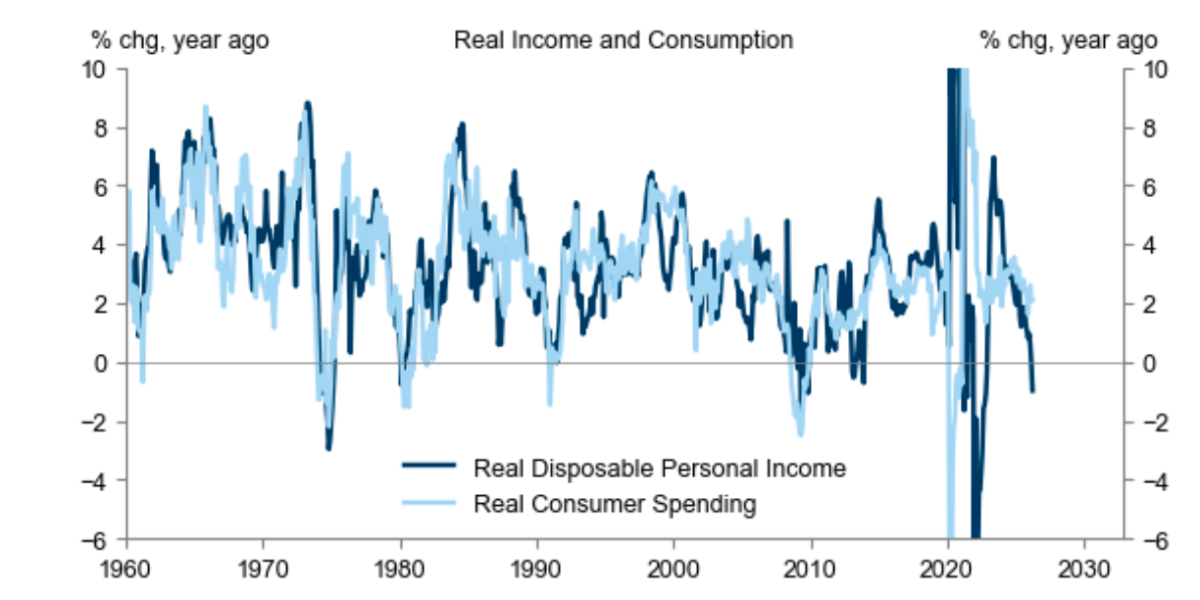
In a research note published Sunday, Goldman economists Manuel Abecasis and Joseph Briggs found that real personal income per worker — stripped of government transfers and adjusted for inflation — declined 0.6% over the past year. That’s a pace they describe as “rarely seen outside of recession,” with the only comparable non-recessionary episodes being a brief inflation shock in mid-2022 and a tax-policy distortion in 2013.
The culprits are familiar by now: tariffs driving up the cost of goods, energy prices eroding what’s left, and wage growth that simply hasn’t kept up. Together, they’ve done something that job growth and a resilient labor market haven’t been able to prevent — they’ve quietly made most Americans poorer in real terms.
It’s a dynamic Goldman has been tracking with growing alarm. In April, the bank warned that the U.S. economy was becoming increasingly K-shaped — one where the income divide between higher and lower earners had been quietly accelerating. The latest note puts numbers to why: lower-income households, who spend a larger share of their budgets on food and energy, are bearing the brunt of the real income squeeze, facing headwinds that higher earners can more easily absorb.
The cushion is running out
So far, consumers haven’t blinked. Spending has held up, and the economy hasn’t shown the kind of demand collapse that typically accompanies recession-level income weakness. But Goldman says that resilience has a clear explanation — and an expiration date.
Two factors have kept spending propped up. First, tax cuts in the One Big Beautiful Bill Act generated larger-than-usual refunds earlier this year, effectively handing consumers a cash cushion just as income was weakening. Second, Americans have been saving less — the personal savings rate dropped to just 2.6% in April, one of the lowest readings on record outside of the pre-financial-crisis era and 2022.
Goldman economists think the savings rate is likely understated a bit because of measurement issues with interest payments in the national accounts, but point out that even a 3.5% rate would be one of the lowest on record.
Goldman does not get into recent economic history, but it’s worth noting that by mid-2022, the post-pandemic inflation surge was at its peak, and real incomes cratered not because wages were falling, but because inflation was running so far ahead of pay increases, crushing real purchasing power. The culprits were pandemic-era supply chain bottlenecks, high demand fueled by massive fiscal stimulus, and then the Russia-Ukraine war spiking energy prices.
As for 2013, wealthy Americans and companies knew that Bush-era tax cuts were expiring, so companies rushed to pay out unusually large special dividends in late 2012, which front-loaded income into 2012, creating an artificial negative base effect: income appeared to fall simply because the prior year’s number was artificially inflated. Neither episode reflected a structural problem with worker pay, unlike the situation Goldman now describes.
Neither tax refunds nor savings can last as buffers. Goldman expects real consumer cash-flow growth to slow to just 0.3% year over year by the fourth quarter as the tax refund boost fades. And with the savings rate already near the floor, there’s little room left to offset the income squeeze by drawing down further.
A below-potential slowdown ahead
The firm now forecasts consumer spending growth of just 1.3% for the remainder of 2026 — below consensus expectations and below Goldman’s own estimate of the economy’s potential growth rate. Real income growth for the full year is projected at only 0.9% on a Q4/Q4 basis.
The squeeze won’t be felt equally. Lower-income households face the steepest real income headwinds as energy prices stay elevated. For those families, the recession-like feeling isn’t just a data artifact, it’s a lived reality.
To be sure, a faster decline in energy prices, stronger equity gains or a rebound in hiring could push spending above Goldman’s forecast. But higher oil prices — particularly if the conflict in the Middle East escalates — or a deteriorating labor market could make the consumer slowdown sharper than currently anticipated.
Not a recession. Not yet.
Goldman stops well short of calling a recession. The labor market remains intact, wealth effects from elevated equity prices are still providing a partial offset, and the income weakness partly reflects one-off distortions — including base effects from a Social Security payout last year and policy-induced swings in farm income — that should fade in coming months.
But once those distortions are removed, the underlying trend is hard to spin. Six decades of data show that real income per worker contracting at this rate almost exclusively happens when the economy is already in a formal downturn. Right now, it isn’t. But Goldman’s message is clear: your paycheck doesn’t know that.
For this story, Fortune journalists used generative AI as a research tool. An editor verified the accuracy of the information before publishing.
Credit: Source link