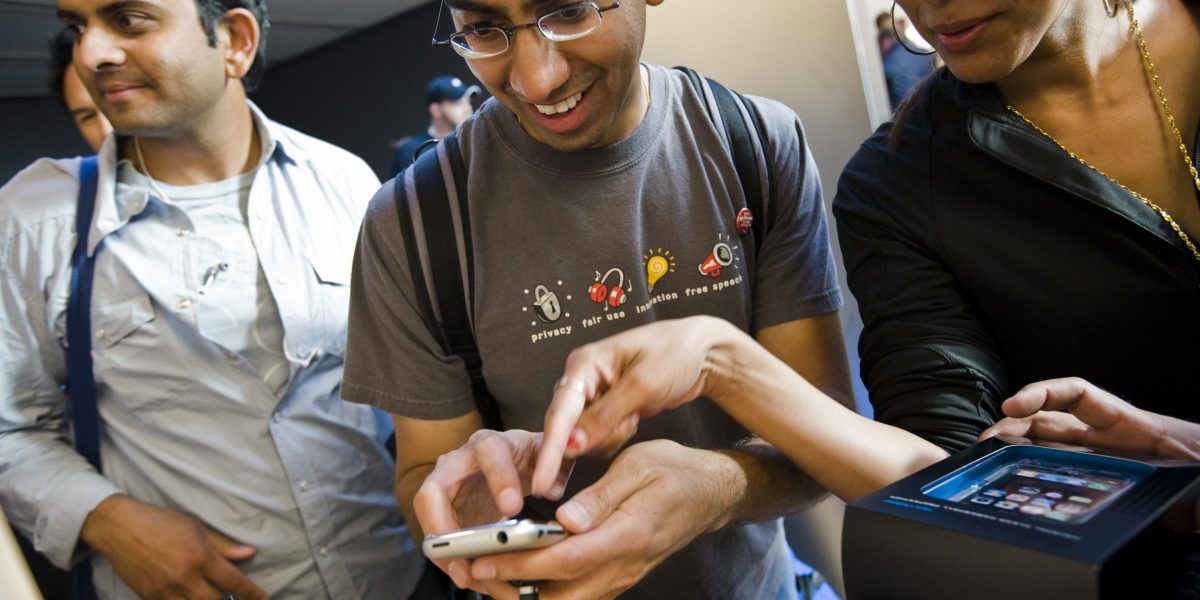
Your iPhone may now be a form of birth control, economists warn.
New research is linking America’s plummeting birth rate to the rise of the iPhone, providing evidence that smartphone use is causing people to have fewer children. A working paper published this month in the National Bureau of Economist Research (NBER) found that in the first four years of the iPhone’s release, geographies with access to the device saw reduced births from 4.5% to 8% for ages 15 to 19, and a 3.2% to 6.6% reduction in births for ages 20 to 24. These birth rates decreased the most among teenagers, but were reduced in every age group.
From June 2007 to Feb. 2011, AT&T was the only provider distributing the iPhone, which pioneered smartphone technology, meaning the researchers were able to create a natural experiment by looking at the areas of the country in which AT&T was selling the device and then compare them to parts of the country where the phone was not yet being sold. The study looked only at the period of time when AT&T had a monopoly over iPhone sales.
Even after controlling variables relating to home prices across the country or regions that were more or less urban, researchers still found a relationship showing greater iPhone sales meant less fertility.
“What we show is that births are declining way faster in the places where you could get the iPhone than the places where you couldn’t,” Caitlin Myers, the study coauthor and professor of economics at Middlebury College, told Fortune. She authored the paper alongside her son.
The U.S. has seen dropping fertility rates for nearly two decades, with rates hitting an all-time low in 2024. At first, fewer births were not surprising to scientists. Lower fertility rates usually correlate to challenging economic times, and the Great Recession, when birth rates began dropping, was no exception. But even after the economy improved, Americans were still having fewer children.
“We had a baby-less recovery,” Myers said of the years following the 2008 financial crisis, the start of which almost perfectly coincided with AT&T’s release of the iPhone. “The economy recovered, and births didn’t.”
Low fertility can mean real economic headaches down the line. It can shrink the total population that’s able to participate in the labor force just as it can reduce total spend in the economy. Lower birth rates also means an aging population with fewer economic stimulants, placing a strain on social benefits like Social Security and Medicare.
While rising housing and childcare costs, as well as economic anxiety, have all contributed to why Americans are having fewer children, it doesn’t tell the full story, Myers argued.
“I’m not saying those don’t play a role,” she said. “But I think one of the really important things to keep in mind is that this effect is huge.”
Instead, Myers noted, it may have more to do with how people are—or aren’t—choosing to connect with one another.
Check your screen time
For years, psychologists like The Anxious Generation author Jonathan Haidt and San Diego State University’s Jean Twenge have warned of the “great rewiring.” As young generations like Gen Z grow up with easy access to these technologies, they are also growing more attached. These psychologists have argued that increased screen usage is associated with mental health struggles like anxiety and depression, as well as lower cognitive capability.
Myers said their theories can extend to birth rates. Using data from the National Survey of Family Growth, the study found not only a decline in the number of activities people participate in with peers outside of work and school, but also a decrease in frequency of sex. About two decades later, this trend looks to be continuing: Gen Z is not only having less sex than older generations, but they are dating less, citing the high costs of going out and the emotional disruptions of dating.
“Many younger adults are no longer treating relationships as proof of stability,” Sarah Meyer, managing director at cognitive assessment platform MyIQ, previously told Fortune.“They are asking whether a relationship adds to their sense of safety, focus, and self-understanding, or whether it introduces instability they have worked hard to avoid.”
For Myers, the data is troubling, as it’s not just indicative of economic obstacles down the line, but also a society grappling with the relationship between technology and its own emotional wellbeing.
“I see these declines in births, and I’m wondering, like, are we okay?” Myers said. “People in their twenties, and more broadly—if the reason we’re seeing this decline is because people are all depressed and alone and doom scrolling—I’m worried about us.”
But data elucidating the reasons behind the declining birth rate could be crucial in designing policy interventions to address the crisis. Myers noted that the data shows declining rates of teen pregnancy, which is in many cases a good thing. Specific solutions informed by more research can help ensure these positive trends continue, while also addressing factors preventing the country’s mental and economic health.
“My answer, as an economist, is just here to measure the phenomenon,” she said. “My answer, as a human, is this could be cause for concern if it’s another signal that our phones are making us less happy.”
Credit: Source link