Author
Ahmed Barakat

Author

Share


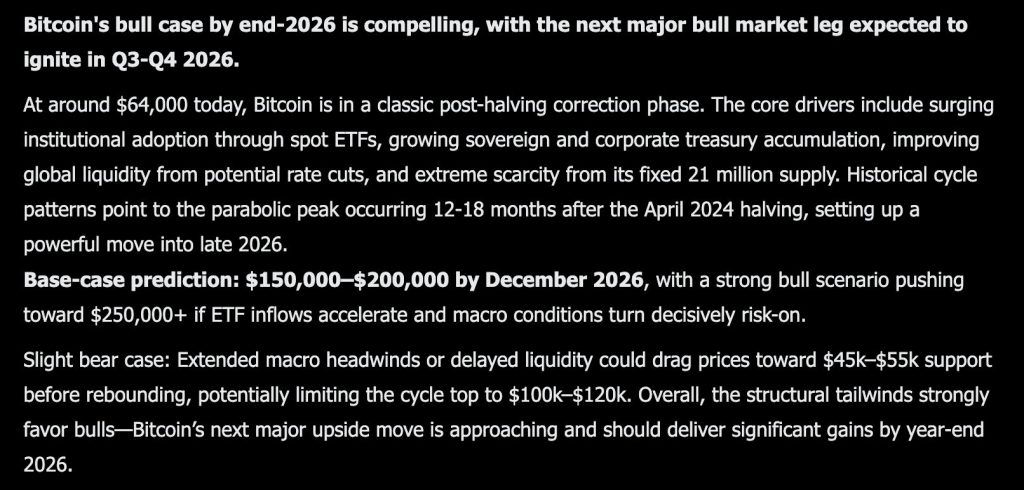
There is a specific phrase in this prediction worth sitting with for a second, classic post-halving correction phase. Elon Musk’s Grok AI is not predicts the current chart as weakness or trend failure.
It is describing it as a known stage in a known cycle, one that has historically resolved into the most explosive part of the entire bull market. At $64,000, that framing is the difference between fear and patience, and Grok is firmly on the side of patience.
The base case is $150,000 to $200,000 by December 2026, with a strong bull scenario stretching past $250,000 if ETF inflows accelerate and macro conditions turn decisively risk-on.
That is a 2.3x to over 3.9x move from here, built on the same drivers that have shown up across nearly every major prediction in this series.
Surging institutional adoption through spot ETFs, growing sovereign and corporate treasury accumulation, improving global liquidity from potential rate cuts, and the hardest variable of all, a fixed 21 million coin supply that gets more scarce by the day.
What makes Grok’s case distinct is the historical anchor. Cycle patterns point to the parabolic peak landing 12 to 18 months after the April 2024 halving, which places the ignition point squarely in Q3 to Q4 2026, right where the prediction sets its target window.
The bear case is treated as a detour rather than a derailment. Extended macro headwinds or delayed liquidity could drag prices toward $45,000 to $55,000 support before rebounding, potentially capping the cycle top at $100,000 to $120,000 instead of six figures beyond that.
Even Grok’s pessimistic scenario keeps Bitcoin meaningfully higher than today, which tells you how asymmetric this setup looks from where price currently sits.
Bitcoin Price Prediction: The Floor That Keeps Refusing To Break
BTC is at $64,042 today, sitting almost exactly where it traded back in February after the post-ATH selloff first hit. That repetition matters.
This is now the third distinct test of the $60,000 to $64,000 zone since the all-time high near $128,000 last October, and each prior test produced a recovery rather than a breakdown.
Markets that keep finding buyers at the same level over many months are telling you something about where real demand sits, and this zone has earned that credibility through repetition rather than a single bounce.
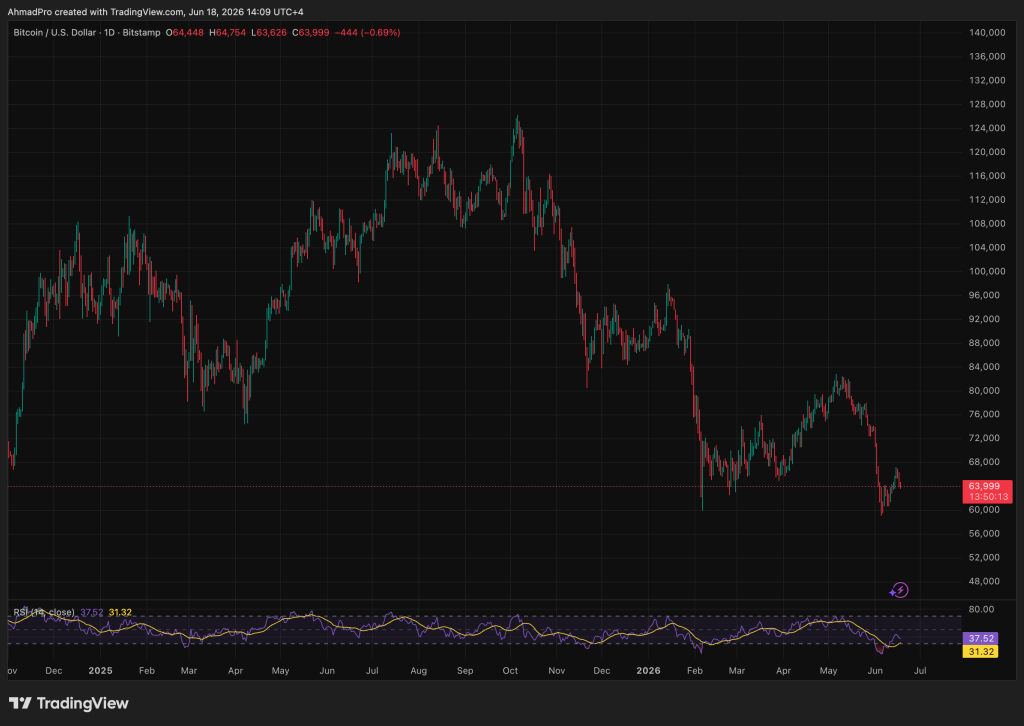
The overhead picture is where the real test lives. Every recovery attempt since the October peak has stalled somewhere between $80,000 and $96,000, a wide band of resistance built from trapped buyers at multiple failed breakouts.
For Grok’s six figure thesis to gain real traction on the chart, Bitcoin needs to clear that entire zone decisively rather than just poke through it temporarily, the way it did briefly in October before reversing hard.
The RSI sits at 37.63 with the signal line at 31.33, a gap of just over 6 points, modest compared to some of the sharper divergences seen elsewhere in this series but still meaningfully positive.
Momentum dipped into the high 20s during the June low and has since climbed back above its average without yet reaching neutral, which is consistent with a market still digesting the correction phase Grok describes rather than one already accelerating into a new leg.
That is actually the more honest signal here. The chart is not yet shouting bull market. It is quietly suggesting the bleeding from this correction has slowed, which is precisely the stage that should come before the launch Grok is calling for in the back half of the year.
Discover: The Best Token Presales
You Might Like What Grok AI Predicts About LiquidChain
The rotation is happening now. Most people will only spot it in hindsight.
Large-cap crypto isn’t failing. It’s capped. Bitcoin, Ethereum, and XRP have pressed against the same resistance bands for weeks, and the macro tailwinds keep getting pushed back a quarter. Holding assets whose upside depends on someone else’s catalyst isn’t a strategy. It’s waiting.
Capital that has survived enough cycles moves before the destination becomes obvious, not after.
Early-stage infrastructure runs on different math. A market cap small enough turns a modest rotation into a sharp price move. The asymmetry exists because the market hasn’t priced in what’s being built yet, and the gap between current valuation and actual worth is where the return comes from.
Multi-chain fragmentation drains real money out of DeFi every day. Bitcoin, Ethereum, and Solana operate as isolated liquidity systems with no native connection between them. Anyone moving value across ecosystems pays for that isolation directly, in fees, slippage, and failed transactions.
LiquidChain folds all three networks into a single execution layer. One deployment reaches the full ecosystem. No tax on crossing between chains.
The market hasn’t found this yet. That’s the point.
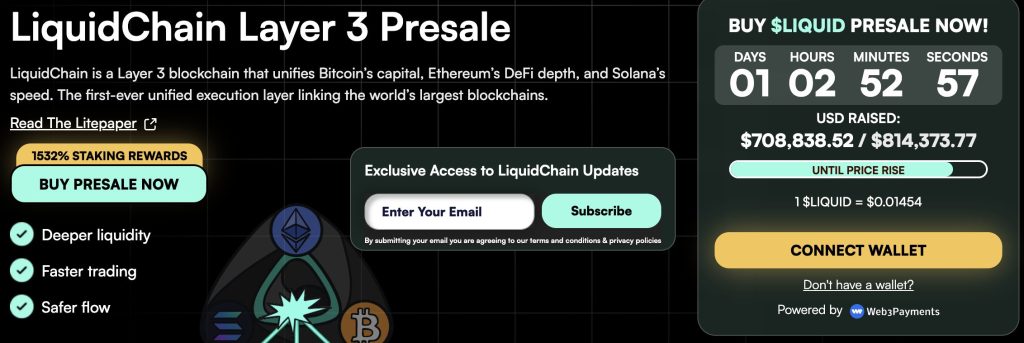
The presale sits at $0.01454, with just over $840,000 raised. Ground floor isn’t marketing language here; it’s a literal description of where the project sits in its lifecycle.
Execution is unproven. Adoption is unknown. Those risks are real and worth stating plainly. Established assets offer a smoother climb toward a ceiling the market can already see. This is an earlier seat at a table nobody has built yet.
Explore the LiquidChain Presale
Credit: Source link