
Up and to the right: that’s the story of nearly all the collective data from the 2026 Fortune 500, which ranks the largest U.S. companies by revenue. Together, the companies generated record revenue of $21 trillion, up 5% from a year ago. Total profits ballooned 12% to $2.1 trillion, and overall market cap surged 19% to $55 trillion in a fiscal year fueled by outsize AI spending and hype.
There’s one big exception. The Fortune 500’s total headcount decreased for the second straight year to 30.5 million employees, down 1%. That’s a loss of 301,049 workers. Fortune 500 headcount has declined before, but since 1995, when the Fortune 500 incorporated service firms for the first time, a downward trend has only taken place during or after a recession.
What’s behind the unusual drop? For 2026, the answer lies, in part, in who left the list.
The Fortune 500 is the sum of its parts, so its overall headcount fluctuates as companies join and drop off of the ranking. A major blow to 2026 list headcount was the departure of Walgreens Boots Alliance, the pharmacy chain, which fell out of the Fortune 500 after being acquired by private equity firm Sycamore Partners in August 2025.
Last year, Walgreens employed 252,500 people, landing it among the top 25 biggest employers on the 2025 list. A second labor-heavy retailer Nordstrom also fell off the list in a take-private deal; it employed 41,000 people. Collectively, 659,640 people worked at the 22 companies that departed the Fortune 500 this year.
The 22 companies that replaced the drop-offs employed fewer than half that amount: 317,414. The largest employer among the newcomers is Amentum Holdings, a Virginia-based engineering and technology services company with a headcount of 50,000; followed by Medline, an Illinois-based health care supply business that employs 45,000.
Headcount growth among incumbent firms offset, to a small degree, the headcount decline caused by list churn. In total, the firms that remained on the list from 2025 to 2026 added 41,177 employees. Dick’s Sporting Goods recorded one of the biggest jumps in headcount; its staffing increased by 83.1%, or 31,050 employees, as it acquired Foot Locker in September. Carvana was another company with big headcount growth. The online used car seller added 5,700 employees, a 32.8% increase, as it continued its impressive comeback after a 99% stock plunge.
But for a group of companies that collectively employ tens of millions of people, employment among incumbent firms was, in fact, remarkably steady, growing only 0.1%. That reflects the “low-hire, low-fire economy,” says Lawrence Katz, an economics professor at Harvard University.
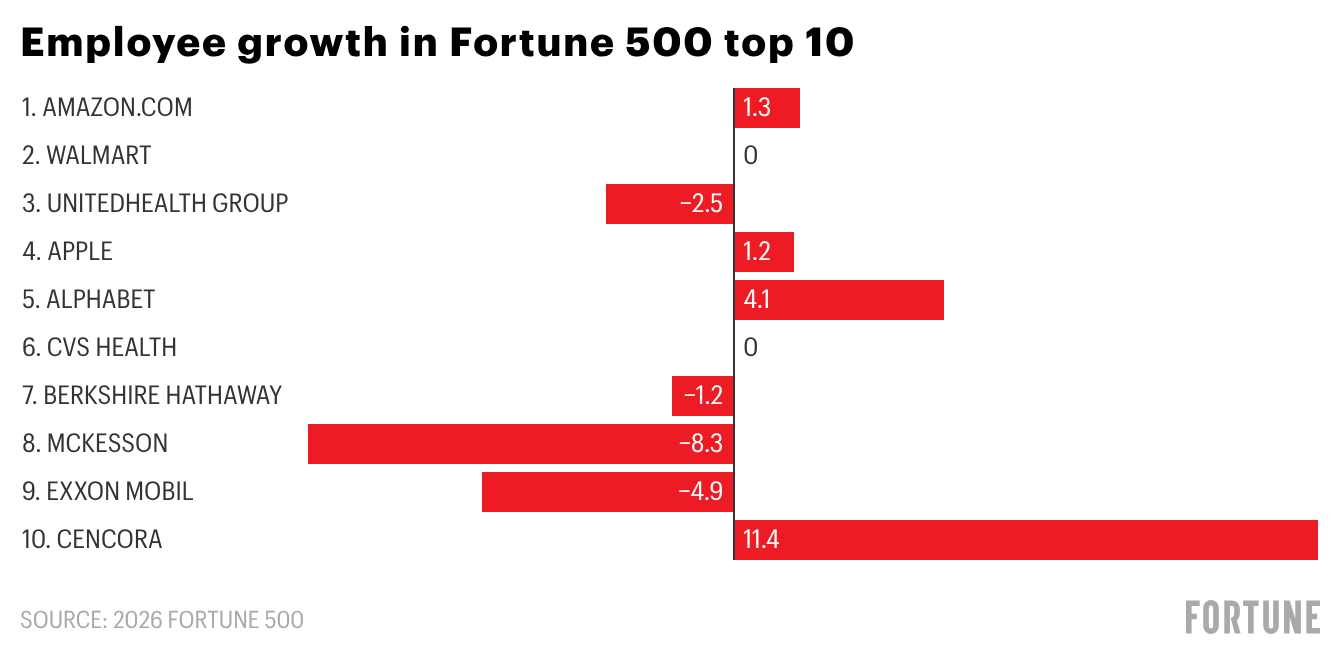
Amazon, the No. 1 company on the 2026 list, added 20,000 employees last year, a 1.3% increase. Headcount at No. 2 Walmart was flat, and at No. 3 UnitedHealth Group, employment dipped by 10,000, or 2.5%.
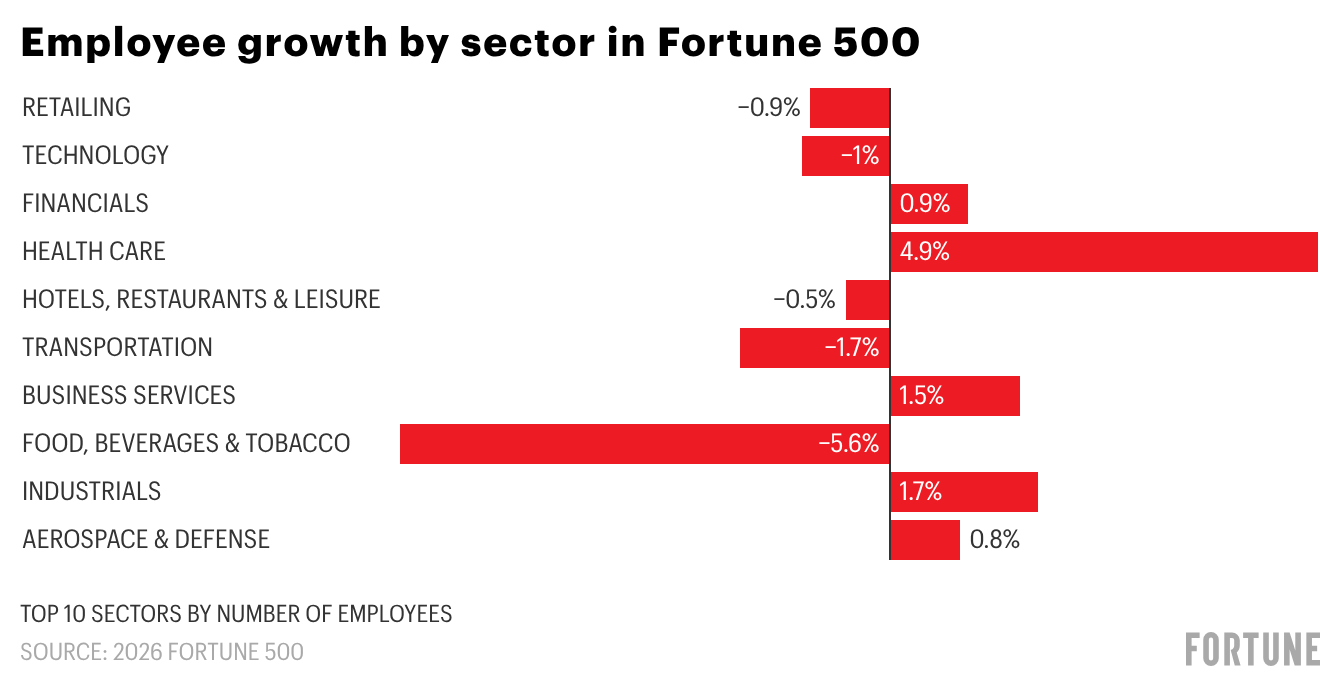
Retailing is the largest sector on the list, with just over 7 million employees, and its total headcount dropped 0.9%. Employment in the second-largest sector, technology, dropped 1% to 3.8 million, while the number of workers in the third-largest sector, financials, grew 0.9% to 3.5 million.
Large firms have outsourced labor-intensive work while reaping technology’s huge productivity gains. “Those factors have meant the sales and value-added have gone up dramatically more than employment for the largest firms,” Katz says. Big companies hire “professional, talented individuals who are rewarded dramatically, but they’re not sharing…the huge productivity gains with this broader workforce in the way that old, often unionized manufacturing companies or even old-style banks [once did].”
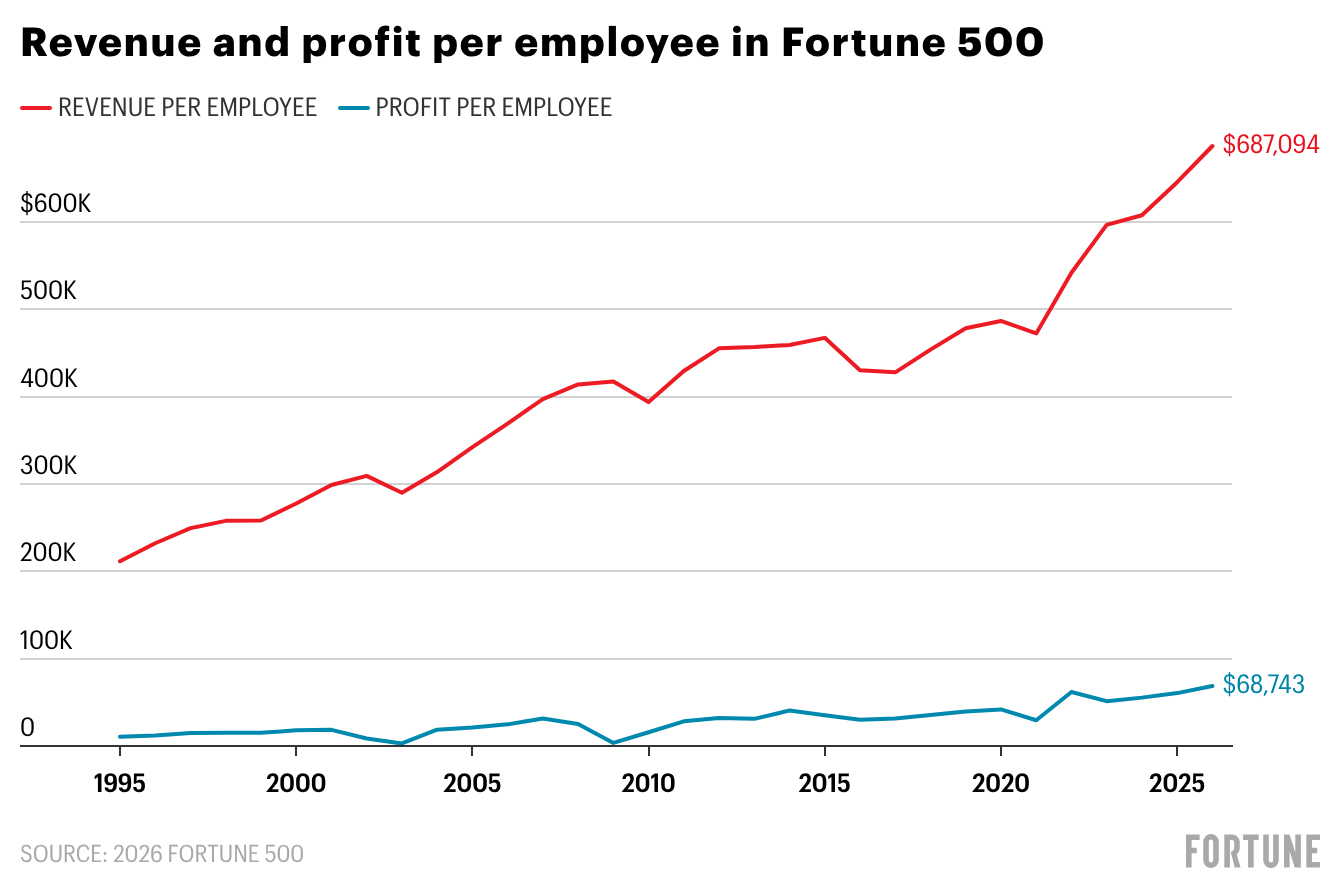
This continues a decades-long trend, and the math is stark: Fortune 500 companies are earning more revenue per employee—$687,094—and more profit per employee—$68,743—than ever before. Over the same period, inflation-adjusted wages have stayed relatively flat.
AI seems poised to push the trend further as CEOs urge their workforces to capture the technology’s efficiency benefits. But the upside is not necessarily reserved for the titans of industry that currently occupy the Fortune 500.
“We are seeing a rise in new business startups, a flourishing of smaller scale enterprises, some of which may eventually become huge, but maybe, as they’re re-engineered to focus on AI agents as their main sort of workers, maybe they don’t end up having as large an employment imprint as traditional firms,” says Katz, adding a note of caution that we’re still in the early days of AI adoption.
Notably, two newcomers on this year’s list have fewer than 1,000 employees. Both operate in the digital asset space: Sioux Falls, S.D.-based Bitgo Holdings employs 603 people and landed at No. 278 on the Fortune 500. New York-based Galaxy Digital has 700 employees and cracked the Fortune 100 at No. 76 in its list debut. The next smallest employer in the top 100 has nearly eight times as many.
Credit: Source link