Singapore has spent decades selling the world on the promise that it can be trusted by all sides. For a new generation of AI companies, that pledge has never been more valuable.
OpenAI and Google DeepMind both established applied AI labs in the city-state over the past year, while Anthropic began advertising local positions in finance, product support, and economic research. Chinese firms like Tencent have also deepened their investment in the country.
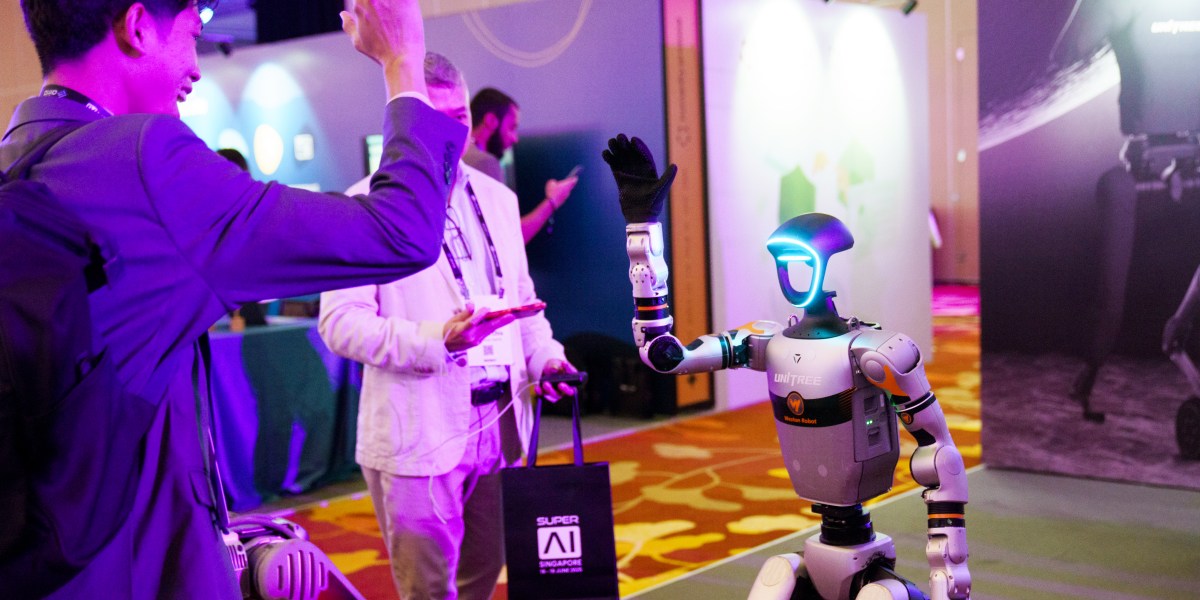
“All the AI companies I work with, whether they’re from China, Korea or Japan, all use Singapore as a hub,” Gunja Gargeshwari, the chief revenue officer of Israel-headquartered web scraping firm Bright Data, told Fortune on the sidelines of the SuperAI summit in Singapore. “It’s easiest to operate in the region if I have people in Singapore—it’s where conversations are happening, and where the innovation hubs for different providers are being set up.” Bright Data, for instance, has chosen to position Singapore as its APAC headquarters, even though 60% of its Asian customer base hails from China and India.
“We have the chance to stand out here,” said Nathan Xu, the CEO of San Francisco-based AI notetaker company Plaud. “Unlike many companies that originate entirely from the U.S., if Plaud can position ourselves aggressively in Singapore, then we’re a cool company to prospective users across the globe.”
Plaud hired its first Singapore-based employee in 2024. On June 10, the company said it would spend 10 million Singapore dollars ($7.8 million) to expand its local operations. It also plans to grow its headcount from 100 to 150 by the end of the year.
Singapore’s appeal to the AI industry is as much due to geopolitics as economics. The country markets itself as an economic safe haven, with a long track record of regulatory clarity and strong governance.
“Some say we are boring, and we will never have the same offerings as New York and Paris,” Singapore Prime Minister Lawrence Wong said during a policy conference last July. “But at the same time, we are stable, we are predictable. We are reliable and we are trusted, and these are intangible assets that others would die to have.”
Founders like Xu also point to the country’s rigorous education system as an incubator for tech talent. “The biggest pain for me and the company is hiring the best engineers, and what’s interesting about Singapore is that it’s home to some of the best universities in the world,” Xu explains. (In this year’s QS World University Rankings, the National University of Singapore ranked #8, while the country’s Nanyang Technological University came in at #12.) “It’s a place which curates generations of talents around software engineering, computer science, AI, data science and operations.”
AI firms go global
The AI build-out in Singapore reflects a broader change across the industry. Global AI firms are shifting away from training massive models to instead figuring out how to monetize their work in the real world.
“The defining feature of the AI cycle through 2025 was capital expenditure… while this has expanded capacity and driven technology leadership, it has also invited skepticism,” wrote BNY’s wealth analysts in a March report. “Attention has now turned decisively from scale to return on investment.”
For firms of Chinese origin, like Manus AI, Tencent, and Alibaba, Singapore often serves as a first and crucial step in going global. To build out their presence in the country, Chinese tech giants are dangling hefty annual pay packages: Singapore-based roles for holders of PhDs in AI can range between $150,000 to $273,000.
“For some of my Chinese customers, the researchers can’t leave the country without telling the government—I kid you not,” said Gargeshwari. “So opening an office in Singapore and having local employees is a necessity for them to do business.”
For U.S. AI firms, overseas markets like those in Asia Pacific represent a massive untapped customer base.
OpenAI opened a regional office in Singapore in 2024. Last month, the firm committed 300 million Singapore dollars ($234 million) to growing the country’s AI ecosystem. It also announced the opening of an applied AI lab—the first outside of the U.S.—which is set to make Singapore one of its hubs for forward deployed engineers: specialized software engineers who embed directly within customer organizations to customize and deploy tech solutions.
Notion, the AI-powered productivity platform, opened a Singapore office in mid-2025. “Our number one priority is to meet and interface with current and potential customers,” said Randy Hunt, the company’s head of design. “I could do a demo for you over video, and while that may be effective, if I can do it sitting next to you, it resonates better.”
Anthropic is betting on enterprise AI instead of the consumer market, which makes Singapore, where many MNCs house their APAC headquarters, a natural choice.
Cracks in the system
Yet, foreign governments are starting to challenge Singapore’s neutrality.
Manus AI and its parent company, Butterfly Effect, relocated its global headquarters to Singapore in mid-2025 to both avoid Western regulatory scrutiny and better access global capital. In December, it sold itself to Meta for $2 billion. Beijing quickly moved to block the deal, and in April ordered the acquisition to be unwound.
In the end, Manus’s legal status as a Singapore company didn’t matter: its continued footprint in China was enough for Beijing to decide it had jurisdiction.
“Regulators looked straight through the Singapore holding structure to the technology’s Chinese origin,” Sebastian Wiendieck, the head of legal practice in China at law firm ROEDL, told CNA. “This marks a new normal: any China-founded AI startup, regardless of its offshore domicile, will face intense national security scrutiny if it tries to sell to a U.S. buyer.”
The U.S., too, could hurt Singapore’s AI ambitions. Last week, the U.S. government barred non-U.S. individuals from using Anthropic’s powerful Mythos model. Singapore could end up losing access to powerful frontier models from U.S. companies like Anthropic and OpenAI.
Still, AI firms remain positive about expanding into Singapore. The country released its national AI R&D plan in January, alongside a 1 billion Singapore dollar injection to fund the buildout of AI-related infrastructure and capabilities. The country also set out plans to build an AI industrial park called Kampong AI, set to open in 2028 with workspaces and housing facilities to woo AI start-ups.
“We feel like we are welcomed here,” Xu said. “We didn’t know we’d be able to set up such a big and meaningful presence here; a year ago, we had zero people here, but now we have close to a hundred.”
Credit: Source link