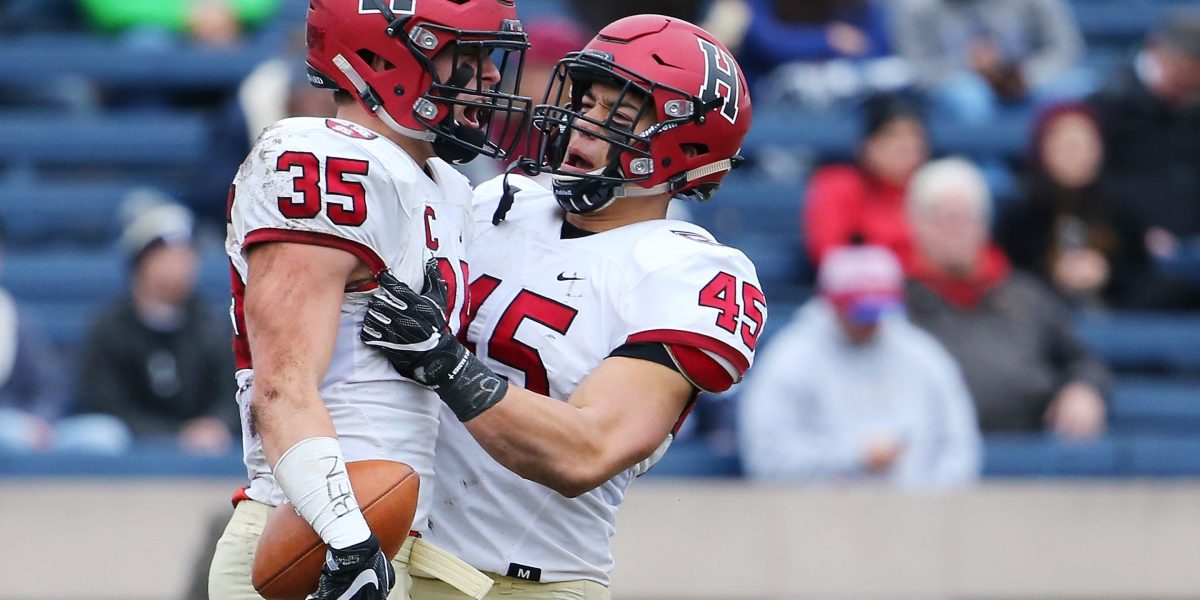
At Goldman Sachs, Morgan Stanley, and Bank of America, the fastest route from the Ivy league to a corner office might not run through the career center at all, but through the football roster.
That’s the implication of a new National Bureau of Economic Research study from Harvard, Duke, and Wharton researchers who tracked the first jobs of 120,306 Ivy League graduates between 1950 and 2020. The team—Paul Gompers, George Hu, Will Levinson and Sachin Srivastava—set out to test something Wall Street recruiters have long insisted anecdotally, namely that being a college athlete is a hiring edge.
What they found was more specific: the team bond is a far more potent career driver than the diploma itself, sharpening the narrative about elite college graduates hiring each other on Wall Street into something more concrete.
“Broad school ties do relatively little; the pull comes from intensive shared experiences like a varsity team,” Srivastava, a co-author and doctoral student at Wharton, told Fortune over email. “If anything, I think the old boys’ club looks less like a club and more like a roster.”
This paper is the second installment of a broader research agenda. An earlier study by some of the same co-authors, covering roughly 400,000 Ivy League graduates, found that athletes out-earn non-athletes and reach the C-suite more often, even controlling for major, graduation year, and school—a premium the authors partly attributed to skills like leadership and teamwork.
“How well you do in your career is highly dependent upon what an economist calls human capital and social capital,” Gompers, a professor at Harvard Business School and a co-author of the paper, told Fortune. Human capital is “the skills you have, what you bring to the table.” This new paper, he said, “really explores potentially that second channel”—the networks and reputational effects that don’t show up on a resume.
In fact, the ranks of the Fortune 500 are replete with examples of executives who played sports at elite schools. Bank of America CEO Brian Moynihan played rugby at Brown University and Comcast CEO Brian Roberts played squash for the University of Pennsylvania, both describing their college sports as formative for their leadership.
The ‘teammate multiplier’
While much research focuses on cognitive skills or classroom performance, the NBER study quantifies a massive, previously unmeasured network: college athletics, the most extensive extracurricular system in American higher education.
The researchers compared each graduate’s actual first employer against every other firm that plausibly could have hired them, then measured how the presence of fellow Ivy Leaguers at those firms shaped where graduates actually landed.
Simply sharing a university with existing employees—without overlap in a sport or team—raised a graduate’s odds of landing there by just 4.6%. Sharing a sport with employees at a different Ivy raised the odds by 16.4%. But having one additional former teammate—same sport, same school, same roster—already working at a firm raised a fellow player’s odds of joining that firm by 193.7%, or nearly triple the baseline. Team identity, the study concludes, “carries most of the effect.”
The effect doesn’t fade with graduation, either. Alumni who played on a team years before a given athlete ever set foot on campus—people that athlete never actually met—still boost that athlete’s odds of getting hired (171.9%) almost as much as teammates who were literally in the locker room with them (193.7%).
Gompers argues those similar numbers likely reflect two different mechanisms. Recent teammates mostly function as an information pipeline, while older, non-overlapping alumni may be shaping how recruiters and HR assess candidates who share their team affiliation, rather than simply passing along a tip.
That finding lands squarely in finance’s backyard. Ivy League athletes made up only about 5% of the graduates in the sample, but a disproportionate 7.08% of first jobs in the finance sector went to athletes. Morgan Stanley and Bank of America topped the list of athlete-heavy employers; Goldman Sachs and JPMorgan Chase led on overall Ivy League hiring. McKinsey and Bain showed up prominently on both lists.
Elite gatekeeping isn’t new to Wall Street—but the paper quantifies it
The findings contribute to the debate over how elite social circles restrict access to top jobs, showing that Ivy League athletes are overrepresented in high-powered, high-retention industries like finance, insurance, and consulting. But Wall Street’s relationship with sports and with gatekeeping isn’t anything new.
Fortune has chronicled how deeply the industry’s culture is fused with athletics—Goldman built out a dedicated sports and entertainment group inside its private wealth division, and the bank recently tapped a fraud investigator, Nicole Pullen Ross, specifically to guard athletes’ fortunes, evidence of how enmeshed the firm has become with the sports world it also recruits from.
Fortune has also reported for years on the machinery of elite-school gatekeeping more broadly, from Wall Street’s secretive alumni societies to the recurring debate over whether an Ivy League degree still buys the career premium it once did.
That debate has taken an odd turn lately. In January, a Blackstone executive told Fortune that elite degrees “aren’t good enough” anymore and that new analysts need to simply work harder. Ramp’s CEO told Fortune that he ignores résumés and Ivy pedigrees entirely, hunting instead for people who built things themselves.
Gompers cautions against reading the findings as pure network capture.
“One of the reasons I’m doing this work on athletics is that I think you learn things in athletics that are hard to learn in the classroom—discipline, goal-setting, dealing with failure,” he said. “Part of the nod that athletes get in hiring may actually be due to an assessment that they have skills applicable to jobs in finance or business—not because of the network.”
Credit: Source link