Being hit over the head can lead people to shed their inhibitions. It appears that prolonged exposure to Donald Trump can have the same effect. At the World Economic Forum in Davos this week, some western leaders dropped their normal caution and spoke with extraordinary frankness about the US and its president.
At a session on Europe, Bart De Wever, the prime minister of Belgium, told the audience: “So many red lines have been crossed [by Trump] . . . Being a happy vassal is one thing. Being a miserable slave is another. If you back down now, you are going to lose your dignity and that is probably the most valuable thing you can have in a democracy.”
The main red line that De Wever was referring to was Donald Trump’s repeated threats to annex Greenland, which is part of Denmark — backed up by the implied threat of force.
The day after De Wever spoke, Trump used his speech to rule out military action. A few hours later he also pulled back from his threat to impose tariffs on Europe over Greenland. Those retreats allowed the Europeans to emerge from Davos with their dignity intact.
The climbdown on Greenland means that the transatlantic alliance is also still intact. Yet the damage done by the row will endure and is likely to permanently reshape global politics.
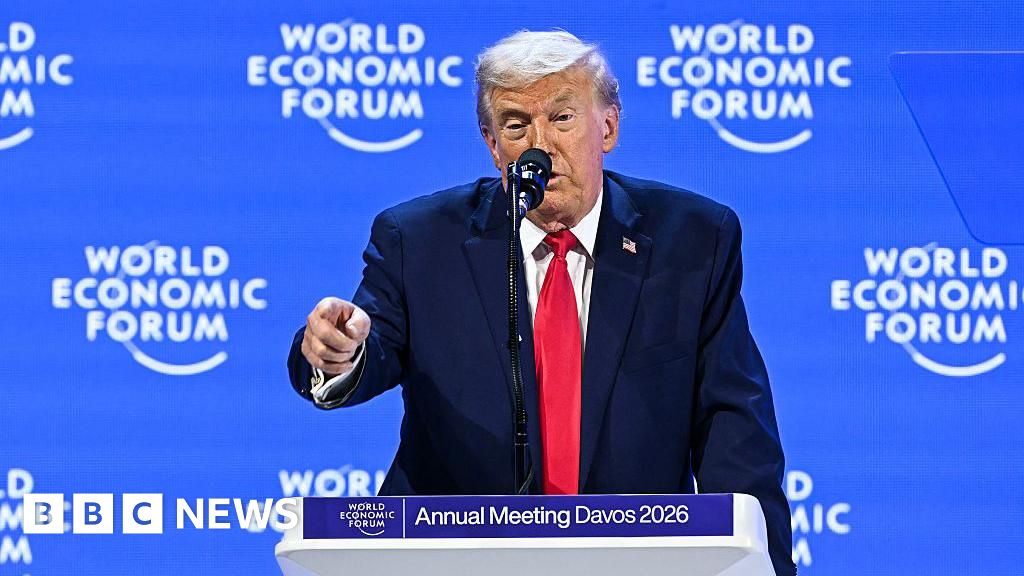
Europeans will not forget the threats made over Greenland. The impact of Trump’s days in Davos should also not be underestimated. His 70-minute speech was a shock to most in the audience — bragging, bullying, threatening, narcissistic, unmoored from reality. No American ally could watch that performance and regard Trump as a credible or reliable leader of the “free world”.
As a result, America’s allies are all accommodating themselves to the changing reality and searching for a new strategy — which explains the extraordinary impact of another speech made in Davos by Mark Carney, the prime minister of Canada.
The Canadian prime minister observed that great powers are now using “economic integration as a weapon, tariffs as leverage, financial infrastructure as coercion”. In such a world, “integration becomes the source of our subordination”. Appeals to international law and a notional rules-based order are pointless in this new environment. So we can “no longer rely just on the strength of our values but the value of our strength”.
Carney’s speech went viral because of its frankness and clarity about what the Trump administration means for American allies — and for its boldness in charting a way forward.
Trump was among those who noticed the speech. In his own address the following day, he warned: “Canada lives because of the US. Remember that Mark, next time you make your statements.”
Carney’s speech offered not just a diagnosis of the problem but an actual strategy: diversify away from America. This is a particularly acute challenge for Canada, which does around two-thirds of its trade with the US. But Carney has made a decisive start. He had just returned from China, where he signed a new trade deal. Other American allies will also be treading the path to Beijing. Sir Keir Starmer, Britain’s prime minister, will make a long-planned visit there next week.
The whole situation offers a huge opportunity for Beijing. The Chinese have avoided commenting on the current ructions within the western alliance, following the well-known principle of “never interrupt your enemy when they are making a mistake”.

It is a sad irony that “de-risking” was a strategy designed for China, in a period of close co-operation between the US and Europe. Now the Europeans and Canadians are attempting to apply the same principle to America itself.
Paradoxically, de-risking from America means accepting more China risk. And the Chinese themselves have pioneered the weaponisation of interdependence — witness the pressure they have put on the US, Japan and others through their near monopoly on the processing of rare earths and critical minerals.
Asked about the parallel threat from Beijing, Carney’s response is that diversification away from America cannot be exclusively about China. Canada and other middle powers have to develop a whole suite of new relations — mainly with each other. The network of cross-cutting economic ties between India, Japan, South Korea, the countries of Latin America and Africa and others needs to become more intense.
There should be plenty of willing takers for such a strategy because the Europeans are not the only ones who are feeling battered by Trump’s America.

India is a prime example. The Narendra Modi government went further than any other major economy in de-risking from China — stripping Chinese tech out of their national infrastructure and banning apps such as TikTok. The flip side of that decision was a big bet on closer co-operation with America. But the Trump tariffs — and Trump’s sharply deteriorating relations with Modi — have led to a big recalculation in Delhi.
The same goes for many states in Latin America, such as Brazil and Mexico, that are alarmed by Trump’s aggressive new strategy of hemispheric dominance.
A true de-risking from America extends well beyond trade. It would have to incorporate every area of strategic significance — including finance, technology and military equipment. Given America’s dominance in all three areas, that would be a formidable challenge — perhaps an insurmountable one.
Arthur Mensch, the founder and CEO of Mistral, the French company that is Europe’s most prominent AI start-up, outlined the tech challenge at a session in Davos, arguing that Europe has developed a huge dependency on American tech — importing around 80 per cent of its digital services, such as cloud computing, from the US.

In Mensch’s view, the development of AI now presents Europe with a fork in the road. “The biggest risk in the coming years for Europe is that we become a colony in AI”, which could lead to “95 per cent of digital services and AI being imported from the US”. That would present a profound risk to European sovereignty because “our entire industry would be run on a technology that can be turned off, if the US decides to”.
But, as Mensch sees it, the development of AI also gives Europe an opportunity to significantly decrease its dependence on American technology because it will give rise to new ways to develop software and digital services. If Europe makes a firm decision to opt for European solutions, he said, it can begin to free itself from excessive technological dependence on the US.
It will be a little easier to diversify away from America when it comes to the purchase of military equipment, given that Europe does have sizeable defence firms. But military planning presents a steeper challenge.

Much of it is done through Nato, which is an American-led organisation. (The US is “team captain”, as one senior Nato official once put it.) But what if America is the threat you are having to defend against? Canada has already developed detailed plans for how it would fight a war with the US, if it ever came to that — which were outlined in a recent article in the Globe and Mail.
More generally, many of America’s allies need to relearn the habit of thinking for themselves about big strategic questions — without guidance from Washington.
France, which has always sought to maintain a certain distance from the US, is well placed to lead this intellectual revolution. As the French foreign minister Jean-Noël Barrot said in Davos: “This is what France has been saying for a decade — we need strategic autonomy for Europe.” Indeed French belief in the need for Europe to keep its distance from the US goes all the way back to the 1950s and the leadership of Charles de Gaulle.

What Trump has done is to produce a kind of European Gaullism — as almost the whole continent (with the exception of Trumpist outriders like Hungary) quietly embraces the need to de-risk from the US. The goal is to avoid the situation that Carney describes, when “integration becomes the source of your subordination”.
The French have their own nuclear deterrent, which is not reliant on American technology, unlike the UK deterrent. But France is also hamstrung by its own weak finances and by its lingering suspicions of its natural partners. There is still a French fear of full-scale German rearmament and a fear that the British will always be in the pockets of the Americans. All that is underpinned by a fear of the rise of the political extremes.

That can still make France a very difficult partner. The British are deeply frustrated by French reluctance to move beyond Brexit on questions like joint defence spending — despite the urgency of the new situation. And France can also be an awkward member of the EU. It is still trying to block (the French would say renegotiate) the new trade deal between the EU and Mercosur, the South American trade bloc — which should be a prime example of the strategy of diversification away from America.
The Europeans and others are also aware that, in the coming months and years, they will be constantly having to respond to new crises produced by a hyperactive American president, whose lack of coherence is only matched by the enormous power at his disposal.
Trump’s latest initiative is his “Board of Peace” — unveiled with great fanfare in Davos. The ambitions for this board now clearly extend well beyond the initial goals of stabilising and rebuilding Gaza. What the Trump administration is doing is creating an alternative forum to the UN.
In the hands of a more persistent and reliable US president, it is possible to see how an idea like that might be made to work. A group that is unambiguously led by America would find it much easier to make decisions and respond to crises than the chronically divided UN Security Council. If it could then harness the power of the American military, it could also respond effectively to those crises — avoiding the painful process of putting together UN peacekeeping operations and securing mandates.

But few rational observers can have any faith in Trump and those around him to have the discipline and even handedness to make the Board of Peace work properly on a global scale.
That points to the biggest issue hanging over Davos — which some attendees described as the “mad emperor” question.
Trump’s behaviour seems to be becoming even more erratic. Since the beginning of the year, he has staged a military operation in Venezuela; promised to intervene in Iran; threatened to annex Greenland; dispatched hundreds of masked federal agents to Minnesota; and launched law suits against the head of the Federal Reserve, Jerome Powell, and the head of JPMorgan, Jamie Dimon. That is in just three weeks and there are three years of his presidency left to go.
Dismayed western diplomats say that there is now no one in Trump’s inner circle who is capable or willing to stand up to him. And the problem extends well beyond the administration itself into the American establishment at large.

“People are afraid to speak out about being afraid to speak out,” as Bill Gates put it in Davos.
Given Trump’s tendency to lash out against anybody who opposes him, that fear is rational — even if it is not particularly noble.
The broader fear is that, with three years to go of the Trump administration, the chances of a his erratic actions provoking a major crisis are surely quite high — from the global economy to the international political system and the stability of America’s own democracy and society.
Under the circumstances, de-risking from the US looks like the only rational strategy for America’s allies. But there is only so much that other countries can do, in a world in which the US remains the dominant power.
Trump’s Greenland plans were a bomb placed under the international system and the western alliance. That seems to have been defused in Davos. But — sooner or later — one of Trump’s bombs is likely to go off.
Credit: Source link