When the pace of hiring begins to slow down, many leaders look to recruiting as an obvious place to cut costs. However, recruiters and other HR professionals know that it can be detrimental to remove resources from recruiting without an eye to strategy and an organization’s business priorities. Especially during times of cost-cutting, HR’s role is to make sure that business leaders have all of the information needed to efficiently make effective decisions.
In this article, we review cost-per-hire, which is one of the most common recruiting measures and a frequent presence on leader dashboards. After unpacking the complexity of this measure, we provide guidance that you can use to help business leaders think about cost-per hire in a nuanced way that benefits the entire organization.
Cost-per-hire hides a lot of complexity within a single measure. It encompasses all of the costs related to recruiting—not only the cost of posting a job but the cost of recruiters, recruiting technology, interviewing and more. Cost-per-hire is the sum of all these costs, divided by the number of employees hired over a 12-month period.
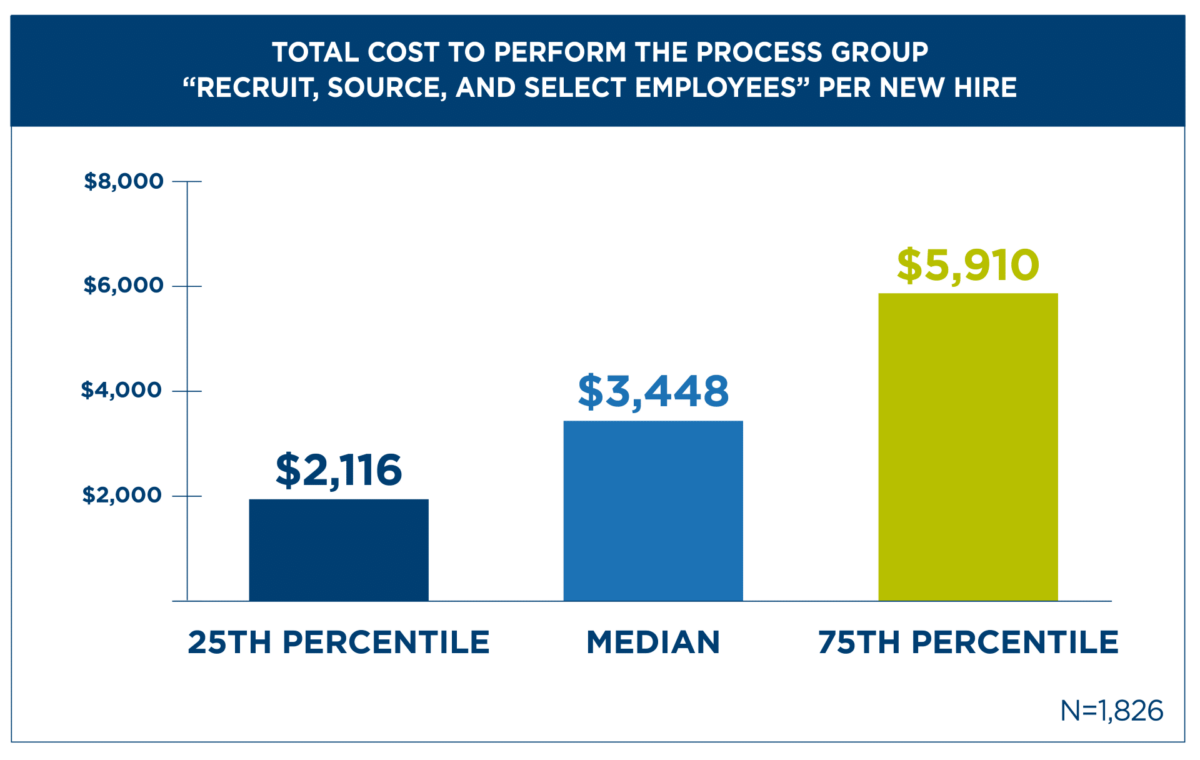
Organizations at the median of our benchmarking data spend $3,448 per hire. At the upper end (the 75th percentile), organizations spend $5,910 or more, while organizations at the 25th percentile spend the least: $2,116 or less.
Interpreting cost-per-hire
Your organization’s cost-per-hire is strongly influenced by a range of internal and external factors. These not only include your industry and location, but also the function(s) and specific roles for which you are recruiting. For example, if your organization is currently hiring data scientists for artificial intelligence, it would make sense for your cost-per-hire to be greater than if you were seeking dishwashers. Keeping factors like these in mind will help you discuss cost per hire with leaders at a deeper level of granularity.
Track cost-per-hire alongside these measures
It’s important to measure and track cost-per-hire as part of a balanced set of measures that also includes:
- Quality-of-hire indicators like candidate and hiring manager satisfaction, new hire performance ratings and retention
- Time-to-hire and time-to-fill measures
- Productivity and efficiency measures for recruiting
Looking at cost-per-hire in balance with these measures will help you ensure that you don’t optimize cost-per-hire at the expense of other priorities. Spending less on recruiting will be counterproductive, for example, if you have a high rate of new employee turnover because you’re not finding the right talent. The goal isn’t to spend the least—it’s to spend the most strategically in light of your specific talent priorities.
Leaders don’t always have the time to think through the complexities of recruiting. However, this presents you with a unique opportunity: If you can tell a convincing story about the importance of ongoing investments in recruiting, you not only help to sustain your recruiting budget but establish HR as a valuable strategic partner that helps the business think critically about where to spend, save and invest.
Below, we provide talking points for three different conversations you could have with leaders. Use these talking points as a springboard to shape your own dialog with leaders around your recruiting budget.
Sustaining competitive advantage in the talent marketplace
A lower recruiting budget may save your organization money in the short term, but these cost savings may come at the expense of your organization’s ability to compete for the best talent. If your recruiting function, budget and staff is going up and down just like the labor market is, you can easily hit a point where you don’t have the infrastructure in place to act quickly when you need to.
The ability to secure business-critical talent when you need it requires your organization to maintain a strong talent pipeline. That means having recruiters on the ground building relationships with potential candidates that can be leveraged as the need arises. You also need recruiters to act as your eyes and ears—both internally and externally—to help anticipate future needs and continually network with potential candidates who can meet those needs. These relationships and networks are the center of a strong, sustainable recruiting effort—and building them is a task that only humans (not AI or automation) can carry out.
Slow hiring periods provide key opportunities to strengthen relationships with the business and develop strategies you can use to hit the ground running when you need hiring to ramp up quickly. Making steep cuts to recruiting means you lose these opportunities and need to start from scratch (or close to scratch) each time hiring picks up. There’s no better way to sabotage your own competitive edge in the talent marketplace.
Maintaining recruiting efficiency over the long term
Short-term cuts to your recruiting budget can also add to recruiting costs over the long term. For example, having a constant churn of recruiters means that your organization will be in a continuous cycle of swings in terms of layoff costs as well as hiring and training costs. Many of these costs could be avoided (to yield overall recruiting cost savings) by retaining a core recruiting staff or base level of recruiting spending.
HR should also help leaders consider the intangible costs associated with churning recruiters. For example, what is the impact on a hiring manager’s time when recruiting is understaffed and underfunded? What opportunities might your organization miss when hiring takes longer and teams can’t work at their full capacity as a result?
Your organization will be better served in the long run by making improvements to your recruiting processes and piloting innovative technologies that can help lower costs in a sustainable way. Process improvements and new technologies both require time and resources to implement effectively, but the payoff in terms of cost savings can be substantial—and is always going to be more sustainable over time than continual recruiting churn.
Cultivating an engaging employee experience
Many organizations and HR functions today have the employee experience as a central objective. However, the employee experience does not begin on the first day of the job or even upon offer acceptance. Instead, it begins when a potential candidate takes notice of a particular employment opportunity in your organization. While HR understands the importance of a competitive candidate experience for outcomes like engagement and retention, leaders may need you to help connect the dots.
Advances in technology are reshaping the ways that recruiters reach out to candidates. For example, recruiting tools powered by AI make it easier than ever to personalize the experience for every applicant. Many tools also have embedded features like chatbots and virtual assistants, which can answer candidate questions quickly and accurately. These tools help to drive the perception that a potential employer is responsive, personable and helpful—which can count for a lot when a candidate is considering different employers.
Rather than cutting back on the technologies and practices that help your organization stand out, now is a good time to train recruiters on how to fully leverage new technologies and understand how AI is also changing how people seek jobs.
The recruiting process is complex and includes many different activities, from job posting to resume screening, candidate assessment and more—along with the technologies that support these activities. It’s critical to help busy leaders understand this complexity and the importance of ongoing investments in recruiting. Breaking down cost-per-hire and showing its implications for the employee experience, long-term recruiting efficiency and the ability to compete for the best talent are all effective ways to begin building a solid business case for your recruiting budget.
*
Data in this content was accurate at the time of publication. For the most current data, visit www.apqc.org.
Credit: Source link