
Just as artificial intelligence is reshaping the world of work, so too is it reshaping the HR function. AI can help HR professionals streamline processes, enhance decisions and improve outcomes for their organizations and people.
But how can HR leaders harness the power of AI in HR? What are the areas where artificial intelligence can add the most value and impact? And what are the challenges and risks associated with adopting AI into the HR function?
In the broadest sense, AI encompasses various technologies that enable machines to perform tasks that normally require human intelligences (e.g., reasoning, learning, creativity). A more sophisticated output is generative AI, one of the most advanced and innovative forms of AI that can actually create new content (e.g., text, images, audio, video).
Generative AI can help HR leaders create engaging and personalized experiences for their workforce, design fair and attractive rewards, and generate insights and recommendations from data. While not yet a mainstream technology, generative AI is a game-changer for HR leaders, potentially delivering more value and innovation to organizations.
Coming in September: HR Tech brings the latest in innovation to Vegas
As generative AI evolves and matures, it faces several barriers to adoption, including cost, complexity and compatibility. Business leaders and executives often are skeptical of emergent technology, voicing concerns about risks associated with new approaches that have unproven ROI. To overcome concerns, it is helpful to understand AI’s adoption cycle.
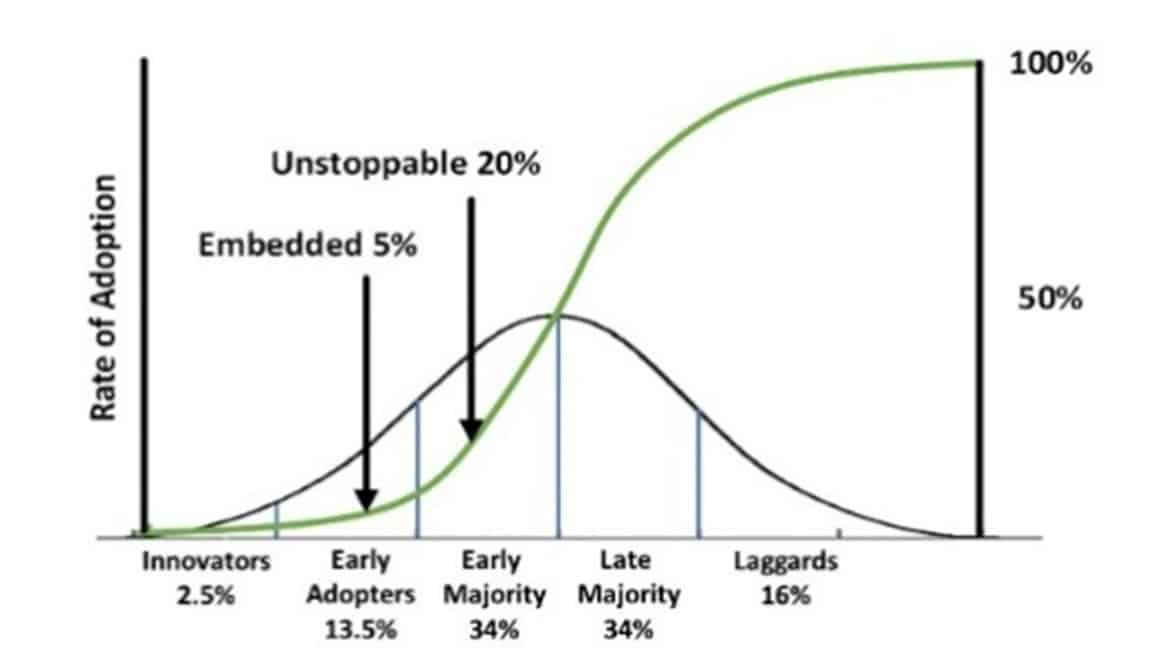
To understand the current state and future potential of generative AI in human resources, consider Everett M. Rogers’s theory of Diffusion of Innovations. This theory explains how new technologies spread, gain acceptance among users and eventually achieve product-market fit (see Figure 1).
Figure 1. Diffusion of Innovations
A technology reaches a market fit, according to the theory, when its adoption rate exceeds 5% of potential adopters. That is, the technology has proven its usefulness and reliability, effectively overcoming the initial obstacles.
Combine this understanding of Rogers’ theory with the findings from WTW’s 2024 Salary Budget Planning Report and there is strong evidence that generative AI has reached this market fit in several areas of HR. This indicates that generative AI is ripe for adoption and implementation, even among organizations with a lower risk tolerance.
How forward-thinking HR leaders are using generative AI
HR leaders from various industries and regions were asked about their current and planned use of generative AI in the 2024 Salary Budget Planning Report. Overall, 10% of respondents said they were using or planning to use the technology, putting them in the early adopter category.
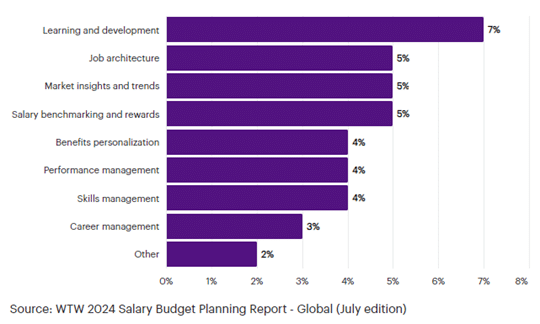
However, respondents also indicated that the use of generative AI varied across different HR functions; some areas had a stronger fit and need than others. The survey results revealed four areas in which generative AI had the highest adoption rates:
- Learning and development (L&D)
- Job architecture
- Compensation insights and trends
- Salary benchmarking
With adoption rates in these areas ranging from 5% to 7%, there is a clear and compelling use case for generative AI (see Figure 2). For instance, generative AI can help L&D leaders create customized and interactive learning content, such as simulations, scenarios and quizzes. It also can help compensation leaders design optimal and equitable pay structures, analyze market data and generate insights and trends across the workforce.
Figure 2. Areas of AI Utilization in HR
The key takeaway is that companies are not waiting for tomorrow; they are using generative AI today. And organizations that don’t start their AI journey soon risk the ability to keep pace with highly differentiated HR offerings of the future.
Where leaders can start the journey
Though it may be tempting for HR leaders to start their AI journey by focusing on the four areas identified by the Salary Budget Planning Report, this is not necessarily the best approach. Each organization’s path depends on its risk tolerance and strategic goals.
For example, if an organization is not an early adopter but wants to keep pace with the market, then perhaps the top four areas are the safest and most proven options. However, if an organization is more comfortable with risk and wants to be a leader in the space, then it may make sense to explore other areas of generative AI that have lower adoption rates but higher potential for innovation.
Three areas were identified as having the lowest generative AI adoption rates but the highest potential for innovation: benefits, performance management and skills. Though these areas only had adoption rates of 3% to 5% (the “innovator” phase), they also have a strong opportunity for growth and improvement. For example, generative AI can help:
- Benefits leaders create personalized and flexible benefits packages, communicate benefits information and generate claims and reports.
- Performance management leaders create SMART goals, provide feedback and coaching, and generate performance reviews and ratings.
- Skills leaders identify skills gaps, create skills profiles and generate learning paths and recommendations.
Overinvestment or underinvestment: Which is the bigger risk?
The use of AI in HR is not a question of if but of when. Survey results show that generative AI has already achieved market fit in several areas of HR and has the potential to transform other areas as well.
HR leaders must decide where to start their AI journey based on their organization’s risk tolerance and strategic goals. Want to follow best practices and benchmarks? Consider starting with the areas of generative AI with the highest adoption rates. Prefer a competitive advantage that challenges the status quo? Look to areas where generative AI has lower adoption rates but higher potential for innovation.
The choice is yours, but the time is now. After all, the biggest risk is simply being left behind.
Credit: Source link



