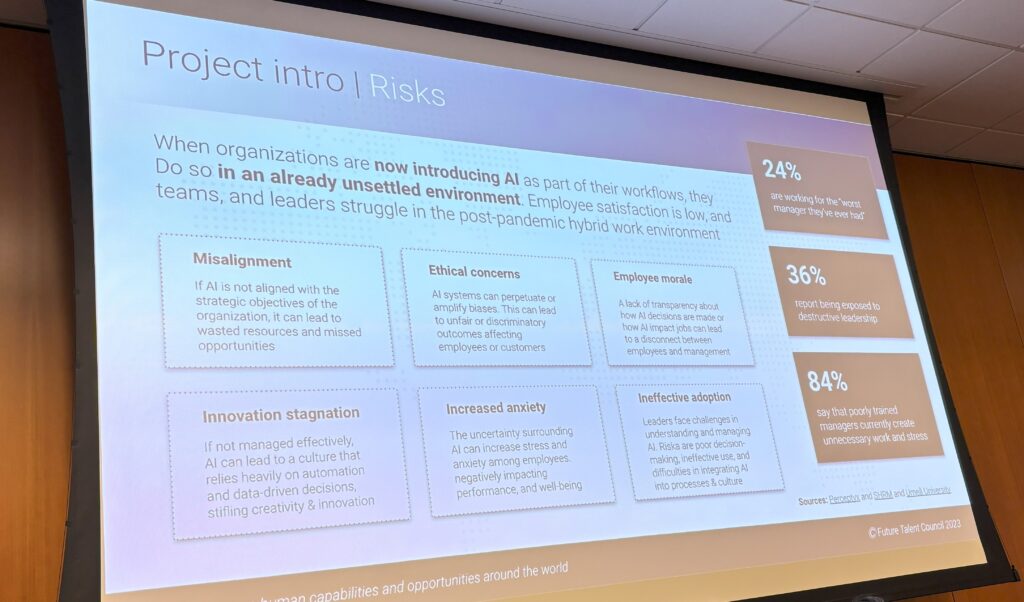
The Stockholm-based think tank Future Talent Council found that most organizations in its network intend to increase AI spending, making this a top-level budget item for many companies. However, the group, which includes employers, educators and policymakers from around the world, says that organizations still need to invest in leadership willing to understand the dynamics of artificial intelligence in the workplace.
Data from other organizations supports this philosophy. A 2023 survey of 1,500 managers and 1,500 employees by employee listening leader Perceptyx found that 24% of people report “working for the worst manager they ever had,” while a 2020 SHRM survey of nearly 500 working Americans found that 84% say that poorly trained leaders create “unnecessary work and stress.”
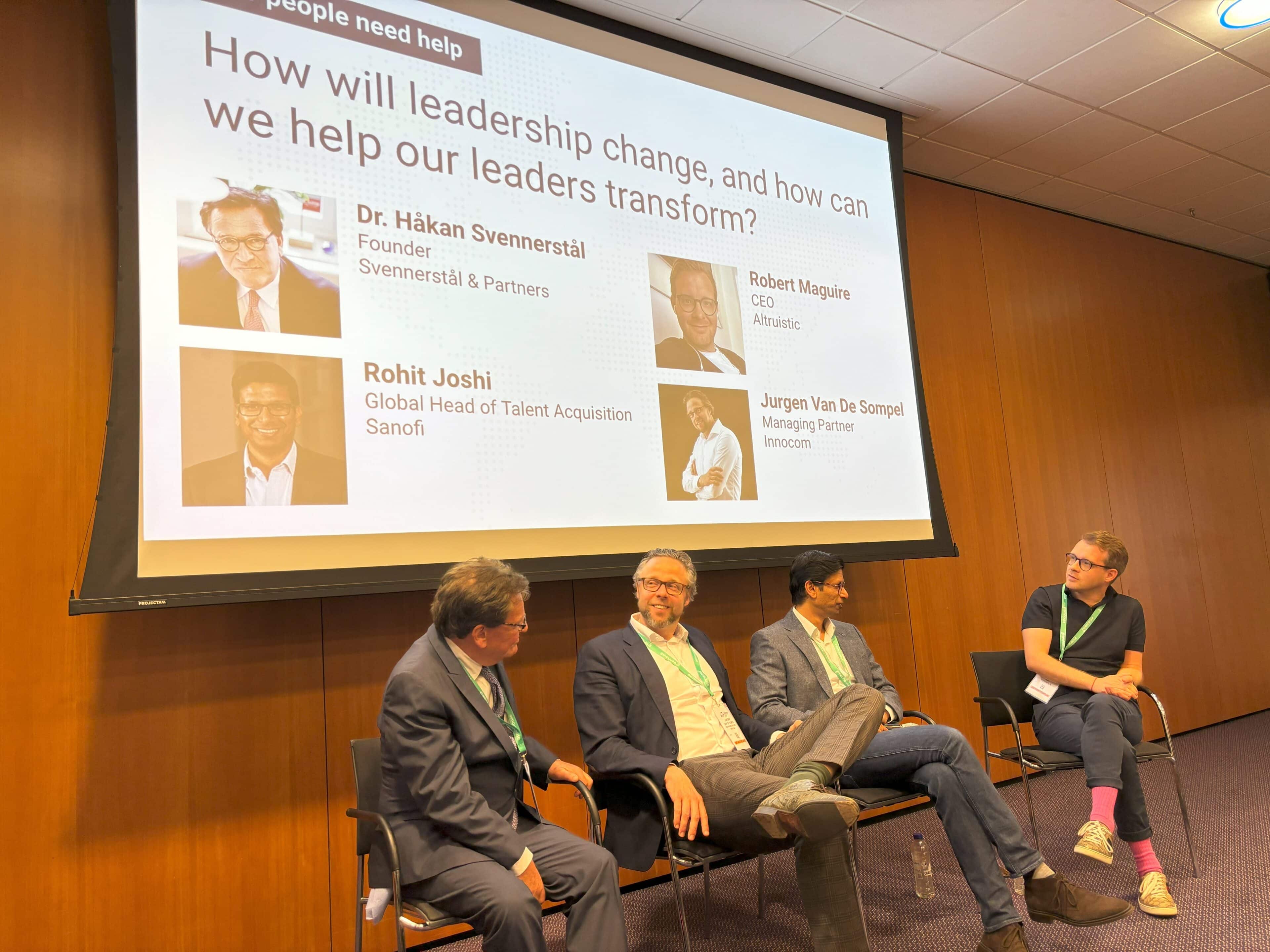
This week at HR Technology Europe, Daniel Kjellsson, co-founder of Future Talent Council, moderated an international panel to discuss the study and explore the impact of AI adoption on organizations and their leadership.
European perspectives and beyond
Panel partners included Rohit Joshi, global head of talent acquisition at Sanofi; Dr. Håkan Svennerstål, chair of Svennerstål & Partners; Robert Maguire, CEO at Altruistic; and Jurgen Van De Sompel, managing partner at INNOCOM.
Artificial intelligence, as expected, was present in many of the conference’s sessions and nearly all keynotes. However, this particular panel offered a unique perspective on the role of leadership, a population with the influence to amplify (or dampen) AI adoption for the millions of people they direct and govern.
Kjellsson indicated that stakeholders are urged to view the “age of AI” as pivotal in human development and to engage in strategies that promote sustainable and harmonious leadership.
A need for ‘sustainable organizations’
“I am quite deeply concerned about the world,” said Svennerstål, a Swedish authority on leadership assessments, with nearly 50 years of experience in the field. He works with ministers, governments, CEOs, board chairs and executives globally.
He pointed out that not every society is supported by leaders who engage with AI innovation and legislation as actively as the European Union. “When you look at the world situation, we have 57 undemocratic states,” said Svennerstål. “And in these states, people are not allowed to develop from their own will. And at the same time, we’re talking about [a need for] sustainable organizations and sustainable leaders.”
Kjellsson explained that when organizations adopt AI in an “already unsettled environment,” employees experience dissatisfaction and are less likely to be effective adopters of new technology. Yet, Svennerstål said that employees who feel discouraged about innovating are a detriment to themselves and the organization. “Everyone has innovation competencies,” he said. “Try to see the barriers that are in the way of competencies and learning.”
Svennerstål said that gaps in leadership often emerge when managers don’t understand the technological landscape, generating indecision and a lack of support for employee AI adoption. However, the widespread prevalence of AI is now something that cannot be ignored, because the impact is significant. “HR is a vital part of this transformation,” he said. “AI is a common responsibility.”
‘AI has a seat at the table, but it’s not the table’
Maguire, CEO of purpose-driven innovation consultancy Altruistic, put it this way: “All theories about digital transformation pre-AI are basically a joke.” In other words: Society is relearning many lessons about the digital landscape in the shadow of artificial intelligence.
He’s seen some organizations struggle to update their thinking to a level sufficient enough to match the complexity of AI’s potential. Others seem to believe artificial intelligence is something that can be acquired and implemented. However, that mindset is missing the key element of the impact on people and the business at large. In terms of the human capital aspect, said Maguire, “AI has a seat at the table, but it’s not the table.”
Maguire said that some executives or HR tech buyers may be misguided to think that AI is “this monolithic solution that you can just almost purchase off the shelf” and realize some immediate value. But this is backward, he said. The investment should focus on training leaders and empowering employees to become proficient in implementing AI into their workdays. “If you grow the internal value of your business, the external value will take care of itself,” said Maguire.
‘Data-driven transformation is a social-technical challenge’
Jurgen Van De Sompel, managing partner at Belgian change and transformation management firm INNOCOM, said that organizational ideas often emerge from the bottom up. However, strategy realization at a leadership level is the most important step to scaling the idea into something useful for a business or group.
This is because data-driven transformation is a “social-technical challenge,” composed of 10% algorithms, 20% technology and 70% business and people. In other words, the tech must be powerful and propelled by humans to serve an organizational need.
He added that the businesses are accountable for realizing the value of AI investments, and there is a clear need for transformative leadership that can translate tech purchases into tangible, productive outcomes.
Van De Sompel predicts there will be more emphasis on “encouraging inspiration and creativity.” He says that leaders who build genuine connections and heartfelt bonds with others will also play a crucial role, but anticipating the exact outcome of these changes may be challenging, with a timeline possibly spanning decades.
Watch out for the ‘shiny coin syndrome’
Rohit Joshi, global head of talent acquisition at international pharma company Sanofi, warned HR leaders to watch out for the “shiny coin syndrome” and more deeply consider how organizational decisions and technology investments will materialize over the next several years.
He encouraged the audience to “take a step back” and define what employees look for in a leader. Joshi said these are often education, confidence and transparency, and even in a highly technological environment, employees still value these traits within their workplace support system.
Keeping this in mind, Joshi said that candidates should not be assessed only on their measurable qualities, but also on their intangible characteristics. These are the elements that set people apart from robots, computers and machine learning. He said that while machines can provide data, they can’t offer the unique aspects that a team brings, such as resilience, forward-thinking and collaboration skills. These qualities, often called “soft skills,” are essential “power skills,” according to Joshi.
For HR professionals or other professionals who are fearful that AI will take their jobs, Joshi reminded the audience of the importance of reputation and likability, two attributes that machines can’t provide, nor do they possess. He brought it back to leadership: “The right team, the right culture and, hopefully, the right leader can mentor you along.”
Credit: Source link