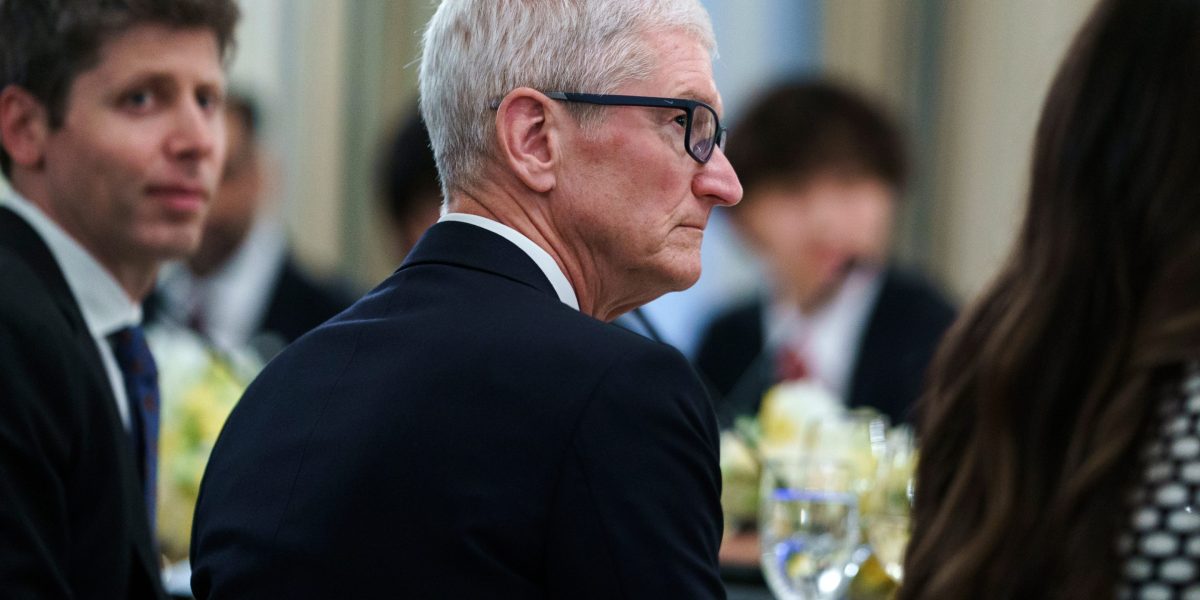
Apple sued OpenAI on Friday for allegedly stealing its trade secrets, an extraordinary move that pits the $4.6 trillion iPhone maker against the fast-growing AI startup as it prepares to release a new class of hardware products that have been shaped in large part by Apple’s former design boss.
In the lawsuit, filed in the Northern District of California court, Apple accused two former Apple employees now working at OpenAI of systematically stealing confidential data including information about unreleased hardware products, technical specifications, and details about vendors and contractors in Apple’s supply chain. The complaint also listed OpenAI as a defendant, as well as io Products, a hardware design firm acquired by OpenAI last year that was cofounded by Apple’s former design boss Jony Ive.
“At every level, from members of its Technical Staff to its Chief Hardware Officer, and in coordination with business partners, OpenAI has been stealing Apple’s trade secrets and confidential information,” Apple said in the 41-page complaint. “OpenAI’s nascent hardware business now rests on the shakiest of foundations, rotten to its core by its illegal reliance on misappropriated trade secrets.”
OpenAI told Fortune in a statement that “we have no interest in other companies’ trade secrets. We remain focused on building innovative technology that empowers people everywhere.”
The lawsuit marks a dramatic escalation between two companies that were once working together to bring OpenAI’s ChatGPT into Apple’s software platforms and Apple’s Siri digital assistant. The partnership between Apple and OpenAI faded over time, and in January Apple announced that it was turning to Google for its Apple Intelligence efforts.
An Apple spokeswoman added in a statement that the company’s teams “are constantly developing breakthrough technologies to create the best products and services in the world, and protecting their work and intellectual property is something we take very seriously.”
OpenAI told Fortune in a statement that “we have no interest in other companies’ trade secrets. We remain focused on building innovative technology that empowers people everywhere.”
Apple accuses Tang Tan, OpenAI’s chief hardware officer and a former vice president at Apple, of systematically stealing secrets, including using confidential Apple codenames during OpenAI’s recruiting process, encouraging interviewers to share secrets from the iPhone maker, and directing them to physically bring Apple hardware parts into interviews. Tan left Apple to join io Products in 2024 after roughly 24 years at the company, where he had risen from product designer to vice president over iPhone and Apple Watch product design.
Chang Liu, a member of OpenAI’s technical staff, is accused of downloading dozens of confidential hardware files, including technical specifications, engineering presentations, and proprietary data for unreleased products. He is also accused of instructing an Apple employee on how to bypass security teams when copying files. OpenAI is accused of misappropriating knowledge of Apple’s supplier relationships and proprietary terminology to approach Apple’s supply chain partners.
Apple’s allegations are all the more striking given the company’s reputation for fiercely safeguarding the secrecy of its products.
OpenAI has been developing hardware devices to run ChatGPT on, part of a strategy to control its own physical products rather than rely on giants like Apple. OpenAI has recruited from Apple, including hiring some of its top product leaders, and in May 2025 it announced that it was buying Ive’s io Products for $6.4 billion.
OpenAI CEO Sam Altman has made no secret that he envisions a new class of AI gadget that replace smartphones as the primary consumer tech device, and Ive’s move to OpenAI turned heads at the time. Ive is not named in the lawsuit.
The lawsuit comes at a period of transition for both companies, with Apple CEO Tim Cook due to hand the reins to John Ternus in September, and OpenAI preparing for an initial public offering as it faces increasing competition from other AI model makers like Anthropic and Google.
Apple is seeking a combination of injunctive relief, monetary damages, and declaratory judgments to stop the alleged theft.
This isn’t the first time OpenAI has faced such accusations. In 2023, the New York Times sued OpenAI and Microsoft, alleging that the companies used its articles and other content to train their AI models without permission. In June, a California judge dismissed a lawsuit from xAI, the company run by Elon Musk, alleging that OpenAI recruited a former xAI engineer to share information about the Grok chatbot.
Credit: Source link