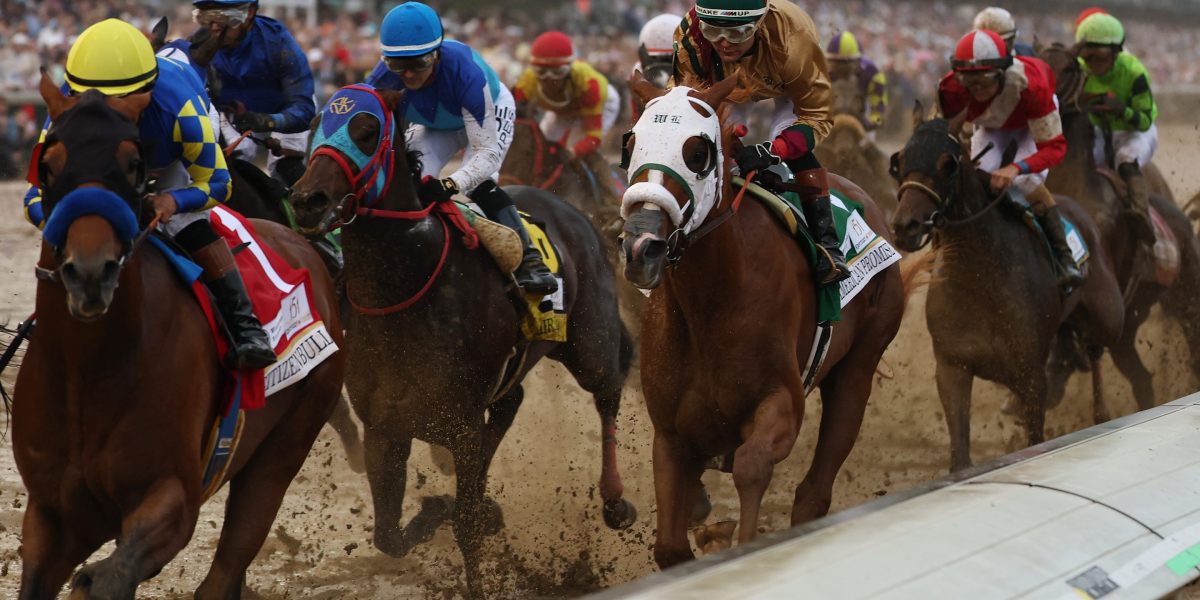
On the first Saturday of May, 150,000 people will pack into Churchill Downs in Louisville wearing their finest hats. Tens of millions more will watch from home. In 2025, 17.7 million Americans tuned in—the largest Derby audience since 1989.
And bettors wagered a record $234.4 million on the race itself: $349 million on the full Derby Day program and $473.9 million across Derby Week, all records for the fourth consecutive year.
That’s a lot of betting for a single two-minute race. But for anyone who has tried to bet on the Derby through a mainstream sports betting app, it’s surprisingly hard to get in on the action. That’s because the Kentucky Derby runs on a fundamentally different legal system than the one powering America’s $166.94 billion sports betting boom.
Kentucky’s betting laws
Horse race wagering in Kentucky is legally required to be pari-mutuel, a requirement that creates an entirely different experience than anything FanDuel, DraftKings, or BetMGM offers on the Super Bowl.
In a pari-mutuel system, bettors wager against each other, not the house. Every dollar bet on a horse goes into a communal pool. The track skims a percentage—the “takeout”—for operations, purses, and regulatory fees. Whatever remains is divided among winners proportionally. It’s the one true example where the house always wins.
As a result, the odds fluctuate until the race starts, based on how much money is placed on each horse. A bettor might place a wager when a horse appears to be 5-1, only to see those odds drop to 3-1 and receive a smaller payout if the horse wins. Kentucky law enshrines this requirement for every legal horse racing wager in the state, whether at a Churchill Downs window or through an app.
Unsurprisingly, this is pretty hard to replicate in the modern sports betting ecosystem. When you open BetMGM or other apps and bet on the Super Bowl, your odds are fixed the instant you confirm: you know your payout and it can’t change. It’s what tens of millions of Americans now expect from a wagering experience, yet this structural incompatibility presents a major problem, especially when you throw in bet types like moneylines, spreads, and totals. Legal Derby wagering offers win, place, show, exactas, trifectas, superfectas, Pick 4s, and more—each with its own pool and its own odds dynamics. For a casual bettor, this is a different language.
You might not even be a casual bettor and still need some definitions: win (finishes first), place (finishes first or second), show (finishes first, second, or third), exactas (pick the top two finishers in exact order), trifectas (pick the top three in exact order), superfectas (pick the top four in exact order), and Pick 4s (pick the winner of four consecutive races). Then this compounds with Pick 5s and 6s, etc.
This is also why the nine licensed Kentucky sportsbooks—DraftKings, FanDuel, BetMGM, Caesars, bet365, Fanatics, theScore Bet, Circa, and Prime—cannot simply bolt horse racing onto their existing platforms. A sportsbook that has cleared every hurdle to offer fixed-odds NFL betting in Kentucky has not automatically cleared the separate licensing, totalizator systems, simulcast rights, and advance-deposit wagering approvals required for pari-mutuel racing.
In fiscal year 2025, those nine books took more than $2.72 billion in Kentucky sports bets and kept $284.7 million, with DraftKings leading at $115.3 million in gross revenue and FanDuel close behind at $111.7 million. But the dominant platform remains Churchill Downs’ own TwinSpires, built from the ground up to operate inside the pari-mutuel system the law requires.
Legal U.S. sports betting handle hit $166.94 billion in 2025, with 20% of U.S. adults placing a legal bet, up from 12% in 2023. More than 80% of wagers happened on mobile. The NFL alone drew an estimated $30 billion in legal wagers during the 2025 season. The U.S. Thoroughbred pari-mutuel handle, meanwhile, was roughly $11 billion in 2025—down from a peak of over $15 billion in 2003, and about 6.6% the size of the sports betting market.
A current federal fight in the middle of the pack
While Kentucky’s pari-mutuel laws create friction at the consumer level, a federal legal battle nearly produced something far worse this year: a scenario where no one outside Louisville could legally bet on the Derby at all.
A 2020 law created the Horseracing Integrity and Safety Authority (HISA), a federally-authorized private body charged with imposing national uniform safety and anti-doping standards on Thoroughbred racing. To fund its operations, HISA charged tracks using a formula that blended racing starts with purse sizes—meaning high-purse tracks like Churchill Downs paid disproportionately more. Churchill refused, arguing the statute authorized fees “based on racing starts,” and paid HISA nothing throughout 2025.
By early 2026, a HISA panel ordered Churchill Downs to pay approximately $5.27 million or face suspension of racing at company tracks. HISA threatened to bar Churchill from simulcasting its races—including the Kentucky Derby and even called the company a “freeloader.” The modern Derby’s entire $349 million handle depends on national simulcast distribution, and a ban would have shut down legal Derby betting for millions of Americans.
A confidential settlement was reached on March 24, resolving the immediate dispute on undisclosed terms—drawing criticism from industry publications who noted the irony of HISA, created to replace racing’s opaque governance. Then on April 1, Judge Benjamin Beaton of the U.S. District Court for the Western District of Kentucky ruled on the underlying lawsuit, finding HISA’s purse-weighted methodology “arbitrary and capricious, and therefore unlawful.”
Churchill Downs CEO Bill Carstanjen called it a vindication, saying the ruling was “indicative of HISA’s ongoing fiscal mismanagement.” HISA said the decision was narrow and that it remained “focused on advancing its safety and integrity mission.”
Another Kentucky law in the mix
That same day last month, Kentucky’s legislature passed the Wagering Consumer Protection Act, which legalizes fixed-odds wagering on live horse racing for the first time, letting bettors lock in a payout at the time of the bet. After Governor Andy Beshear vetoed it, lawmakers overrode him just weeks ago.
Supporters say it brings horse racing more in line with mainstream sports betting and could attract younger bettors. It also raises the minimum sports betting age from 18 to 21 and bans any Kentucky-licensed entity—sportsbooks, racetracks, fantasy operators—from partnering with prediction market platforms like Kalshi or Polymarket.
Under federal Commodities Futures Trading Commission oversight, prediction markets offer consumers a way to effectively bet on Derby outcomes without any pari-mutuel complexity, with no changing odds, no separate account, and no exotic bet types. While the new law passed the Kentucky legislature, it’s not operational just yet and certainly won’t be in time for Saturday’s race, meaning for another year, if you want to bet on the on the most famous betting event in American sports, you won’t know the odds
Credit: Source link