The scene plays out in family offices from Greenwich to Geneva, in slightly different variations but with a familiar arc. A junior analyst — often the founder’s grandchild, or close to it — has spent the last six months running investment memos through an AI summarization tool. The results are good. Hours of work compressed into minutes. The CIO is impressed. Then the principal finds out what data has been flowing through the system, and the conversation stops.
“Data privacy is non-negotiable,” family office principals told Citi Institute researchers. “AI solutions that cannot guarantee data security are unlikely to be adopted.”
The problem, as a sweeping new report from the institute makes clear, is that in many cases they already have been.
The report, based on in-depth interviews with single-family office principals and CIOs across North America, Europe, Asia and Latin America, captures a generational cold war playing out inside the world’s most secretive financial institutions. On one side: founding-generation principals who have spent decades constructing privacy architectures around their wealth. On the other: a younger cohort — junior analysts, third-generation family members, grandchildren of founders — who are AI-native, impatient, and convinced that the future of wealth management is lean, automated, and built on large language models.
The divide is not abstract. It has a direction, and the younger side is gaining ground.
The yawning generational gap splitting heirs and billionaires
To understand why this matters, it helps to understand what the Great Wealth Transfer has already revealed about these families. An estimated $83 trillion in private wealth will change hands over the next two to three decades — the largest generational redistribution of assets in modern history. And it is, according to the research, going badly.
Previously, UBS Wealth’s 2026 Global Next Generation Report found that the greatest threat to a smooth handoff isn’t a market downturn or an estate-planning error. It’s silence. Communication breakdowns were found to be the single most common source of conflict in ultra-wealthy families, cited by 33% of respondents — ahead of disagreements over spending habits or fairness. Nearly half of all surveyed heirs say the previous generation conducted no structured wealth transfer at all, leaving successors to inherit not just assets, but ambiguity.
The heirs feel the weight of it early. “You feel a sense of responsibility from a very young age,” one heir told UBS researchers. “Even when parents never talk about the wealth, you feel it.”
What’s changed — and what the UBS data made clear — is that the next generation is no longer content to be passive recipients. In families where the wealth transfer is already underway, the share of heirs actively driving the process has nearly doubled, from 13% to 22%. These aren’t reluctant inheritors hoping for a windfall. They’re prospective stewards demanding a seat at the table.
And in the family office, they’ve found one.
The machine they’re remaking
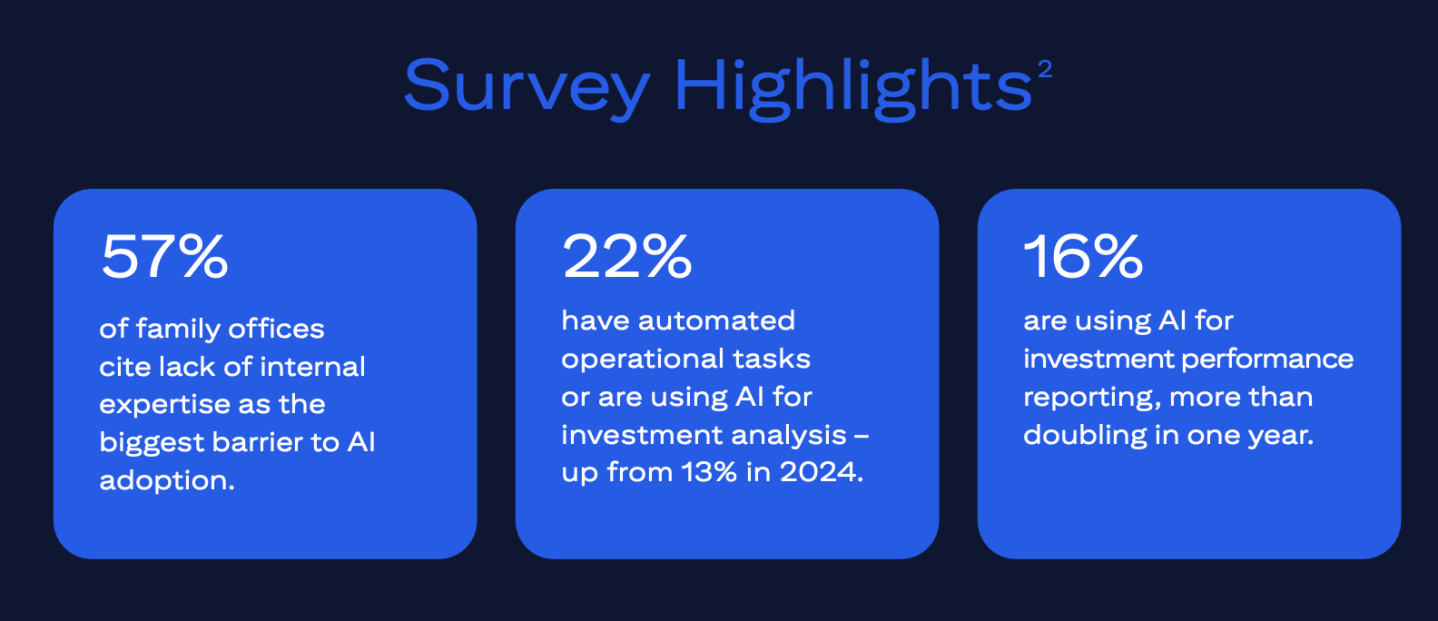
Already, 22% of family offices currently use AI for operational tasks or investment analysis, up from 13% just a year ago, according to the Citi report. The number of offices using AI for investment performance reporting has more than doubled in 12 months. The pace is accelerating. But the adoption gap between family offices and the institutional investors they increasingly benchmark themselves against remains vast, and the reason is almost always the same: data privacy.
Family offices are not like hedge funds or asset managers. They manage institutional-grade investment portfolios, yes, but also deeply personal family affairs — estate planning, philanthropy, tax strategy, succession. A breach isn’t just a financial event. It’s an exposure of the family’s most intimate vulnerabilities. As one cybersecurity report noted, a single intrusion can expose travel itineraries, physical security details, and information that creates personal safety risks far beyond the balance sheet.
The families who have the most to protect are, structurally, the least equipped to protect it. Single family offices operate with lean teams and limited internal IT capacity. Fifty-seven percent cite lack of internal expertise as the biggest barrier to AI adoption. They cannot afford the sandbox experimentation that large institutional investors run as a matter of course. And yet the tools keep arriving — but not always through a formal decision.
“A small number of family offices might inadvertently have access to AI through ‘the back door’ via SaaS providers or daily devices they already use,” the Citi report noted with the careful neutrality of a document written for the people responsible for those offices. The implication is uncomfortable: in some cases, the principal’s data is already in the model. The decision was made — just not by the principal.
The grandchildren are the ones pushing
Citi’s researchers are direct about who is doing the pushing. “Junior staff and younger family members are the biggest advocates for AI,” the report said. “They experiment, demonstrate value and bring older generations along.”
This dynamic is visible elsewhere in family office governance. Research on fine art collections in wealthy families — another domain where the older generation controls the asset and the younger one will inherit the complications — found that roughly six in 10 collectors haven’t discussed their collections with their heirs at all. A 2025 Deloitte Art & Finance report called the next generation of art heirs “largely uninformed and unprepared.”
The generational pattern Citi identifies is consistent: the founding generation tends toward caution, often framed as institutional conservatism, but rooted in an acute awareness of what exposure means at their level of wealth. The second generation is more pragmatic, focused on efficiency and open to cloud-based solutions if security can be demonstrated. The third generation — the grandchildren — treats AI as foundational, not experimental. They are, in the Citi report’s framing, the “innovation with institutional rigor” cohort, and they are not waiting for permission.
“If not embraced,” the report warned, “there’s a risk of losing talent to organizations that fully endorse the technology.”
The zero-staff horizon
The most striking finding in the Citi report is not the adoption numbers or the privacy concerns. It is the ambition. A significant cohort of technically sophisticated family offices are pursuing what the report describes as near-zero operational headcount — running lean, AI-powered operations that deliver institutional-quality investment outcomes with a fraction of the traditional resources.
The threshold these offices often cite is 80% efficiency savings as a baseline justification for AI deployment. That number sounds like an efficiency metric. It is actually a workforce target. The vision, stated plainly across multiple interviews, is a family office in which humans manage agents rather than do the work themselves. Analysts are replaced by AI systems with defined roles — researcher, risk manager, portfolio monitor — that work in parallel, around the clock, without adding headcount.
For founding-generation principals who built their offices on discretion, relationship depth, and the quiet judgment of trusted long-tenured advisors, this is not a vision of efficiency. It is a vision of the institution they built not existing anymore.
The irony is structural. The families who most need to protect their data are the ones whose heirs are most aggressively automating the systems that handle it. The privacy moat that took a generation to build can be crossed, it turns out, not by a cyberattack or a regulatory failure, but by a 28-year-old with an enterprise ChatGPT license and a mandate to cut costs.
For this story, Fortune journalists used generative AI as a research tool. An editor verified the accuracy of the information before publishing.
Credit: Source link