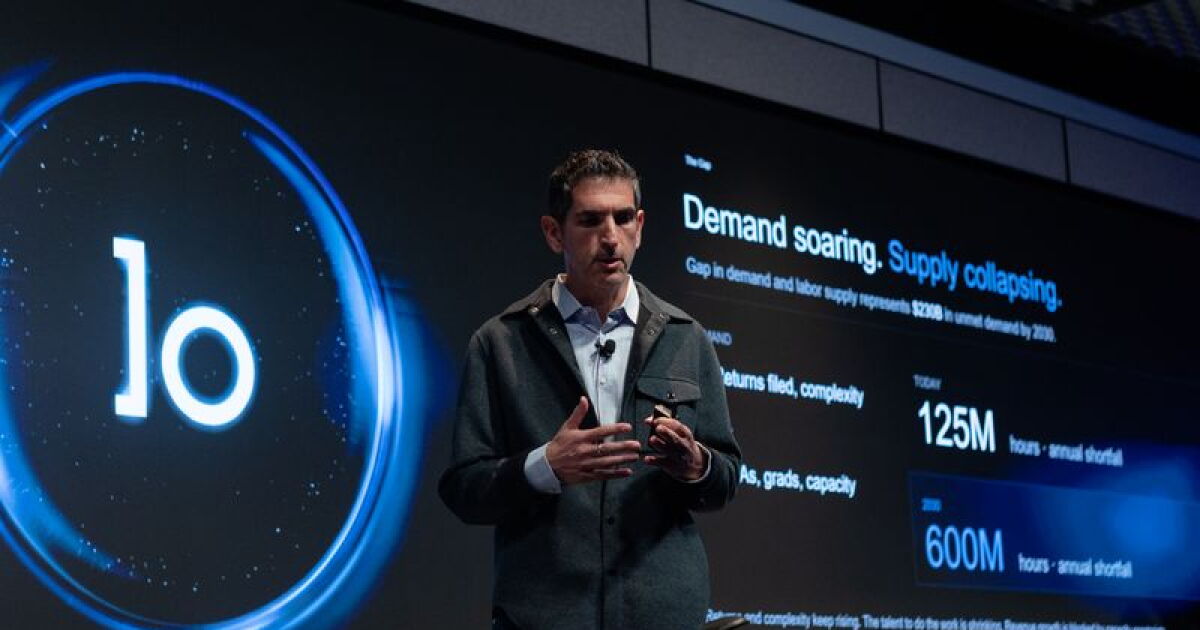
Black Ore, a tax artificial intelligence startup, hosted a series of panel discussions at the Nasdaq MarketSite in Times Square where experts discussed the growing role of AI in making tax preparation and planning more efficient — and noted that the journey hasn’t always been smooth.
Processing Content
“When I think about myself and my leadership team, and think about excellence when it comes to AI, I would say we spun our wheels a lot,” said Belinda Pestana, deputy vice chair of tax at EY Americas. “But I think down to its core, it’s about the data, and when you think about it, most of our people probably spend 40% to 70% of their time wrangling and manipulating data, so really focusing on the data is for us the way that I think we’re going to get to excellence.”
She believes it’s important to make AI a team member for the people she oversees on EY’s tax team. “You can invest all the dollars you want, but if your team is not coming to the office Monday morning, doing something different and using the technology differently, you’re wasting your money,” said Pestana. “It’s all about implementation and change management. That is the hardest part. We are a very old career and profession, and it’s really hard to get folks to do things differently.”
KPMG has also been making use of AI for tax. “I think there was a realization early on that technology transformation and tax are actually not about technology,” said Amit Ringshia, a principal in KPMG Tax’s Ignition team. “It stands at this intersection of tax, technology, data governance and our operating model.”
AI isn’t seen as just a tool at KPMG. “AI just does not just change the tooling,” Ringshia added. “It actually changes how we’re going to deliver judgment in the future and how we’re going to scale that across our organization.”
BDO USA has also been investing heavily in AI.
“We’re really investing in understanding how what we’re building is impacting our teams, so user experience is really paramount in what we’re trying to do,” said Lawrence Friedman, a tax principal at BDO specializing in digital transformation and innovation. “We’re all accountants. We all are so used to checking our Excel files, and AI is totally throwing that on its head, so we’re really investing our time and efforts and different tools in not only understanding what the user experience is, but then in how we are going to articulate that change management.”
He noted that new AI tools seem to come out extremely frequently, but BDO has to be selective. “It seems like every two weeks there’s a new tool coming out,” said Friedman. “We’re trying to stay on top of it. Unique to accounting, we deal with a lot of personal information, so you can’t just pull things off the shelf. In our firm, we’re really focused on how we are going to empower that staff senior manager to use these tools in a way that’s going to add value, and we think it’s ultimately going to come down to relationships.”
PwC has to decide which tools it builds for itself, which it buys and which it partners on developing.
“It’s the question that we’ve been dealing with for a number of years, and I think it’s only getting more amplified with investments like we’ve seen today with AI,” said Daryl Sherred, head of tax transformation at the Big Four firm. “Every decision that we make from a technology perspective, it ends up a build, buy, maybe borrow-type decision in some cases. The reality is the more that the tax legislation continues to change and reporting requirements change, you’re always going to have to figure out a way to meet your clients where you are, while also keeping up, and sometimes you can’t even make the investment fast enough. The reality is, it’s part of our core competencies that we have to evaluate that.”
Firms like PwC have to make decisions on their priorities. “The first decision is what’s the business requirements that we have,” said Sherred. “It may not be the same thing that the tech vendor offers, even the capabilities that we have inhouse. Then once we get through that, it’s really a question of how long is it going to take until we have the right resources available. That’s really how it gets into a blended type of decision-making process, and then there’s always the speed element of how fast we need it.”
Cost will always be a factor, even with the automation provided by AI.
“If you think about your practice, and I’m focusing mainly around tax, we don’t have very many options,” said Randy Johnston, executive vice president of K2 Enterprises. “It’s a little bit of a Ghostbusters problem here. ‘Who are you going to call?’ is part of it, so you’re going to continue to outsource where appropriate. You’re going to have to have a lot more policies and governance in place, but you’ve got to think about your long-term software and hardware strategies for tax, and you’re going to continue to see escalating costs.”
Austin, Texas-based BlackOre announced
“They were not happy customers the first time they used it,” he said during the event last Thursday. “Now they are very happy customers.”
He predicts that, by the end of 2027 for individual tax customers and the end of 2028 for business customers, most of the tax prep work will be diverted to places that are arguably higher margin. “That can help a firm that’s using us heavily to look more like a tech firm in the sense that the margin is going to be higher and the growth will be expanded,” he added.
Private equity investment
Firms have been leveraging private equity funding to invest in artificial intelligence. Koltin Consulting Group CEO Allan Koltin pointed out during a later panel discussion that Citrin Cooperman was one of the earliest firms to receive PE funding initially from New Mountain Capital, which then
“The journey we’ve had with private equity has been really interesting, a great learning experience for not just the management team, but really all of our partners and everybody who’s been involved,” said Ronan. “It’s been very positive for us in our firm. Five or six years ago, we really started to look at the future. When we went through a strategic planning process, it was clear that there were a few things that we were going to need to do to unlock the potential that we saw in the marketplace. One of the things that has become evident as we progressed through New Mountain’s ownership and now Blackstone’s involvement is that the strategy of an individual firm often should be the thing that primarily dictates the capital structure. For us, we knew that we needed more capital to adjust to an industry that was evolving very, very quickly, and it looked like it was poised to evolve even faster.”
He has seen it evolve even faster than he expected. “We needed capital in order to do what we wanted to do, to be fair to our retired partners, and a number of other things,” said Ronan. “For us, it seemed like the right option at the time. I think the last five or six years have borne out that it’s worked really well for our particular strategy. It’s certainly accelerated our ability to grow. It’s dramatically accelerated the pace at which we can invest in the business. Certainly technology is obviously very expensive if you want to do it at a high level of ambition, but it’s also the people and putting a team together organically, inorganically, putting the right service mix in place for your clients, and being able to put yourself at a competitive advantage in the marketplace.”
Another mid-market firm,
Sax Advisory Group CEO Joe Damiano noted that the partner group at his firm was “fiercely independent,” so when he saw the market shift in 2022, he started talking to private equity firms, “I started pitching the way I wanted it done, which was a minority private,” he said.
The extra funding has allowed Sax to
AI is bound to automate many routine tax and accounting processes. “I think there’s never been a better time for the kids to go into public accounting,” said Koltin. “Less is more. I think we’re going to find revenue per equity partner, revenue per client service professional, whatever metric that matters, that it’s not what it used to be. We don’t need as many people anymore. My bold prediction is four years from today, by May 2030, we accountants will no longer be preparing financial statements or tax returns.”
Credit: Source link