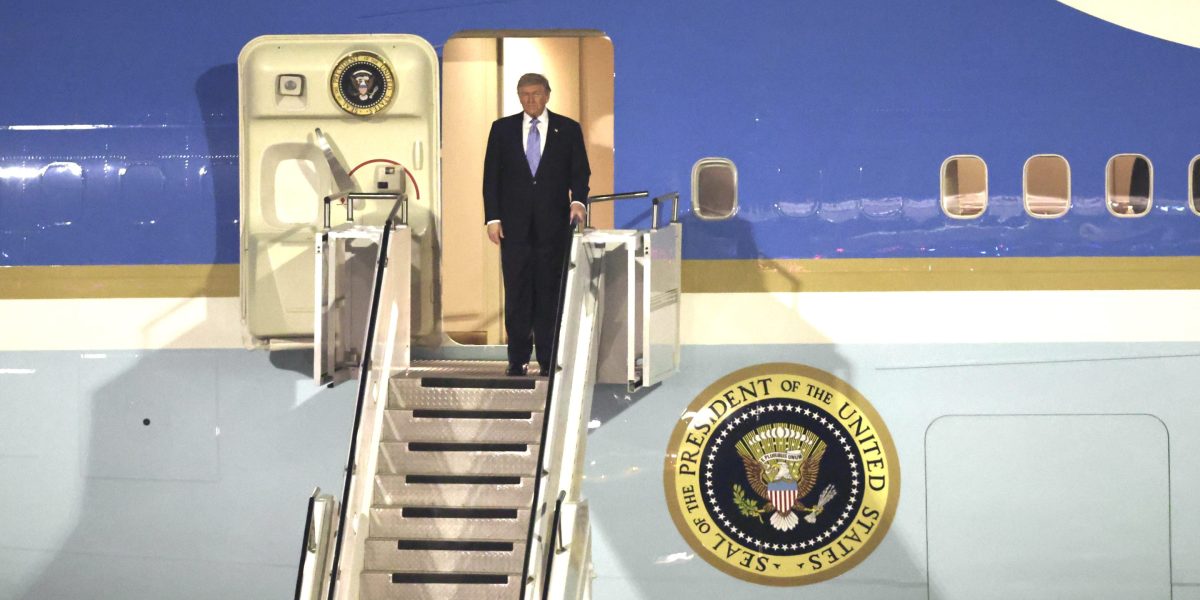
Good morning. While few expect a radical policy shift to result from the U.S.-China state visit, as my Hong Kong-based colleague Lee Williamson noted yesterday, it’s an opportunity to reflect on the stakes for business. President Donald Trump’s ongoing tariff war cut U.S.-China trade in goods by 29% last year to $415 billion without dentingChina’s record trade surplus. Even Canada has now opened its doors to Chinese products like BYD, which surpassed Tesla as the world’s top EV seller last year. But China, like the U.S., is an innovation leader that’s also facing significant challenges at home, such as high youth unemployment, rising energy prices, and falling fertility rates.
A tale of two debtors: Yes, the U.S. Treasury is paying $3 billion in interest a day to service almost $39 trillion in debt, but China’s level of indebtedness is “in a league of its own,” according to Mark Williams, chief Asia economist at Capital Economics, with a debt-to-GDP ratio topping 300%. Unlike the U.S., China owes most of that money to its own banks and citizens. The risk is not borrowing costs but bad loans to zombie firms. That stifles competition at home and, with China’s dependence on global consumption, raises concerns about dumping and deflation abroad. While Xi Jinping need not worry about voters, the Chinese leader’s legitimacy rests in part on stoking growth, prosperity and social stability.
Keep an eye on Boeing: Shawn Tully reports that America’s struggling aerospace manufacturer is likely to be a big winner on the deal front, with rumors of a sale of 500 aircraft to China’s major carriers. Boeing CEO Kelly Ortberg is one of the 17 high-profile CEOs accompanying Trump on this trip. It would be a big feat for Boeing to regain its foothold in China, and revive faith in the 737 MAX, which China was first to ground seven years ago after a series of fatal crashes.
Innovation is borderless: China can’t compete on new AI models like Anthropic’s Mythos and GPT-5.5-Cyber from ChatGPT, but it’s racing to catch up. I spoke about the impact of the latest advances yesterday with Fabricio Bloisi, CEO of Dutch e-commerce and investment giant Prosus, which owns 23% of Tencent. “Everyone is now doubling or tripling their expectations,” he told me. “In China, they talk 10 times more than here.” And China’s cheap open-source language models, such as Qwen and DeepSeek, now account for nearly 30% of global AI usage. If everyone has the same tools, winning may be determined by factors like distribution, data, differentiation, and the ability to dream big. Nobody has a monopoly on that.
Contact CEO Daily via Diane Brady at diane.brady@fortune.com
Top leadership news
How Publicis chairman Maurice Lévy scaled VivaTech
Publicis chairman Maurice Lévy launched VivaTech in 2016 with no budget and no plan, and the conference has grown from 45,000 attendees that first year to 180,000 expected in Paris this June. Lévy says he also turned down a request from former President Barack Obama to replicate the event in the U.S.
Do we have enough jet fuel?
Greg Raiff, CEO of private jet company Elevate Jet, told Fortune the jet fuel shortage is manufactured by industry players looking to cut unprofitable flights. “We are not going to run out of jet fuel,” he said.
The real AI bottleneck
Goldman Sachs Alternatives warns that power generation and grid infrastructure, not chips, are the true bottlenecks determining whether AI can scale. The concern is set to intensify as agentic AI systems arrive that are 60 to 130 times more energy-intensive than today’s AI tools.
The markets
S&P 500 futures are up 0.11% this morning. The last session closed up 0.58%. The STOXX Europe 600 was up 0.48% in early trading. The U.K.’s FTSE 100 was up 0.25% in early trading. Japan’s Nikkei 225 was down 0.98%. South Korea’s KOSPI was up 1.75%. China’s CSI 300 was down 1.68%. Hong Kong’s Hang Seng was flat. India’s NIFTY 50 is up 1.16%. Bitcoin was down at $80K.
Around the watercooler
The crypto industry’s Clarity Act hits a critical juncture: Where things stand going into Senate markup by Jack Kubinec
America’s data centers are thirsty. Rural towns are paying the price—from tanked water pressure to stolen desert groundwater by Catherina Gioino
Lloyd Blankfein just put his finger on why even Goldman Sachs is wary of AI agents by Nick Lichtenberg
‘Maybe me too’: Elon Musk accepts some of the blame for Claude learning to blackmail users from ‘evil’ online AI stories by Sasha Rogelberg
CEO Daily is curated and edited by Joseph Abrams, Jason Ma, Claire Zillman, and Lee Clifford.
Credit: Source link