The next frontier in the AI arms race may be a couple miles beneath the Pacific Ocean.
Minerals like copper and cobalt are in high demand thanks to the $700 billion AI infrastructure buildout. Microsoft’s 80-megawatt Chicago site, for example, required 2,100 tons of copper alone. Nickel, cobalt, and lithium are needed for the batteries that power data centers. Rare earths are critical to powering the magnets in server fans and hard drives that keep AI systems up and running.
The problem is that most of these minerals are mined or processed by the U.S.’s main geopolitical competitor: China. The country is the leading refiner for 19 out of 20 of the most important strategic minerals, with an average market share of 70%, according to the International Energy Agency.
Without a new source of minerals, the U.S. faces a precarious dependence on China for the raw materials underpinning its technological and economic future. If left unaddressed, that vulnerability could hand Beijing enormous leverage over American industry for decades to come.
The Trump administration has taken notice of this resource dilemma. In 2025, President Donald Trump signed an executive order directing the Department of Commerce and other agencies to pursue the exploration and exploitation of deep-sea resources.
Several U.S. companies are now planning on extracting polymetallic nodules (PMNs), mineral-rich rock formations that sit unattached on the abyssal plain of the ocean floor.
Of those is American Ocean Minerals, a firm in the process of closing a $1 billion merger with Odyssey Marine Exploration, and which tapped former Rio Tinto CEO Tom Albanese to take the reins.
American Ocean Minerals holds investment interests in two companies, Ocean Minerals and CIC Ocean Research, which have earned licenses to conduct research in an exclusive economic zone around the Cook Islands in the South Pacific.
“This could be hundreds of years of endowment,” Albanese told Fortune of the scale of one of PMNs in one of the Cook Island zones.
The big bet on potato-sized mineral balls
PMNs are potato-sized balls that form over millions of years as layers of metal oxides slowly accumulate around an existing object on the ocean floor, such as a shark tooth or shell fragment.
Composed primarily of manganese and iron, they also contain economically valuable metals including nickel, cobalt, copper, and rare earth elements.
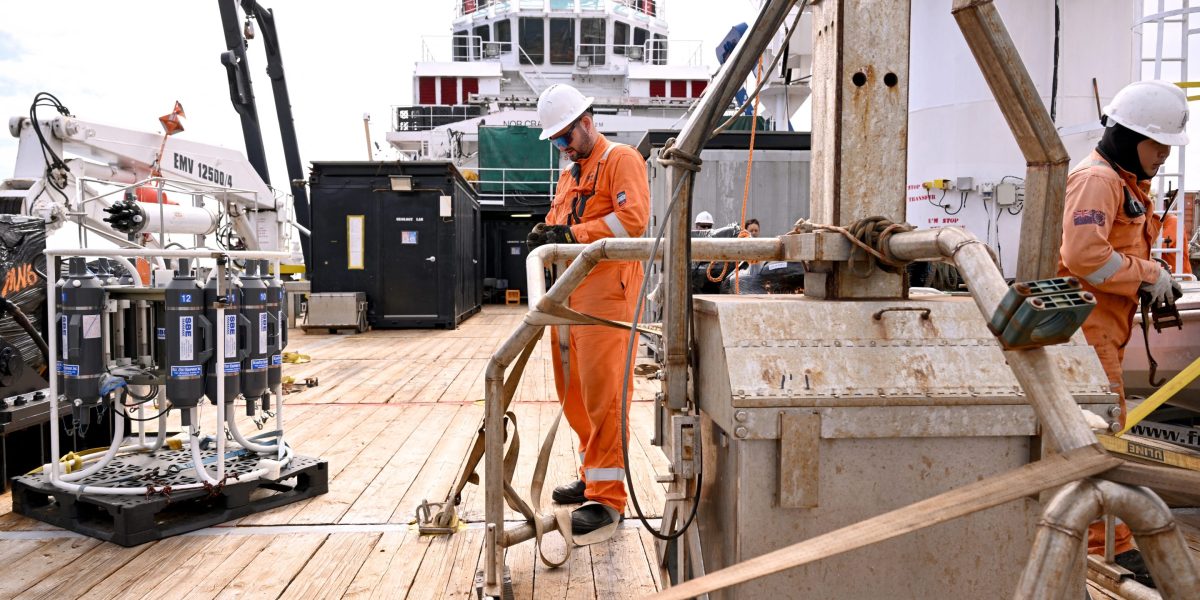
WILLIAM WEST/AFP via Getty Images
The Cook Islands EEZ is over 770,000 square miles wide, nearly five times the size of California.
“And you can imagine that’s sprinkled with nodules,” Albanese said.
The Cook Islands Seabed Mineral Authority, which ensures responsible management of the country’s seabed minerals, said the region holds 6.7 billion metric tons of PMNs. That includes an estimated 20 million metric tons of cobalt, about 100 times the annual amount coming from the Democratic Republic of Congo—the world’s top producer, where China controls the majority of output.
Environmental, governance, and scientific considerations
While American Ocean Minerals has investments in two companies both holding exploration licenses in the Cook Islands EEZ, the horizon for actually mining commercially is a bit further in the distance. In fact, there is currently no deep-sea mining activity happening anywhere in the world. These minerals, rather, are harvested from land sources.
The International Seabed Authority, which regulates mineral-resource-related activities in the ocean, hasn’t yet approved any company to extract them commercially, with a meeting in March ending in a stalemate.
And a growing coalition of 40 countries is now backing a moratorium on deep-sea mining, raising environmental, governance, and scientific concerns. Others have called for an outright ban, including some island nations in the South Pacific.
The ocean floor is quite biodiverse. The Ocean Exploration Trust, a nonprofit ocean discovery organization, led an expedition of the seabed around the Cook Islands last year and found “so many creatures we know absolutely nothing about.” It’s likely deep-sea mining would disrupt life under the sea.
A separate report from the American Museum of Natural History estimated that the impact of a deep-sea mining machine would decrease the abundance of animals by 37% in the Clarion-Clipperton Zone, a Pacific region also said to be rich with PMNs.
Still, proponents argue deep-sea mining may be less damaging than land mining, which contributes to massive habitat destruction, biodiversity loss, and toxic contamination of water sources. In addition, many operations, like those in the DRC, rely on forced labor.
Mineral demand is only expected to increase. The International Energy Agency estimated that demand for nickel, cobalt, and rare earth elements could more than double by 2040. For Albanese, the lack of mineral source diversification will remain a key geopolitical tension if new, independent sources aren’t explored.
“I see the merits of continued engagement with China,” he said, “but also see the risks of being overly dependent on the Chinese industry for any part of critical supply chains.”
Credit: Source link