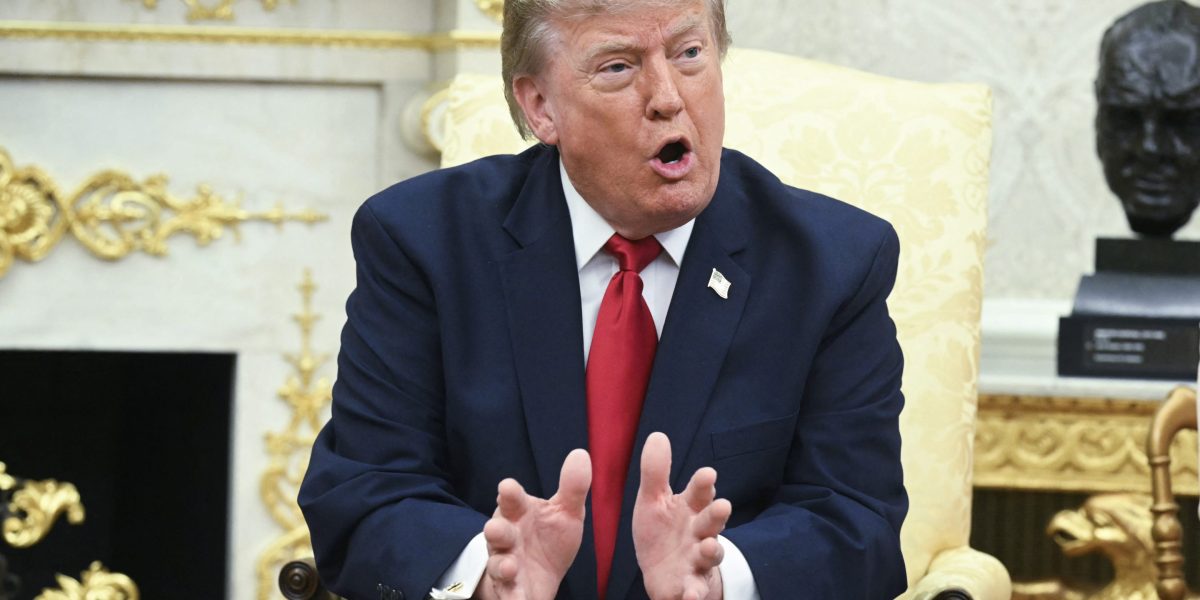
Donald Trump’s second term in the White House threatens to trigger global spats over tax, with experts voicing concerns over Republican vows to penalise countries applying extra levies to US multinationals.
The head of tax at one large multinational told the Financial Times that 2025 “could be the year that everything goes to hell in a handbasket and businesses get caught in the middle”.
Alan McLean, chair of the Business at OECD tax committee, which represents business interests in discussions among the Paris-based group of rich economies, said the imposition of tariffs in response to global tax measures “could hamper economic growth by raising operational costs for businesses and increasing prices for consumers”.
The disputes are focusing on Republicans’ unhappiness about a critical element of a global tax pact agreed at the OECD that from this year will allow other countries to levy top-up taxes on US multinationals.
Trump, a self-described “tariff man”, has often threatened to resort to using the levies to ensure that the interests of US businesses and households are protected. Since winning the US election, the president-elect has threatened to rip up a free trade agreement with Canada and Mexico and impose 25 per cent tariffs on imports from its neighbours.
Tax experts believe the EU is in the crosshairs of Republicans, who have branded a key part of the OECD deal, known as the undertaxed profits rule and often referred to as the UTPR, as “discriminatory”.
The rule allows countries to increase taxes on a local subsidiary of a multinational group if the multinational pays less than 15 per cent of corporate tax in any other jurisdiction. The rule would mean other countries would be able to levy top-up taxes on US companies.
“There is a broad feeling among Republicans that US companies shouldn’t be paying the UTPR,” said Aruna Kalyanam, EY’s global tax policy leader.
The EU enacted the measure under a directive in 2022, but some experts believe the bloc could compromise with Trump on its enforcement in return for favourable treatment of its exports.
The EU has a trade surplus with the US of €158bn, according to figures from the European Commission.
“Europe has a strong legal culture and law is law, but I can imagine a future arrangement between Trump and the EU where the EU will give up the UTPR for the sake of not getting engaged in an economic war,” said Valentin Bendlinger, a senior consultant at ICON Wirtschaftstreuhand, a tax consultancy company in Austria.
However, others say that a change is unlikely as it would require agreement from all 27 member states.
“[The UTPR is] widely implemented, a powerful bargaining chip, and can’t be easily rolled back,” said Rasmus Corlin Christensen, an international tax researcher at Copenhagen Business School.
Since 2021, more than 140 countries have been working at the OECD on implementing the landmark tax agreement.
The deal, which countries agreed in principle, consists of two “pillars”. The first seeks to force the world’s biggest multinationals to declare profits and pay more in the countries where they do business. The second introduces a 15 per cent global minimum effective corporate tax rate, designed to limit multinationals shifting domiciles to pay less tax on their profits.
Influential Republican congressman Jason Smith in 2023 described the global OECD deal as “Biden’s global tax surrender”.
Smith drafted a bill to increase the tax rate on profits of companies headquartered in jurisdictions with “extraterritorial and discriminatory taxes”, against US multinationals, including the UTPR. The bill was not enacted but that could be revived under Trump’s presidency.
It would not be a “heavy lift” for a Republican administration, which controls all branches of government, to enact it, Kalyanam said.
Smith’s opposition to the OECD deal is shared by Republican senators. One senior congressional aide echoed Smith’s language and said the UTPR rule was broadly seen by Republican lawmakers as “discriminatory” and “extraterritorial”.
“Generally, Senate Republicans feel the tax deal undermines US interests,” the aide said.
The question of whether a tax war ensues could depend on if and how other countries seek to enforce the UTPR rule.
So far, the UTPR has been legislated in jurisdictions including Australia, Canada, Japan, New Zealand, Norway, South Korea, Turkey and the UK, alongside the EU.
However, some countries at the OECD that are mindful of US concerns have introduced a “temporary safe harbour”. This delays the date the UTPR applies until 2026 for countries with a statutory corporate tax rate above 20 per cent. The US has a rate of 21 per cent — though Trump has proposed cutting it to just 15 per cent for domestic manufacturers.
Not all jurisdictions that have enacted the UTPR have introduced the safe harbour clause.
“That’s causing a lot of hand-wringing for companies,” said Danielle Rolfes, head of KPMG’s Washington national tax practice.
Others are optimistic that a compromise could be found among countries that would also avert a tax war.
“There will be some kind of deal. That’s what Trump likes to do. It’s going to be painful along the way though,” the multinational tax head said.
One way that countries might decide to avoid the potential problem of US multinationals being subject to the UTPR is to further delay the date the enforcement rule kicks in past 2026.
Grant Wardell-Johnson, global tax policy leader at KPMG International, said: “I suspect they will kick it down the road and the UTPR safe harbour will be extended. Many countries wouldn’t want a political fight with the US in relation to that.”
Credit: Source link