Stay informed with free updates
Simply sign up to the US inflation myFT Digest — delivered directly to your inbox.
US inflation rose to 2.7 per cent in the year to March, another sign that price pressures remain stubbornly high, complicating the Federal Reserve’s plan to cut interest rates this year.
Friday’s data on personal consumption expenditures, the Fed’s preferred gauge for measuring inflation, surpassed economists’ expectations of a slight increase to 2.6 per cent from 2.5 per cent in February.
The unexpected rise is likely to increase traders’ doubts about that the Fed will lower interest rates this summer, with US mortgage and other borrowing costs expected to remain high in the run-up to November’s presidential election.
“Inflation is hot, it’s getting sticky and more broad based,” said Diane Swonk, chief economist at KPMG US. “Those are three things the Fed doesn’t want.”
The figures come a day after data showed the US economy grew far more slowly in the first quarter than expected, while inflation for the quarter remained above the Fed’s 2 per cent target, prompting a sell-off in equity markets and a jump in Treasury bond yields as traders pared back rate-cut bets.
Markets reversed some of those moves on Friday, with the S&P 500 index closing up 1 per cent, while the technology-heavy Nasdaq Composite rose 2 per cent, helped by powerful gains for Google parent Alphabet.
Moves were more muted in government bond markets, with the policy-sensitive two-year yield broadly flat at 5 per cent and the benchmark 10-year yield 0.04 percentage points lower at 4.67 per cent. Yields fall as prices rise.
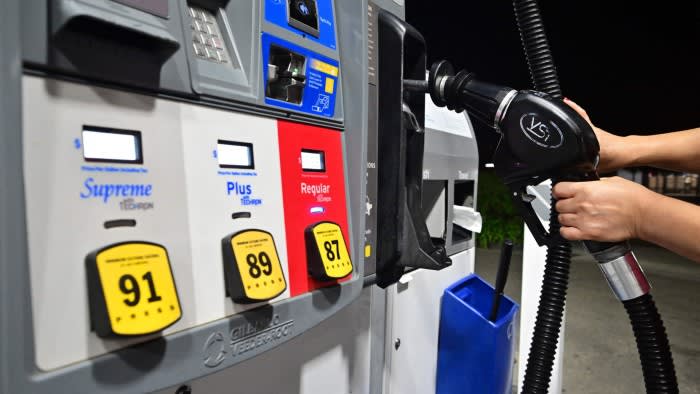
The rise in inflation in March was largely due to a jump in petrol costs, as tensions in the Middle East pushed up oil prices. Further energy cost inflation would bring a risk of “cyclical stagnation” to an otherwise strong US economy, said Freya Beamish, an economist at TS Lombard.
“If oil is pushed to $100 [per barrel], for predominantly supply-side reasons, this could coincide with a wobble in US labour markets, which is already in the pipeline,” Beamish wrote in a note. Brent oil futures were trading at about $89.50 a barrel on Friday and are around 18 per cent higher this year.
Core PCE, which excludes volatile food and fuel prices, remained at 2.8 per cent in March, compared with an anticipated fall to 2.7 per cent.
The latest economic readings are a blow to US President Joe Biden, whose re-election campaign has stressed the steady decline of inflation, which hit a multi-decade high in 2022, alongside the continued strength of the American economy and job market.
Lael Brainard, the director of the White House’s National Economic Council, reacted to the data by saying that “while inflation has fallen more than 60 per cent from its peak, today’s report reinforces the importance of our ongoing work to bring costs down”.
She said the Biden administration had taken measures to lower prescription drugs costs, stop big companies from imposing excessive fees on customers, and expand housing supply.
But Biden himself recently said he expected the Fed to begin cutting rates this summer.
“The last three months of US inflation have really jumped up and smacked the Fed in the face,” said Ajay Rajadhyaksha, global chair of research at Barclays.
Futures traders are now only fully pricing in the first quarter-point cut by the Fed’s meeting on November 6-7, just after the presidential election.
US borrowing costs are at a 23-year high, while the PCE index has been above the central bank’s 2 per cent goal since March 2021.
“We’re probably going to have sticky inflation from here,” said Tim Murray, multi-asset strategist at T Rowe Price. He argued that price pressures were being fuelled by factors such as demand for chips, semiconductor materials for artificial intelligence and clean energy.
“The news is not good,” he added. “If you look at things on a year-over-year basis, pretty much every way you look at it, it looks like the trend is sideways to slightly up.”
Additional reporting by James Politi in Washington
Credit: Source link