Christine RoTechnology Reporter
 Christine Ro
Several months ago Andie started playing around with a fitness app. It recommended that she substantially increase her protein intake.
The hard part for her was doing so without also increasing calories.
“So I started trying to find high-protein alternatives to things I was already consuming,” she explains.
This included yogurt, milk, coffee, cereal and pasta.
“I realized that everything tasted pretty much the same to me, and I started then actively seeking these products.”
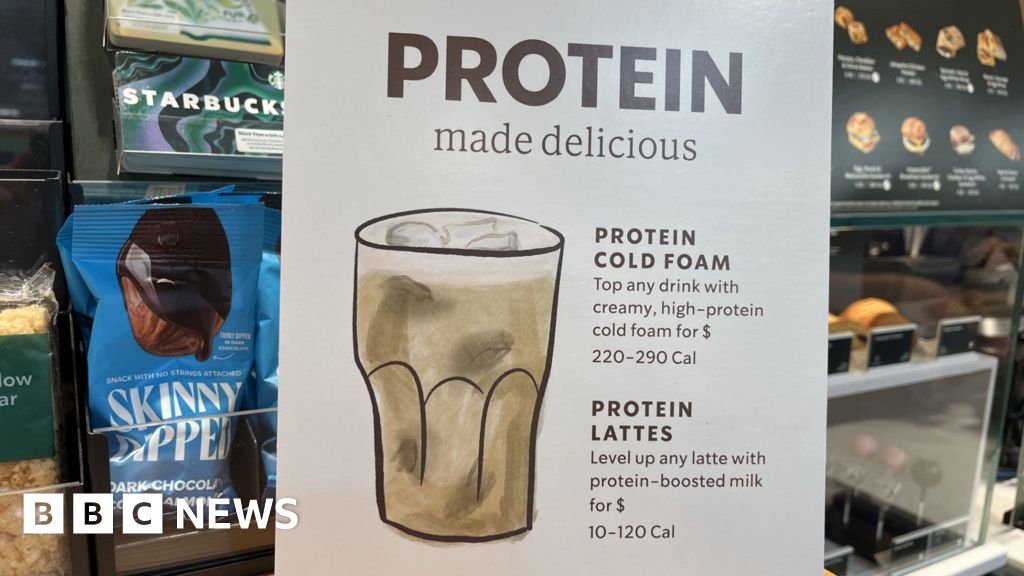
So she was excited when a Canadian restaurant chain introduced high-protein lattes earlier this year. Andie, who did not want to give her surname, drinks them without sweetener, and describes it as a “decent” product.
Is it a more expensive diet?
Living in Vancouver, Andie says prices are already quite high. “High protein is usually a couple of dollars extra, so it’s not a big difference.”
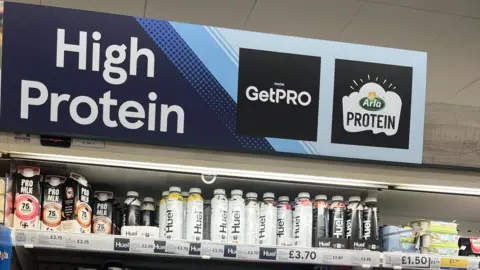
Like Andie, you may have noticed on supermarket shelves and restaurant menus a high-protein craze sweeping the food sector.
Surveys show consumers increasingly care about the protein content of their food.
In the US between March 2024 and March 2025, there was 4.8% volume growth in sales of products labelling themselves as protein-rich, compared to the previous year, according to research group NielsenIQ.
Milk has been one beneficiary of the protein craze.
Last year saw the first increase in milk consumption since 2009, according to data from the US Department of Agriculture.
That’s partly being attributed to the enthusiasm for protein.
The so-called back-to-cow movement includes products like bovine colostrum, the protein-rich milk cows produce soon after giving birth.
The protein trend has been especially driven by the expanded availability of protein from whey, typically a by-product of cheese production. Whey protein is a billion-dollar sector that continues to grow.

 Getty Images
While dairy is doing well, plant-based alternatives to dairy products are going through some lean times.
The sales volume of milk alternatives has started to decline, mainly driven by lower consumption in the Americas. Almond milk especially is losing market share.
Slowing sales are reflected in slowing chatter online. While US searches for “oat milk” outnumbered Google searches for “whole milk” in 2020, in 2025, that has reversed. People are searching more for various types of cow milk now than ever before.
One reason is the perceived naturalness of foods from cows, including collagen and beef tallow.
According to NielsenIQ, milk’s global market value is almost eight times larger than that of milk alternatives ($69.3bn; £50.8bn, compared with $8.4bn; £6.2bn).
Milk’s market value is also growing much faster.
Plant-based manufacturers are responding to the demand for high-protein drinks by mentioning protein more on their packaging, and reformulating their products to include more protein.
 Serena Bolton
Nutritionists are often frustrated by the fervour over protein. They point out again and again that most residents of rich countries already consume more protein than they need.
The exceptions may be for certain groups, including the severely malnourished, the elderly, women going through menopause, and people with chronic inflammatory conditions.
Federica Amati is a research fellow at the School of Public Health at Imperial College London. She is also the head nutritionist for the nutrition company Zoe.
Dr Amati worries that “people are being hoodwinked into thinking ‘high protein’ on a label necessarily means that it is healthy. Honestly, it’s another health halo.”
While excess consumption of protein is not likely to harm most people’s health, “consuming more protein than your body can use during midlife is linked to an increased risk of multiple diseases, including cancer,” Dr Amati warns.
“An important point on this, though, is that plant-based sources of protein don’t seem to increase cancer risk.”
And because most people don’t have unlimited money to spend on food, high-protein products could be an unhelpful distraction.
“The price of fresh whole foods is going up so shoppers are best off buying more whole foods, and the standard already high-whey natural Greek yogurt without the markup,” Dr Amati comments. “And remember, most of us can get plenty of the protein we need if we’re eating enough whole foods.”
If anything should be seen as a hero nutrient, according to many nutritionists, it should be fibre rather than protein.
Dr Amati believes: “The popularity of high-protein products in general is entirely due to marketing. Manufacturers can easily [and cheaply] add extra protein to their products and whack the price up.”
 Verley
Businesses are responding to that demand.
At French start-up Verley a gleaming row of stainless steel tanks, called fermentors, hold special microorganisms being fed on sugars.
Eventually they’ll produce beta-lactoglobulin, a protein found in whey.
The team at Verley, a French startup, will then purify the protein, including extracting the lactose.
The end result is a high-protein powder that is essentially dairy, but which Verley says is suitable for vegans as no cows are involved.
The process is both traditional and cutting-edge, believes Stéphane Mac Millan, Verley’s CEO.
On the one hand, fermentation has a long history in French food culture, including in cheesemaking.
On the other hand, Verley wants to modernise dairy by honing the nutritional benefits while reducing the environmental impacts. Dairy production requires large amounts of water and land, while generating large amounts of greenhouse gases.
“A goal really is to help the dairy industry move into the 21st century,” Mr Mac Millan says.
Mr Mac Millan is betting that nutrition-conscious consumers will care increasingly not only about getting enough whey protein, but about getting specific forms of it.
He says that some US consumers are now seeking out beta-lactoglobulin, which is high in the amino acid leucine, rather than non-specific whey protein.
The increasing number of people using weight-loss injections could also help drive the company’s growth, Mr Mac Millan believes. People concerned about rapidly losing muscle might reach for high-protein products.
He acknowledges that Verley’s protein will be more expensive than whey protein initially. “But considering that we are bringing more to the table and we are sustainable, it’s normal that there is a premium.”
The company is also hoping to bring costs down with greater scale. It is currently seeking regulatory approval in various countries.
Overall, when it comes to nutrition, the general public is more likely to listen to friends, families and influencers than to experts like him, acknowledges Jack Bobo, executive director of the Rothman Family Institute for Food Studies at the University of California, Los Angeles (UCLA).
This is partly related to the aspirational nature of much fitness content on social media, particularly targeting young men. Most viewers and listeners are not elite athletes, but many are seeking to eat and drink as if they were.
One difficulty is that consumers are somewhat fickle. Soymilk is among the cheapest and highest-protein alternative milks, yet it has lost ground to the newcomers even as the protein craze has intensified.
And social media moves faster than the people making or regulating food.
For the time being, it seems to be smart business to focus on protein – whether it’s truly beneficial or not.
Credit: Source link






-1.png "CRM data migration: A practical process overview")