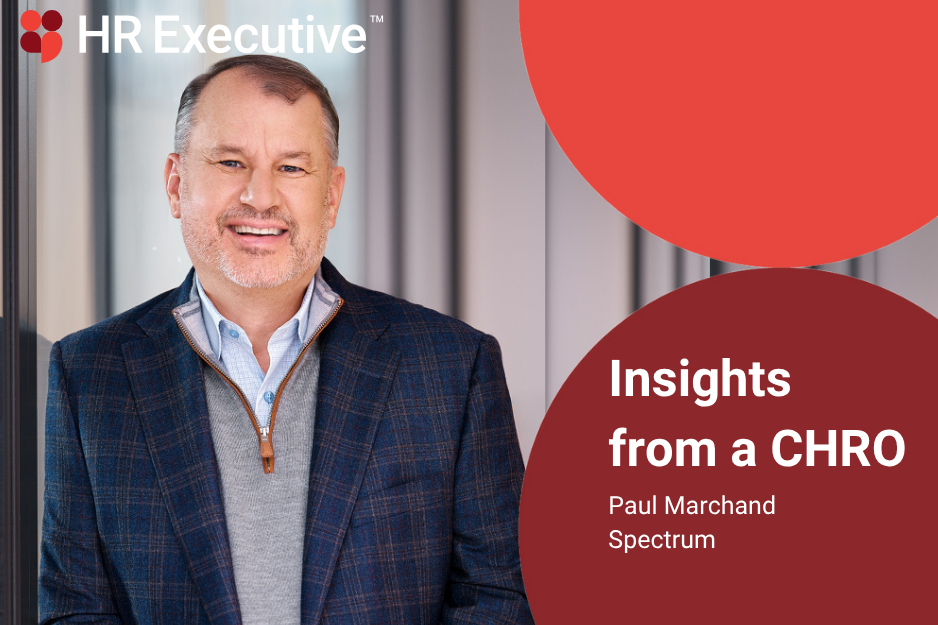
With 95,000 employees across 40 states, cable provider Spectrum already has a talent challenge on its hands. Factor in that many workers are frontline employees who are struggling with economic uncertainty and that AI is rapidly redefining how work can and should get done—and Spectrum’s people function knew some of its strategies needed a refresh for the modern landscape.
Take, for instance, its tuition benefit, says Paul Marchand, executive vice president and CHRO at Spectrum, the country’s largest provider of rural internet services, operating under Charter Communications. Marchand and his team recognized that lagging participation was connected to the steep upfront costs in the program’s reimbursement design. They revamped to a new offering that is zero-cost to the employee—and found unprecedented demand with a significant impact on advancement and retention of enrolled employees.
At the same time, Spectrum is doubling down on on-the-job learning, including by leveraging AI in the design and delivery of its L&D offerings. Such work is part of an effort to reimagine the long-held HR priority of “attract, retain and develop” in an environment of fast change, evolving expectations and new opportunities for innovation.
Marchand—who has been with Spectrum for a decade after a dozen years at PepsiCo and HR leadership positions at Merrill Lynch and J.P. Morgan—spoke with HR Executive about how leaders can reimagine HR standards for a changing world.
Marchand: It wasn’t necessarily a heavy lift. We already had a more macro program called Investing in You. That moniker has been used around a lot of efforts in pay, benefits and development for our frontline workers in the effort to decrease turnover, increase retention and attractiveness, and create a longer, more skilled workforce. [Leadership agreed] that the business side of this [tuition program] leads to a longer-tenured customer.
What was a heavy lift was that we were oversubscribed in interest in the program out of the gate. I think that shocked people. After about two quarters of this hitting our budget, I got the question from finance: “Do you know you’re running at ‘blank-blank’ over budget for this program?” And I was like, “Yep, I do.”
I had to go in and explain and defend it, if you will, but all in a positive way. No one is regretting us launching it and having it as a way to recruit and retain. It’s been a success greater than we ever thought it was going to be.
HR Executive: As you work to attract and retain talent through efforts like benefits additions, what role do managers play?
Marchand: You’ve asked the $1,000,000 question. HR people have to be there to help support and assist, but I regularly communicate and reinforce that managers are a critical part of this relationship. They need to give employees that coaching on a day-to-day basis. They’ve got to sit with them and have career development planning conversations. They’ve got to think about succession of talent. They’ve obviously got to attract new talent.
We’re pretty passionate about managers having a critical role in this conversation. That was actually one of the concerns about the design of the [tuition] program, because in the design of the program, it actually takes away a bit of the manager’s authority of saying yes or no that you can get a reimbursement of a class. We had to help managers understand that we’re taking away the administrative friction. That doesn’t remove you from the career development portion of the conversation. That’s actually the more important part of what you should be focusing on.
We have existing career progression within customer service reps; you can go from a Rep. 1 to Rep. 2 to Rep. 3, and Supervisor 1, 2, 3 to director. We want managers to reinforce all those career development pathways but also talk about this [tuition] benefit as a means for that person to grow, not just within the function of customer service, but into other functions or just have personal growth.
We want managers very involved in this whole journey.
See also: 5 global TA tips from a remote-first chief people officer
HR Executive: How is AI playing a role in your learning and development strategy?
Marchand: We’re just starting to get into AI. It’s coming from a couple of different places. It’s coming from the vendor community, all the partners we have, who are all bringing to us the AI enablement of their products. And then we’re thinking about ways in which we can utilize AI—running the gamut from improving core processing and making things more efficient to how AI can replace the mundane activities so people can work faster and smarter and more strategic.
In new hire training, we’re doing a lot of digitization of activities, and AI technologies are playing a role in that. It doesn’t sound earth-shattering, but getting to an entirely paperless process for certain things is transformative. It creates a much more frictionless experience for the end user. Everything that in a traditional world has been workbooks or textbooks is now in an online digital guide that’s interactive and that, on the back end, our team can easily update and modernize with the flip of a switch.
We have 600 retail stores around the country, and there are specific things from an instructional perspective that we want them to do, so those instructional designers can use AI to support the creation and customization of content. And [we’re using AI] for looking at the data: Who took a class? How have they progressed? Did they get promoted? Did they advance? Did they go from a 3 to a 4 in terms of their performance rating? That scorecarding takes forever for our workers, so that data collection and analysis can be a great space to use AI. AI is absolutely a piece of the [talent development] puzzle. Right now, we’re crawling, but eventually, we’ll walk and then run.
HR Executive: How different a mindset do today’s HR leaders need to have to contend with reports of job hopping, particularly among younger talent?
Marchand: I think HR leaders, and leadership in general, really need to think about this important dynamic of attract, retain and develop. They are basic, but they are so critical. We have to figure out what’s table stakes. A lot of times, job hopping is for a very specific reason—direct issues we could address.
I’ll give you an example: We have to stay on top of pay and compression and issues associated with hourly rates—as we operate across 40 states and in urban communities to rural communities. We have to be hyper-focused and hyper-clear on: What does compensation on an hourly rate look like for a store associate, for a customer service rep, for a technician who goes into a home who’s highly skilled relative to the market in which those people live? We want to be competitive and stay ahead of the curve.
It’s very important for HR leadership to constantly think about retention as a critical goal, such as through programs that tie to retention. We just launched an Employee Stock Purchase Plan that has a retention element to it: The longer you’re with us, the bigger or better that stock purchase plan will be for you.
I do hear a mixed narrative on job hopping: There are those with professional degrees versus hourlies who may be more scared about the economy and are looking for some stability. We do hear some conflicting narratives. But for some, just 20 cents more an hour or a lack of development could be a reason to change.
HR Executive: What was the communication strategy like as you got the Employee Stock Purchase Plan off the ground?
Marchand: It was pretty comprehensive. We did a combination of a CEO message to the whole company, including participants in our existing executive compensation plan, to let them know what we were doing. We did a landing page on our internal website to inform people. We certainly want our leadership to be aware of programs and policies that we roll out.
These are personal decisions you’re making. We can’t influence that decision, so there are actually some interesting communication elements that were very much regulatory or legally constricting because we didn’t want to be in a place of pushing a benefit. We want to be in a very interesting place of informing and helping them enroll, but not necessarily recommending they should or must do this.
We did mailers to homes. We still use snail mail for benefits, for an annual compensation statement we send to homes. We want kids or partners or family members to see that on the dining room table or on the credenza, and be talking about it at the dinner table or over a cup of coffee in the morning.
HR Executive: How do you continue to invest in your own learning and growth potential?
Marchand: I am a big believer that one should continue learning throughout their entire career, and I do my best to do that today—to have a network to turn to, to ask a very tactical question or to get into a lengthy debate over drinks on a philosophical topic like pay-for-performance or long-term incentives.
I’m a big believer in development through the experiential process of peer-to-peer coaching and peer-to-peer relationships. And I’m a proponent of the CHRO being part of a community of other CHROs if you don’t have your own network already.
The starting point for me is my own network of people that I work with. The second level is to join a community that’s out there: the Global 50, World at Work, the HR Policy Association. It’s not about which one; it’s just a great space to get that peer-to-peer networking.
And lastly, it’s about staying up on the trends and what’s happening. Plugging into the communities that are out there, bringing content to us, and understanding the trends, the policies, and the best practices.
Even though HR is across many industries and it’s global, it’s pretty tight-knit in the sense that we are all here to help businesses grow and employees do well.
Credit: Source link