The Supreme Court’s nixing of President Donald Trump’s “reciprocal” tariffs is throwing fresh confusion over the raft of trade deals negotiated by global partners as the inescapable reality of ongoing levies remains a threat.
Processing Content
The European Union is poised Monday to
The Trump administration
The dollar and U.S. stock futures slid in Asia on Monday as the renewed uncertainty damped sentiment. But moves were modest when compared with the dramatic swings seen last April when Trump’s unilateral tariffs were first announced, setting off months of deal making.
Now, whether a new status quo settles quickly will largely depend on what America’s trading partners do after administration officials called on them to honor prior trade pledges.
Any walk-back from prior agreements, especially given recent European pushback over Trump’s bid to gain control over
“Uncertainty is back, and given the latest muscle-flexing by European leaders, the risk of escalation is now higher than it was a year ago,” Carsten Brzeski and James Knightley at ING Groep NV wrote in a note. “Announcements since the Supreme Court’s ruling strongly confirm that Trump has no intention of removing his ‘most beautiful word’ from the English dictionary.”
“I, as President of the United States of America, will be, effective immediately, raising the 10% Worldwide Tariff on Countries, many of which have been ‘ripping’ the U.S. off for decades, without retribution (until I came along!), to the fully allowed, and legally tested, 15% level,” Trump said in a social-media
Senior U.S. officials said the tariff defeat at the Supreme Court
“The Supreme Court decision may appear to be a major blow to the administration’s tariff policies, but its trade agenda can be pursued through other avenues,” said Mike Reid at RBC Capital Markets.
That means little relief for U.S. companies and consumers paying the levies. Economists at Goldman Sachs Group Inc. including David Mericle estimate that the combination of the Supreme Court ruling and the newly announced Sec. 122 tariff will reduce the increase in the effective tariff rate since the start of 2025 from just over 10 percentage points to 9 percentage points.
‘Uncertainty’
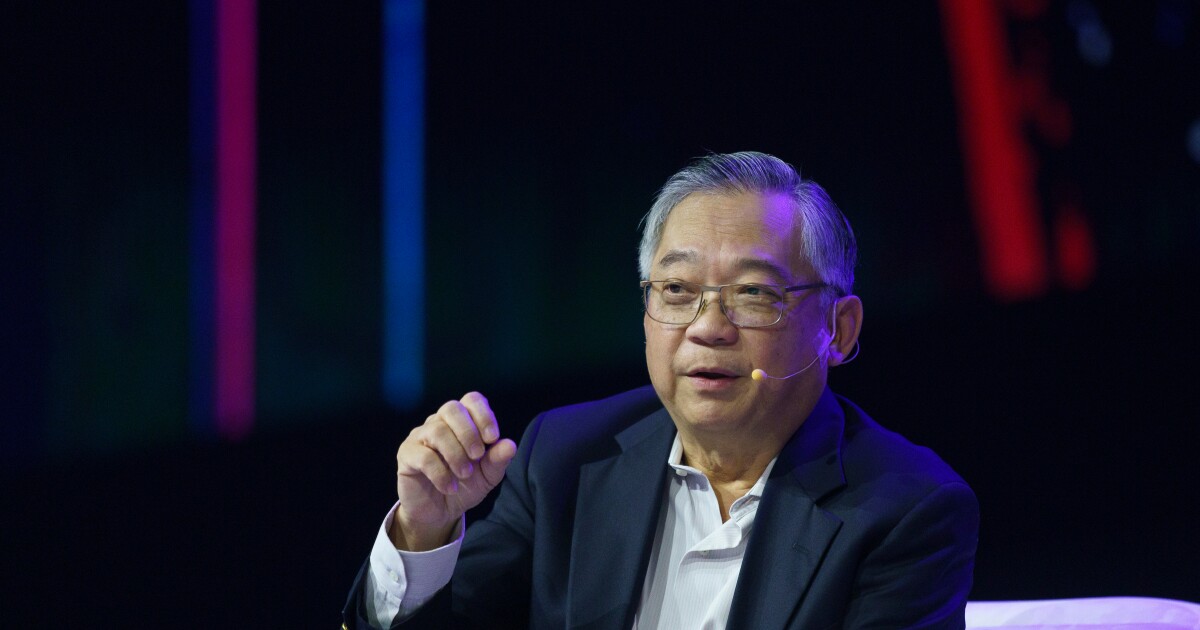
The court decision and new 15% tariffs are “a stark reminder to all of us that we are now facing a very unpredictable and uncertain operating environment,” Singapore’s Deputy Prime Minister Gan Kim Yong said at a briefing Sunday. “The key word really is uncertainty.”
Singapore’s government will seek clarity from U.S. counterparts as to whether the new 15% global tariff will apply to the island nation, Gan said. Singapore had been subject to a 10% baseline tariff, the lowest rate under the earlier framework.
Other economies now facing higher levies than they had negotiated include the U.K. and Australia.
“We have consistently advocated against these unjustified tariffs,” Australian Trade Minister Don Farrell said in a statement Sunday. “We are working closely with our Embassy in Washington to assess the implications and examine all options.”
Indeed, officials across much of Asia were in wait-and-watch mode.
“We are ready to face all possibilities,” President Prabowo Subianto said, according to a statement Saturday from Indonesia’s Presidential Secretariat. Indonesia only finalized its
South Korea is also reviewing developments and will proceed in a direction that best serves the national interest, the Blue House said in response to Bloomberg queries. A heavyweight of Japan’s ruling Liberal Democratic Party called U.S. tariffs “a
Officials in Taiwan are assessing the situation, with a statement posted on Vice Premier Cheng Li-chiun’s
Lower levies
For Asia, Morgan Stanley economists say the weighted average tariff rate will fall to 17% from 20%, with average levies on goods from China declining to 24% from 32%. Relief may be temporary as the Trump administration seeks to impose sectoral and economy-specific duties to rebuild its tariff regime.
Still, “the peak level of uncertainty on tariffs and trade tensions has passed,” Morgan Stanley economists led by Chetan Ahya said.
While the Supreme Court setback is a win for Chinese President Xi Jinping, who’s set to host Trump in Beijing from March 31, officials there have been cautious in their reaction. “China will closely monitor these developments and firmly safeguard its own interests,” a Ministry of Commerce spokesperson said Monday.
Investigations under Section 301 and Section 232 have previously been used to place duties on Chinese exports, automobiles and metals. These alternative legal authorities could allow the White House to enact more import taxes despite the ruling against the use of the International Emergency Economic Powers Act to justify the global levies.
“As the U.S. shifts from IEEPA, the original tariff discussion for Trump to this new powerful 301, I think we will look back on IEEPA with a certain amount of fondness.” Deborah Elms, head of trade policy at the Hinrich Foundation, said on Bloomberg television.
Still, for China, which also saw a 10% fentanyl tariff scrapped by the court, exports now face less punitive rates.
Another unintended consequence of the Supreme Court’s ruling may be a surprise pickup in tariff receipts, said Brzeski and Knightley at ING.
“While the new universal tariff rate of 15% should theoretically mean a slightly lower average tariff rate, it may be that a simplified tariff structure leads to a higher realized rate,” they wrote. “Reduced complexity leaves less room for ambiguity and fraud and lowers incentives to reroute trade through third countries.”
So while the Supreme Court’s IEEPA ruling has created a new layer of uncertainty over how tariffs will be applied, the certainty of ongoing levies remains perhaps the more important reality for global commerce.
“President Trump really believes that tariffs work and that trade deficits are bad,” said Libby Cantrill, managing director and head of public policy at PIMCO. “Given the tools he has, we should expect tariff and trade policy uncertainty to last as long as Trump is in the White House.”
Credit: Source link