Knowing how to rank in search engines and how to rank in AI search results are two different games now.
As of early 2026, BrightEdge found AI Overviews appear in roughly 48% of tracked Google searches, and prevalence climbs as high as 100% for healthcare and treatment queries. ChatGPT handles over a billion queries per week, while Perplexity, Claude, and Gemini are routing millions of searches every day without a single click.
But here’s the silver lining: You can be invisible in blue-link results and still win AI visibility if you know how to optimize for it.
I’ve spent a lot of time inside the data, working with content marketers who are trying to figure out exactly this. What follows is everything that actually works, backed by research — no fluff, no guessing.
Table of Contents
Why Ranking in AI Search Results Matters
AI-referred visitors aren’t just traffic — they’re pre-qualified buyers. Ahrefs analyzed their own traffic data and found that AI search visitors accounted for just 0.5% of total visitors, but drove 12.1% of all signups. That’s 23x the conversion rate of visitors from traditional organic search.
Semrush confirmed the pattern, finding that AI search visitors on average convert at 4.4x the rate of standard organic visitors.
These visitors are inherently more qualified than visitors forced to click onto your website. In most instances, they’ve already received the answer they needed from AI and actually chosen to click through for more. That self-selection shows high intent and interest.
The volume of AI search traffic is still small compared to Google, but it’s growing fast. The teams investing in AEO (or GEO) now are building citation authority while competition is still low. If SEO trends continue, that tide won’t stay low for long.
How to Optimize Content for AI Search Prompts
1. Make sure your website is accessible to AI crawlers.
Cloudflare reported that AI crawlers now account for 4.2% of all HTML requests across their network. OpenAI’s GPTBot alone grew 305% from May 2024 to May 2025. However, if your robots.txt or server configuration blocks AI crawlers, even the greatest content will go unnoticed by AI knowledge bases.
Seasoned digital marketers know that before search engines can even rank you, they need to be able to crawl your pages, and it’s the same for AI search results. Every major AI platform has its own crawler.
Here are the most important ones to know about:
Platform | Crawler / User-Agent | Purpose |
ChatGPT Search | OAI-SearchBot | Real-time retrieval (not training) |
OpenAI | GPTBot | Model training |
Perplexity | PerplexityBot | Real-time retrieval |
Anthropic / Claude | ClaudeBot | Training and retrieval |
Google AI Overviews | GoogleBot | Indexing and retrieval |
Now, if you have some sort of intellectual property (IP), private, or proprietary content on your website, you don’t want AI using without compensation, having AI crawlers blocked isn’t a bad thing — but make sure you’re not blocking crawlers you want to let in.
Check your robots.txt file.
OAI-SearchBot and PerplexityBot, for example, are retrieval crawlers. They don’t use content for training, but they power real-time AI answers. Block them, and you disappear from ChatGPT and Perplexity search results.
Pro Tip: Even if you’re protective about your content, don’t block all AI crawlers. Research from Rutgers Business School and Wharton found that publishers blocking AI crawlers via robots.txt lost roughly 7% of weekly traffic within six weeks.
AI crawlers aside, there are several other things you can do to make your website technically accessible to AI.
Consider adding an llms.txt file.
An llms.txt file is a document added to your website that serves as a map and resource guide for AI models, search agents, and autonomous web bots. This newer standard, officially supported by Anthropic, helps AI systems understand which content is safe to summarize and cite.
What we like: The llms.txt file is a quick win. It takes under an hour to create and tells AI crawlers clearly which parts of your site you want them to use. Think of it as a welcome mat for AI systems.
Improve your page speed.
AI bots prioritize fast servers (and let’s face it, users want fast sites too). Aim for sub-200ms TTFB (Time to First Byte) to ensure your content is crawled frequently and refreshed quickly. Use HubSpot to check your site speed, then try these ways to improve your page loading speed.
Fix crawl errors.
Broken pages (404s), redirect chains, and invalid sitemaps can also reduce crawl budget. So, keep your robots.txt error-free. Google Search Console is great for catching technical errors that prevent both Google and AI crawlers from reading your content.
Make sure Bing indexes you.
Google is still the top search engine, but ChatGPT Search is built on Bing. If you’re not indexed on Bing, you may not appear in ChatGPT search results. Set up Bing Webmaster Tools and submit your sitemap.
2. Lead with an answer-ready (or answer-first) structure.
AI systems don’t read content the way humans do. They scan for easy-to-extract answers to users’ queries and intents. If your page doesn’t make these answers obvious, the AI skips to a page that does.
Answer-ready content starts with a direct answer. And this is not a suggestion — it’s the single most reliable structural tactic for AI citation. Let’s get more granular.
- Use question-based headers (H2s and H3s). Structure sections around the natural-language questions your audience types into AI search. Think “How do I…” and “What is…”
- Lead with the answer. Don’t bury the answers to queries three paragraphs down. State it clearly in 1-3 sentences using plain language. Aim for 75–150 words.
- Use short sentences. AI systems favor content written for human comprehension. Long, complex sentences get paraphrased badly or skipped entirely.
- Support it with facts. Follow with data, examples, or context that proves the point.
- Write for the query, not the topic. AI search is conversational. Your content needs to match the way real people phrase questions, not how marketers write about topics.
TL;DR: Whatever your heading promises, deliver it immediately. Don’t make the reader wade through context before getting the answer.
Example Header: “How Does Content Marketing Drive Revenue?”
STRUCTURE Type | EXAMPLE |
Before answer-led | “In today’s competitive digital landscape, brands are increasingly looking for ways to connect with their audiences in more meaningful ways. Content marketing has emerged as one of the most discussed approaches …” |
After answer-led | “Content marketing drives revenue by attracting high-intent visitors through search and converting them with useful content before they ever talk to sales. Companies that blog consistently generate 67% more leads per month than those that don’t.” |
Pro tip: Use HubSpot Content Hub’s AI writing tools to restructure existing blog posts into an answer-first format. Paste your section into the AI editor with the prompt: “Rewrite this to lead with a direct 2-sentence answer to [question].” It takes minutes per section.
Depending on the nature of your page or section, you may also want to use schema markup in your page structure or, more specifically, FAQ schema. More on that in our next section.
3. Use structured data on your pages.
Structured data or schema markup is one of the most effective ways to translate and communicate your content value for AI. Schema outlines the meaning of your content explicitly. Without it, AI systems have to guess based solely on what’s visibly on the page, and let’s face it, clarity isn’t every brand’s strong suit.
But that doesn’t make schema a magic wand for AI search either.
Three important things to remember:
- Schema is only confirmed to increase your potential for Google AI Overviews. Its impact on ChatGPT, Perplexity, and Gemini is still unclear.
- Schema markup doesn’t directly affect rankings. Google’s own Search Central documentation states explicitly that structured data changes “won’t affect how pages are ranked.” But it significantly improves how AI systems understand and extract your content.
- For ChatGPT and Perplexity, visible on-page Q&A formatting matters most. These LLMs read your JSON-LD as raw text. Your schema signals intent to Google’s Knowledge Graph, while the visible content structure is what ChatGPT and Perplexity extract directly.
There are several types of schema markup, but here are the ones most likely to improve AI search performance and are applicable to most businesses.
Schema Type | What It Does | Best For |
FAQPage | Signals Q&A content structure to Google AI | Blog posts, help articles |
Article | Identifies author, date, and topic for content clarity | All editorial content |
Organization | Confirms brand identity and contact details | Homepage and about pages |
HowTo | Structures step-by-step instructions | Tutorial and guide content |
Product | Defines product details, pricing, and reviews | Product pages |
When implementing these, always use JSON-LD format. It’s cleanly separated from your HTML, makes it easier for AI crawlers to parse, and is explicitly recommended by Google. Then, validate your schema with Google’s Rich Results Test and fix any errors before publishing.
Data and comparison tables also help. Like schema, tables organize your data in an easy-to-understand way. If your content compares options, shows data, or lists features, put it in a table.
4. Organize your content into pillar pages and clusters.
Topic clusters build topical authority. AI systems use topical authority signals to decide which sources to trust on a given subject, and you want your business or brand to be one of them.
A site that covers a topic deeply (say with a pillar page and supporting cluster content) signals expertise that a single blog post can’t.
Fan-out is why this matters even more now. Fan-out is the process by which an AI system takes a user query and breaks it into multiple related sub-queries before generating an answer.
For example, if someone asks ChatGPT: “What’s the best CRM for a small sales team?”
The AI doesn’t just search for that exact phrase, but expands into:
- “CRM software comparison for small businesses”
- “best CRM for sales teams under 20 people”
- “HubSpot vs Salesforce for small teams”
- “affordable CRM with pipeline tracking”
This is important because it means your content can still be cited even if you don’t rank for the initial query, as long as you cover the subtopics on your cluster pages well. The subtopics show you go deep on a topic; you don’t just scratch the surface.
The internal links created by clusters are also essential. When you link from a cluster page to your pillar and vice versa, you’re creating a semantic web that AI systems can follow. It shows them which content on your site is most authoritative on a given topic.
Learn how to get started with pillar pages.
Pro tip: Use HubSpot’s SEO tool to identify content gaps in your cluster. It maps your existing content to topic themes and shows you which subtopics are missing — so you know exactly what to create next instead of guessing.
5. Follow Google’s E-E-A-T framework.
E-E-A-T (Experience, Expertise, Authoritativeness, and Trustworthiness) isn’t just a Google quality signal anymore. It’s an AI citation filter. But E-E-A-T isn’t about writing style, it’s about proof. AI systems look for signals that the content comes from a real, credible person with real experience.
Add the following to your website:
- Author bios with credentials. Make it easy for AI to verify who wrote the content and that they actually know what they’re talking about. Include their name, job title, years of experience, photo, and links to published work.
- First-person experience. Anecdotes from real practitioners outperform generic advice. That said, use phrases like “I tested this” or “In my experience…” when you have direct experience.
- Data citations. Link to reliable, primary sources. This is a big quality signal.
- Original research. Proprietary data and survey results have no substitutes. AI systems must cite the original source. Original research is the #1 type of content for earning AI citations.
6. Optimize for authority off-site.
On-site content only gets you so far. Think of it like someone telling you they’re the best chef in the country. You certainly wouldn’t just take their word for it; you’d want to confirm with third parties. Authority works the same way with AI systems.
Brands are 6.5x more likely to be cited by AI via third-party sources than via their own domains, according to Airops 2025.
To build off-site authority:
- Earn mentions in reputable publications. Guest posts, expert quotes, positive mentions, and PR placements in well-known industry publications all vouch for your authority in your area of expertise.
- Maintain consistent brand data. Inconsistent contact and brand info confuses AI and buyers alike. Make sure your name, address, phone number, product details, and descriptions match across all your internet presences (LinkedIn, G2, Crunchbase, Wikipedia, and industry directories).
- Monitor AI misrepresentation. Run brand queries in ChatGPT, Perplexity, and Google AI regularly. If AI is misrepresenting your brand, prioritize publishing content that crowds out the misinformation.
- Get active on Reddit and in communities. Brand mentions in discussions weigh just as mentions on social media do.
Pro tip: Create a Wikidata entity for your brand if you don’t have one. A clean Wikidata entry is one of the fastest E-E-A-T wins for ChatGPT visibility. It gives AI systems a machine-readable source of verified brand facts.
7. Refresh your content regularly.
Content refresh timing depends on the topic and how fast the space is moving. Here’s a simple framework:
Content Type | Recommended Refresh Cadence |
Pillar pages/cornerstone content | Every quarter |
Blog posts with statistics | Every 6 months, or when key stats are outdated |
Product/feature pages | Within 30 days of any product change |
FAQ sections | Every 3 months, based on new customer questions |
Pro tip: When you refresh your content, update the publish date.
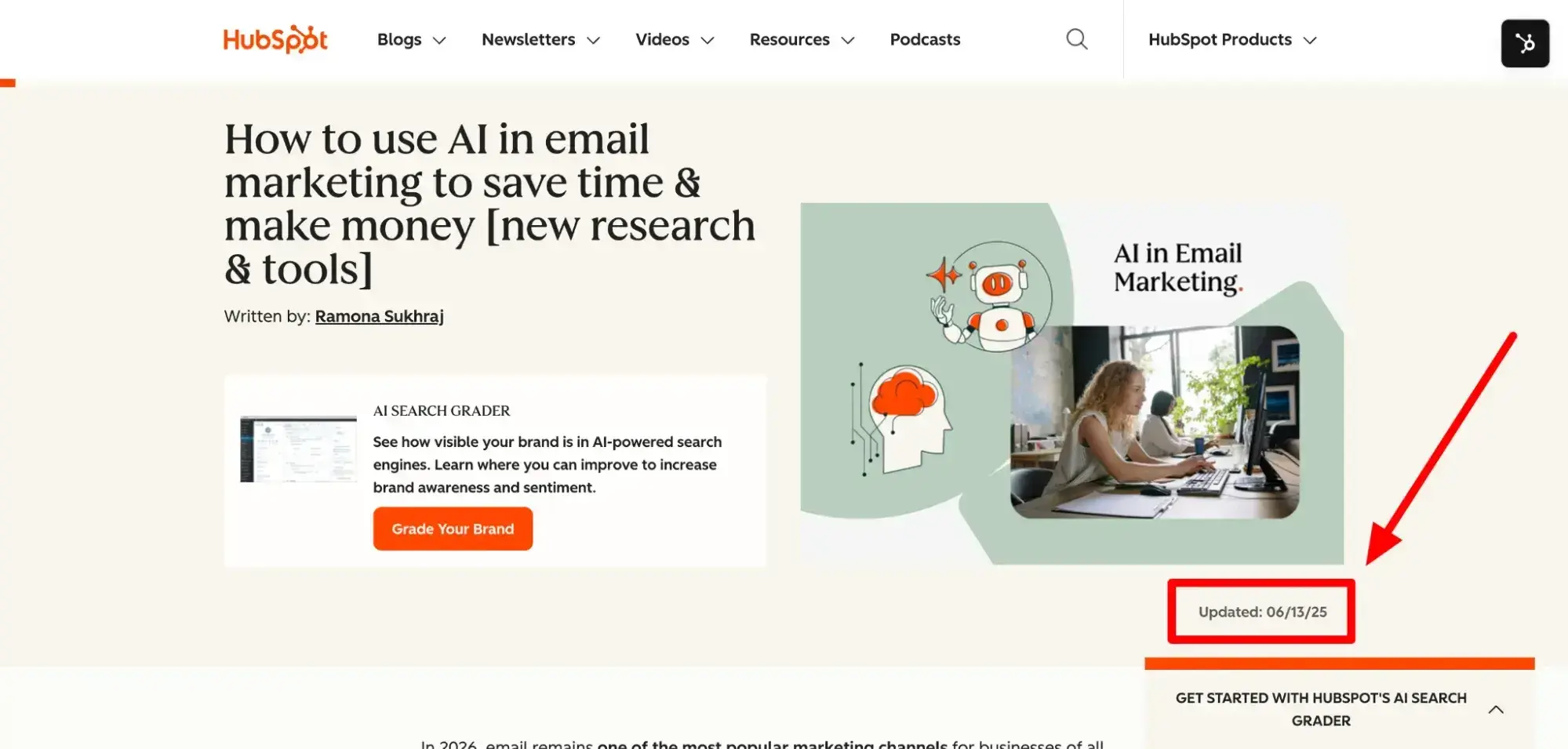
AI Overviews and RankBrain favor recently updated content. So, a page refreshed in March 2025 will outperform an identical page last updated in 2022, even if the actual content is similar.
How to Track AI Search Ranking Performance
You can’t improve what you don’t measure, but AI citation tracking is truly different from traditional rank tracking. Here’s the framework I recommend for building a real AI visibility measurement practice.
There are three metrics that matter most for AI visibility:
Metric | What It Measures | How to Track |
Citation presence or Visibility | Does AI mention your brand/content in answers? | HubSpot AEO, Otterly.AI, Semrush AI Toolkit |
Share of voice | How often do you appear vs. competitors in AI answers? | HubSpot AEO Sensor, manual brand queries |
AI-referred traffic quality | Are AI-sourced visitors converting? | GA4 session source, CRM attribution |
These are new metrics for most, of course, so you likely don’t have baseline data to set goals or even evaluate performance.
To set your baseline:
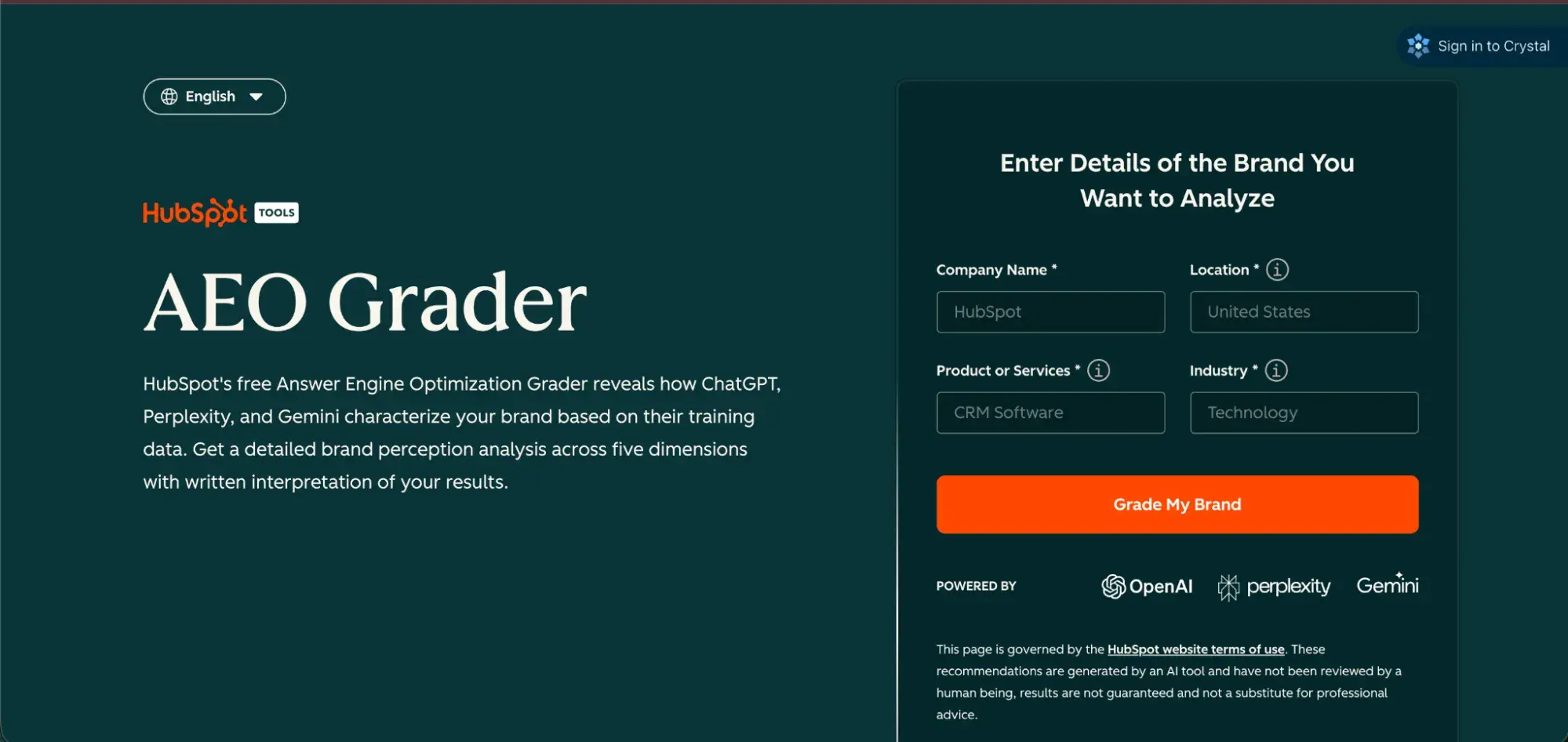
- Run 20-30 target queries in ChatGPT, Perplexity, Google AI, and Claude. Record whether your brand is cited. You can also get a snapshot of your performance with HubSpot’s free AEO grader.
- Track your AI-referred sessions in Google Analytics 4 under source/medium. Look for referrals from ChatGPT, Perplexity, and other AI platforms.
- Benchmark your citation rate against your top three competitors for the same queries.
From there, set a 90-day target. AI search optimization typically yields initial results within 2-3 months of implementation.
What we like: HubSpot AEO tracks your AI citation presence and brand mentions across all major AI platforms, gives you a readiness snapshot with the AEO Grader, and benchmarks your performance against industry trends via AEO Sensor. It connects AI visibility directly to your CRM data so you can see which AI-referred visitors actually convert. We’ll get deeper into that in a few sections.
How to Get Started with AI Search Rank Optimization: A 3-Month Plan
Start with what moves the needle fastest and builds a foundation for everything else. Here are the prioritized steps I recommend for this quarter:
- Technical access (Week 1). Audit robots.txt, fix blocked AI crawlers, and confirm Bing indexing. This is a must for everything else.
- AEO baseline (Week 2). Run HubSpot’s free AEO grader and target queries across ChatGPT, Perplexity, and Google AI. Document your current citation rate.
- Schema implementation (Week 2-3). Add JSON-LD Article and FAQPage schema to your top 10 most-visited pages.
- Answer-first refresh (Week 3-4). Rewrite the intros of your top 20 pillar pages to lead with direct 1-3 sentence answers.
- Content cluster audit (Month 2). Map your existing content to topic clusters. Identify the biggest gaps and fill them.
- E-E-A-T and off-site authority (Ongoing). Build a cadence of original research, expert guest posts, content updates, and brand mention monitoring.
→ See how HubSpot connects AI citation tracking to CRM pipeline — Get a demo
How to Rank in AI Search Results with HubSpot Solutions
HubSpot has built AI visibility and AEO tools directly into our platform, so you can operationalize most of this program without adding new software.
Here’s how HubSpot’s tools map to each part of the AI search ranking program:
HubSpot Tool | What It Does for AI Search |
HubSpot AEO | Tracks AI citation presence, brand mentions, and visibility across platforms. Connects AI referrals to CRM pipeline. |
AEO Grader | Gives you an AI readiness score for any page or domain. Flags structural, schema, and content issues with recommendations. |
AEO Sensor | Tracks industry benchmarks and AI citation volatility. Tells you how your share of AI voice compares to competitors. |
Content Hub | Manages topic clusters, pillar pages, and internal linking at scale. AI writing tools help restructure content for an answer-first format. |
Breeze AI | Automates content refresh suggestions, identifies outdated stats, and recommends AEO improvements across your content library. |
Smart CRM | Attributes AI-referred sessions to contacts and deals, so you can see which AI channels are actually driving revenue. |
Now, the real advantage of managing AI search visibility inside HubSpot is attribution. Most teams track AI citations as a vanity metric, like “we appeared in 40 AI answers this month.”
HubSpot’s Smart CRM connects those citations to real results, such as sessions, contacts, deals, and revenue. That’s the difference between reporting on visibility and proving business impact.
Start with the AEO Grader. Run your top 5 pillar pages through it before doing anything else. It’ll show you exactly where the biggest gaps are, so you can prioritize your next steps.
Frequently Asked Questions About AI Search Ranking
How long until AI citations improve?
Brands with established topical authority and active content distribution can see citations improve within weeks of a major content refresh. Patience plus consistency is the formula.
Do I need separate strategies for Google AI Overviews and ChatGPT?
Yes, but there’s a lot of overlap between the core principles. A universal foundation of technical access, answer-first structure, schema, and E-E-A-T supports all platforms simultaneously.
The biggest differences:
- Google AI Overviews favor E-E-A-T signals, mobile optimization, and freshness. Organic ranking still helps, but it’s not required.
- ChatGPT incorporates Bing indexing and favors Reddit and Wikipedia in its training data. Active community presence matters more here.
- Perplexity favors conversational, experience-based content with practical examples and cited sources.
What if AI misrepresents my brand?
Unfortunately, this happens more than most brands realize. The fix is to be proactive, not reactive. Publish accurate, authoritative content that crowds out misinformation.
Make sure your brand facts are consistent across all platforms (e.g., website, LinkedIn, G2, Wikipedia, Crunchbase). AI systems learn from the most authoritative available sources. So,if you own those sources, you own the narrative. In critical situations, you can also consider blocking AI crawlers.
Should I block AI crawlers?
In most cases, no. If AI can’t crawl your site, it can’t cite it. The exception is if you have proprietary content or significant server cost concerns, you can selectively block training crawlers (like GPTBot) while allowing retrieval crawlers (like OAI-SearchBot and PerplexityBot) that power real-time AI search answers.
What’s the best way to track AI citations over time?
Build a simple tracking cadence with tools like HubSpot AEO. That may look like:
- Weekly manual checks: Run your 10 most important queries across major AI platforms.
- Monthly tool review: Use HubSpot AEO or Semrush AI Toolkit to track citation trends at scale.
- Quarterly attribution analysis: In GA4, review AI-sourced sessions and tie them to conversion events in your CRM.
AI citation rates fluctuate. Don’t panic about week-over-week swings. Look for the 90-day trend.
Rise in AI search rank.
AI search is not the future; it’s our current reality. AI overviews, ChatGPT, Perplexity, Gemini, these platforms are where your audience is finding answers, and they’re usually finding them without clicking to your website.
The marketers who figure this out first will build durable AI visibility advantages that compound over time, while others spend the next two years trying to catch up.
You have the playbook. Now, run with it.
Credit: Source link