As any marketer or SEO knows, there’s a special satisfaction in seeing your hard work pay off in the form of snagging a top result on the SERPs. But in the age of answer engine optimization (AEO), search results don’t tell the full story. To gauge success, you need to learn how to track your brand’s presence in AI search — which introduces a new set of metrics, including mentions, citations, and share of voice.
This guide will introduce you to AI search visibility, plus the tools and metrics to track your presence in AI search.
Table of Contents
What is AI search visibility, and how is it different from SEO?
AI search visibility measures how often answer engines like ChatGPT, Gemini, and Perplexity mention or cite your brand in their answers. While traditional SEO focuses on where a page ranks on a results page, AI search moves the unit of measurement from a ranked list of blue links to a single synthesized answer, and your brand either makes it into that answer or it doesn’t.
That shift changes what you track. In traditional search, a number-one ranking is the goal. In AI search, ranking first no longer guarantees you appear: A Semrush analysis of 200,000 Google AI Overviews found the top organic result was used as a citation only 34% of the time on mobile and 46% on desktop.
The AEO metrics worth tracking now include:
- Mentions show whether an answer names your brand without a link.
- Owned citations show which of your pages an engine references as a source.
- Share of voice compares how often you surface against competitors for the same prompts.
The workflow changes, too. Instead of tracking keyword positions, you monitor a fixed set of prompts and log how each engine responds over time.
None of this negates SEO. Strong rankings, crawlable pages, and topical authority still feed the models that generate these answers, so your existing foundations stay relevant. AI search adds a layer on top rather than replacing the one underneath.
Curious where you stand in AI search? AEO Grader scores how answer engines represent your brand today, giving you a free baseline before you commit to ongoing tracking.
How to Track My Presence in AI Search Step by Step
You can run this tracking workflow manually with a spreadsheet or automate it with a dedicated tool. Either way, the four steps are the same.
1. Add your domains and define prompts to monitor.
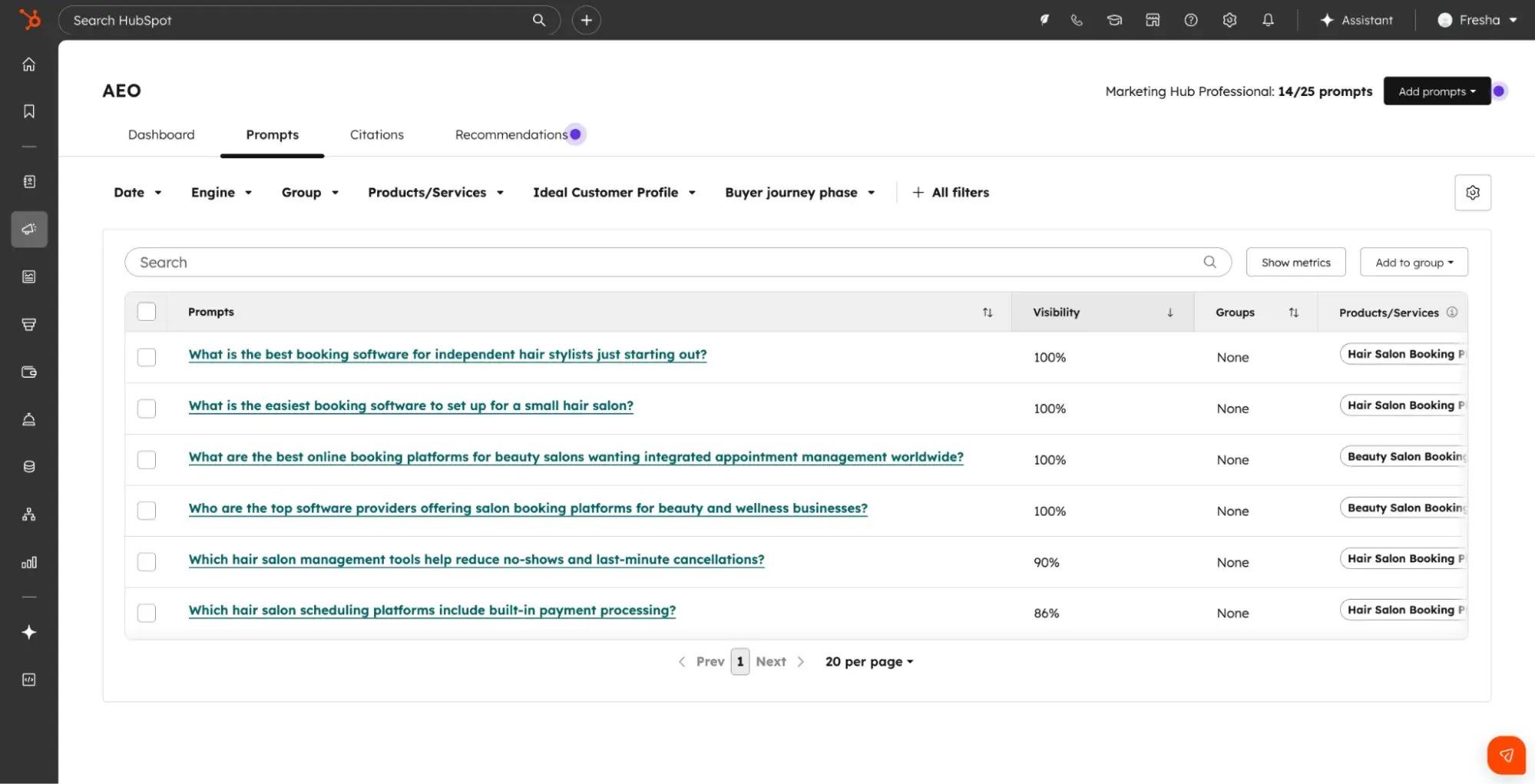
Start by adding your domain and any subdomains you publish on. Instead of keywords, AEO focuses on prompts. Build your initial prompt set. While you can track branded prompts to see how you compare to competitors, focus heavily on unbranded, solution-seeking prompts, as these do the heavy lifting for your visibility score.
Pro tip: You don’t have to start from scratch or guess what to track. AEO in Marketing Hub uses your CRM data to automatically suggest prompts informed by your real business context.
Source
2. Configure AI search tracking per engine.
Run every prompt through each engine separately, because answers differ across ChatGPT, Gemini, and Perplexity. Use logged-out or temporary sessions so personalization doesn’t skew what you see. For each response, record whether your brand is named, which pages get cited, and which competitors appear. HubSpot AEO automates this step across ChatGPT, Perplexity, and Gemini so you don’t re-prompt by hand.
3. Map KPIs and build a simple dashboard.
Choose a short list of KPIs to watch over time (the next section breaks down which metrics matter most). A spreadsheet can work for a small initial audit, especially if you’re checking a limited set of prompts once a month. But manual tracking becomes difficult quickly because AI answers vary by engine, session, model update, and retrieval source. For ongoing monitoring, use a dedicated AEO tool that can rerun prompts consistently, track citations, compare competitors, and show visibility trends over time.
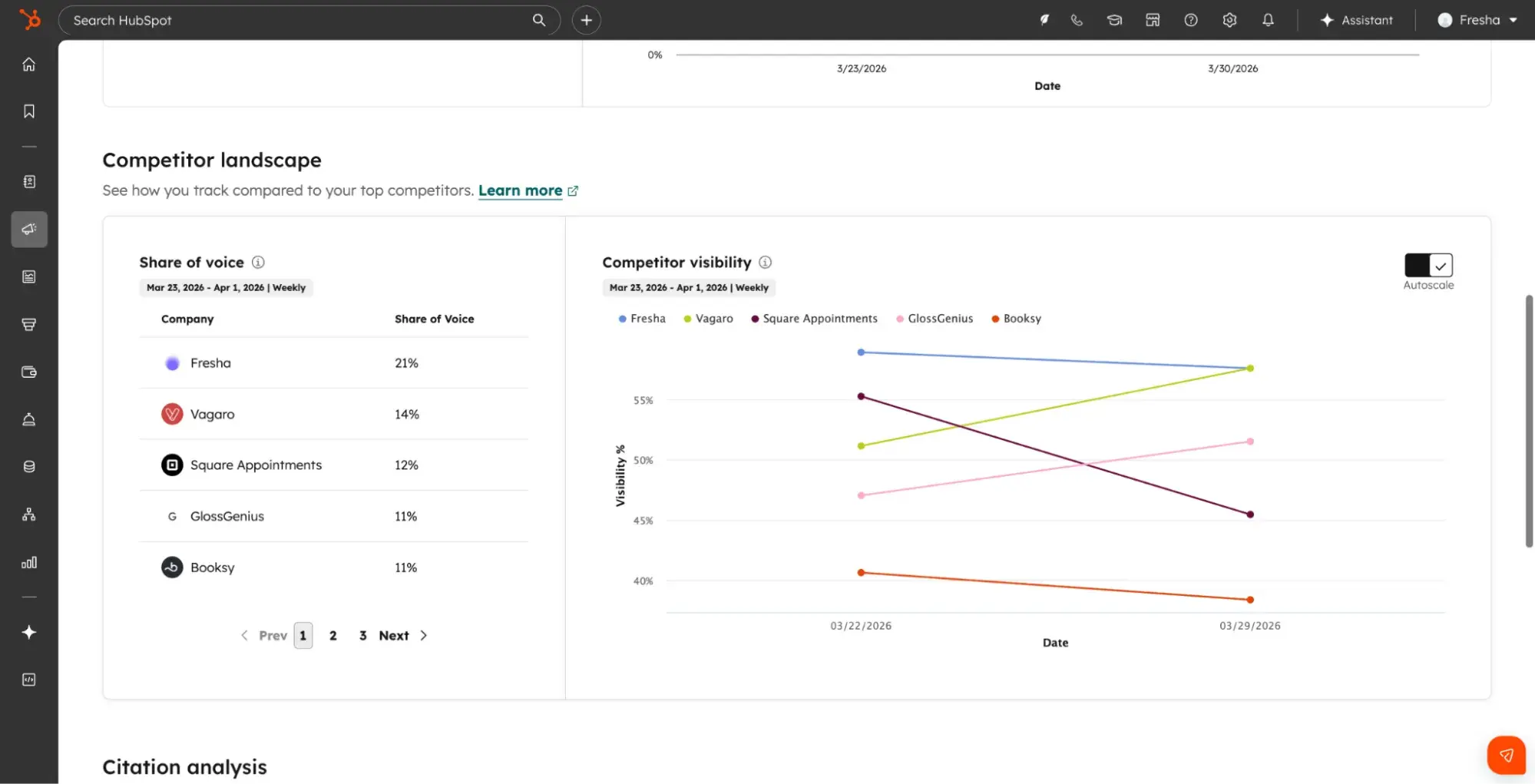
4. Analyze competitor share of AI voice.
For each prompt, note every competitor the engine names, then calculate your share of voice against them. Repeating this monthly surfaces which rivals own which question clusters, telling you where to focus content first. HubSpot AEO reports competitor presence on your tracked prompts automatically, so you can spot these gaps without manual tallying.
Learn more about HubSpot AEO.
What metrics matter for AI visibility tracking?
Once tracking is live, these seven metrics show whether you appear, whether that visibility drives revenue, and whether engines describe you correctly.
Mentions and Citations
A mention is your brand named in an answer without a link. A citation is a source the engine references; when that source is your own page, it’s an owned citation. Your brand can also be cited through pages you don’t own.
AI-Referred Traffic
The visits that arrive when someone clicks a cited link. Many engines pass no referrer, so these sessions often land in direct and undercount AI. HubSpot tags clicks from ChatGPT, Claude, Perplexity, and Gemini as a distinct AI Referrals source automatically.
Conversions and Pipeline Attribution
The leads, opportunities, and deals that trace back to AI discovery. A “How did you hear about us?” form field, plus a CRM that records each contact’s first-touch source, connects AI-driven visits to revenue.
Consistency Over Time
Answer engines vary by platform, prompt, timing, and user, so one check is a snapshot. Track how steadily your brand holds its place across repeated runs on a fixed cadence to spot trends.
Accuracy and Hallucination Detection
How often answers get your brand wrong. Log inaccurate pricing, features, or claims by engine and by prompt so you can correct them later.
Sentiment and Tone Analysis
How favorably engines describe your brand. HubSpot AEO scores this from -100% to +100%, separating a perception problem from a visibility one.
Retrieved and Cited Pages
Which of your specific URLs engines pull from. Cited pages appear as linked sources and show which content is earning visibility, so you can create more like it.
How to Improve AI Search Visibility With Answer Engine Optimization
Now that you know how to track your AEO progress, let’s go over five tactics that help you get ahead in AI search. For a fuller playbook, see how to write for AI search.
Strengthen external brand signals.
What other sites say about you shapes what answer engines repeat. In an SE Ranking study of 129,000 domains, the number of referring domains predicted ChatGPT citations most strongly out of the 20 signals measured. The same study linked Reddit and Quora mentions to higher citation rates. Build these signals through digital PR, expert commentary, and real participation in the communities your buyers trust.
Rank in traditional search to feed LLMs.
Answer engines assemble responses on top of traditional search indexes, so organic rankings stay a prerequisite. ChatGPT’s search can draw on Bing results in some contexts, and Google AI Overviews pull heavily from pages that already rank. As covered earlier, a top ranking no longer guarantees a citation, but pages that rank nowhere rarely surface at all. Keep crawlability, topical depth, and internal linking in good shape, and see our AI SEO article for tips on using AI to improve your SEO workflows.
Add structured data and schema.
Schema markup labels your page’s entities and the relationships between them in a format engines can parse. Its citation impact is debated, but HubSpot’s State of AEO 2026 found that pages pairing a Q&A section with FAQ markup earned higher citation rates on Gemini, Google AI Mode, and Perplexity.
Write with semantic clarity.
Answer engines are more likely to lift declarative, self-contained claims than hedged or pronoun-led prose. State each fact as a clear subject-verb-object relationship, name the entity instead of falling back on “it” or “this,” and resolve the question before adding context. Keep your brand name, category, and key facts consistent across your site, LinkedIn, and review profiles like G2, so engines recognize the same entity wherever they find it.
Create compact, prompt-shaped content units.
Answer engines retrieve passages, not whole pages, so each chunk has to stand on its own. Lead every section with the direct answer, then add support below it. Format comparable facts as tables and bulleted lists rather than burying them in prose. The right tool can flag these gaps for you, and AEO in Marketing Hub turns them into prioritized recommendations connected to HubSpot’s content tools. The next section covers how to choose the tool that fits your team.
Which AI visibility tools should I use, and how do I choose?
The right tool depends less on its feature list than on what you’re trying to prove. Before comparing options, rank these four questions by what matters most to your team:
- Engine coverage: Does it track the engines your buyers actually use? Look for ChatGPT, Gemini, and Perplexity at minimum, plus Google AI Overviews or Copilot if those matter to your brand.
- Monitoring versus optimization: Does it only report where you stand, or also tell you what to create and fix?
- Attribution: Can it connect visibility to traffic, leads, and revenue, or does it stop at a mention count?
- Cadence and cost: How often does it re-run your prompts, and is there a free tier to start?
The answers split the market cleanly. Standalone monitors report your score and competitor share; HubSpot AEO pairs that tracking with prioritized recommendations and, in Marketing Hub, ties visibility to CRM records.
Quick Start with a Free Baseline
A free baseline settles one question before you spend anything: Are answer engines representing your brand at all? The free AEO Grader returns a scored snapshot across ChatGPT, Perplexity, and Gemini, including a share-of-voice read against competitors, in a few minutes.
As a decision point, an occasional pulse check may be all a free grader needs to cover; weekly movement tracking, prompt-level competitor monitoring, or pipeline attribution calls for a continuous tool.
Get a demo of AEO in Marketing Hub.
How to Connect AI Search Tracking to Leads and Revenue
Once you can see your brand in AI answers, the next question executives ask is whether that visibility produces pipeline. Connecting the two means tracing one path: an AI-referred visit becomes a contact, the contact carries a source, and that source rolls up into a dashboard beside leads, opportunities, and revenue.
Start with the source dimension. HubSpot stamps visitors arriving from ChatGPT, Claude, Perplexity, and Gemini with an AI Referrals original source, so every contact created from those sessions inherits the label automatically. Reporting on the Original Source property then segments leads, deals, and closed revenue by AI Referrals the way you would segment organic search or email.
Self-reported attribution covers what referrer data misses. Because many engines pass no referrer, some AI-driven visits still land in direct. A “How did you hear about us?” form field with explicit options for ChatGPT, Gemini, and Perplexity lets buyers name the source that the headers couldn’t, and their answers write to the contact record.
From there, one CRM dashboard connects AI visibility metrics to business outcomes: mentions and citations on one side, pipeline by source on the other. HubSpot’s Smart CRM ties these AI-attributed leads to the records your sales team already works with, so you can follow each contact from first AI touch to closed deal. That view answers what a standalone monitor can’t: whether the people who found you through AI actually convert. Review it monthly to see whether rising visibility moves revenue or only impressions.
Get a demo.
How to Report Results and Govern AI Brand Accuracy
A monthly report turns scattered tracking into a story leadership can follow. Pull the metrics from the previous section into one recurring view: mentions and citations for reach, sentiment for how engines describe you, accuracy for how often they get you wrong, retrieved pages for which content is earning visibility, and pipeline impact for whether any of it converts.
Reporting tells you what changed. Governance decides what happens when an engine gets your brand wrong. Build a short checklist that your team runs every cycle:
- Reviewers: Name who owns the monthly check and who signs off on flagged inaccuracies, so nothing stalls waiting for an owner.
- Correction process: Accuracy checks identify hallucinations, outdated claims, and brand misstatements; log each one by engine and prompt, then route it to whoever owns the source page behind the answer.
- Documentation: Keep a running record of what was flagged, what was fixed, and when, so you can show the accuracy trend improving over time.
- Escalation: Set a threshold that skips the queue, like a pricing error or a competitor misattribution, and triggers a fix before the next report.
Treat the report and the checklist as one loop: The report surfaces the problem, governance assigns the fix, and next month’s report confirms it worked.
Frequently Asked Questions About Tracking AI Search Visibility
How often should I re-run prompts and update my AI visibility dashboard?
Monthly works as a baseline for spotting trends, since a single check is a snapshot rather than a pattern. Run a fixed prompt set on the same cadence so movement stays comparable month to month. Increase the frequency when you’re testing new content or watching a competitor closely. HubSpot AEO runs prompts daily and alerts you to notable shifts, so volatility surfaces without manual re-prompting.
What if AI platforms don’t pass referrers and I can’t see traffic sources?
Use a form to allow visitors to tell you how they found you, and give them options like ChatGPT, Gemini, and Perplexity, so buyers can name the source the headers dropped. HubSpot also tags visits from those engines with an AI Referrals source automatically, capturing what referrer data does pass. Together, the two methods recover many of the AI-driven sessions that would otherwise land in direct traffic.
How can I correct inaccurate answers about my brand in answer engines?
You can’t edit an AI answer directly, so correcting one means changing the sources engines pull from. Update your own pages with accurate pricing, features, and claims, then strengthen the authoritative third-party signals that reinforce them. Log each error by engine and prompt so you can confirm the fix on later runs.
When should I consider a dedicated LLM visibility tool?
A free grader answers whether engines represent you at all, which may be enough for an occasional pulse check. Move to a dedicated tool once you need weekly tracking, prompt-level competitor monitoring, or attribution that ties visibility to pipeline. AEO Grader gives you that free baseline, HubSpot AEO adds continuous tracking and recommendations, and AEO in Marketing Hub connects those metrics to your CRM records.
What is the best way to present AI visibility to executives?
Lead with business impact, not mention counts. Executives want to know whether AI visibility produces pipeline, so open with the leads, opportunities, and revenue traced to AI discovery, then use mentions, citations, and share of voice to explain the trend behind them. Keep it to one view, updated monthly. Because AEO in Marketing Hub puts this visibility data in the same platform as your CRM, you can use HubSpot’s reporting tools to connect your AI-referred traffic to the real contacts and deals it touches.
Credit: Source link