Office usage has changed for many employees and HR leaders, making workplace analytics increasingly essential for understanding how employees use their workspaces and, subsequently, how employers should invest in real estate.
According to Gallup, 50% of full-time U.S. employees currently hold jobs that can be performed remotely. Before the pandemic, the majority of these remote-capable employees still worked primarily on-site, and remote work was considered the exception rather than the norm. Now, most remote-capable roles involve at least some degree of work from home, with Gallup data citing that only 21% of remote-capable roles are performed totally in-office.
Remote and hybrid work are now the norm for millions, reshaping where work happens. As companies adapt, HR teams are leading a data-driven shift in how organizations manage their physical spaces. According to Caitlin Kamm, director of people growth at workplace platform Envoy, analytics-informed workplace decisions represent one of the most significant changes in HR strategy today.
Envoy researchers found that 54% of companies are already using analytics to track when employees show up to the office, Kamm explains. “However, many are still making million-dollar real estate decisions based on executive intuition rather than hard data.”
For HR leaders ready to advance with workplace data, the kickoff is surprisingly simple and obvious. “The place to start is to simply begin tracking basic attendance patterns rather than making assumptions about how your office is actually being used,” Kamm advises. This foundational step can immediately reveal critical gaps between perception and reality.
Kamm suggests that HR leaders start by collecting basic badge data to uncover seasonal trends, department usage and peak collaboration times. “This baseline will immediately reveal differences between what leadership thinks is occurring and what is occurring,” she says.
The impact extends far beyond attendance tracking. HR teams can then connect this data to employee satisfaction surveys and retention rates to understand the relationship between workplace experience and business outcomes. As Kamm notes, “Even basic usage analytics will prove more insightful than the gut-feel approach that has been guiding workplace decisions for too long.”
From monitoring to meaningful
Once this data is in place, HR teams can take their strategy to the next level. A new way of thinking about how the workplace functions involves moving from “daily desk” models to event-driven office utilization. Companies implementing this approach are seeing remarkable results, says Kamm.
“This shift fundamentally changes HR’s role from one of monitoring daily attendance to one of designing meaningful in-office experiences,” Kamm says. “We’re seeing companies achieving 90% attendance rates not through mandates, but by giving valuable reasons to be present.”
This mindset requires HR teams to become sophisticated experience designers, says Kamm. She suggests other ways to use the office other than a cubicle corral. “Instead of trying to fill desks daily, invest in designing quarterly team summits, monthly departmental collaborations and weekly cultural events that naturally compel colleagues to attend.”
In addition to employee attendance, Kamm says, the financial implications of rethinking the office setting are significant. Companies are discovering cost savings when they use their own properties for team events instead of renting out third-party venues.
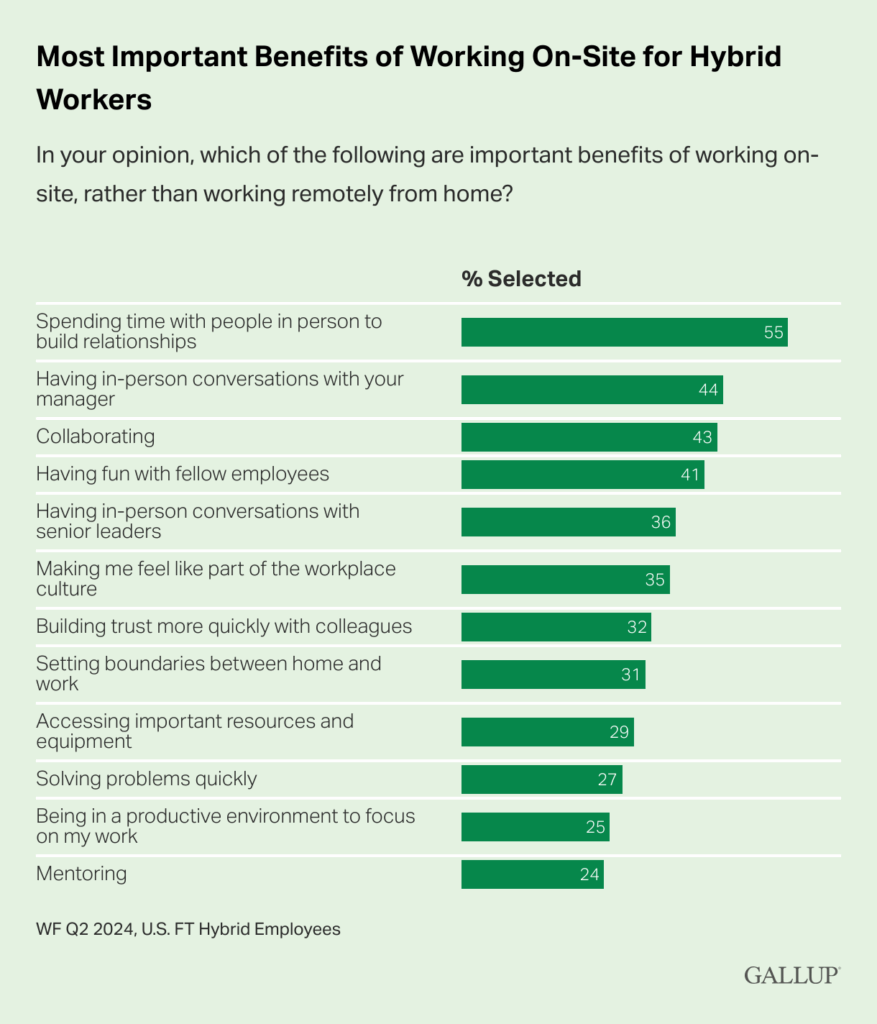
Workplace analytics reveal benefits of being on-site
Rather than implementing standard in-office requirements, forward-thinking companies are developing differentiated strategies. HR leaders should be aware that there are nuances in how different employee groups want to interact with office spaces. According to Gallup, 60% of employees with remote-capable jobs prefer a hybrid work arrangement. About one-third would rather work fully remotely, while fewer than 10% prefer to work entirely on-site.
While Gallup’s data isn’t broken down by employee tenure or generation, Envoy’s data suggests junior employees have better retention rates when they spend some time in the office. Kamm says these patterns have implications for HR policy development and how HR professionals approach hybrid work and career development.
She suggests that CHROs should position the office as the place where people come to do work that’s better accomplished together. “The office is essential for relationship-building and absorbing culture that remote work just can’t,” she says. Gallup’s research supports this, finding that the leading benefits of working on-site, rather than working remotely from home, are driven by a desire for face-to-face time.
For HR leaders, this insight suggests the value of communicating office time as career and relationship development rather than compliance. “The key is framing office time as an investment … rather than a requirement, especially for employees at the start of their careers,” says Kamm.
Demonstrating the value of the workplace
Beyond helping HR understand generational preferences, workplace data reveals surprising insights about how employees use office spaces. Despite popular images of fun offices filled with nap couches and ping pong tables, the Envoy team found that trendy design elements don’t always match what employees prefer.
“What is surprising is that workplace analytics show employees favor conference room furniture over stylish lounge chairs for real meetings,” Kamm explains. She says these insights are leading to more practical design choices that “prioritize function over form.”
Kamm adds that another unexpected finding is that the ideal office utilization rate isn’t 100%, but rather 40%-60%. “That’s the perfect balance of energy and elbow room,” Kamm says.
With adequate workplace analytics, HR leaders can put a fine point on how they demonstrate real estate value to executive leadership. “The challenge is connecting workplace metrics directly to business outcomes that executives care about,” Kamm explains. She notes that many companies use analytics to show ROI through higher retention rates, cost savings from more efficient space utilization and productivity gains driven by better collaboration.
With workplace budgets increasing across the majority of companies, according to Kamm, executives need concrete evidence that HR practices make sense for the business. These metrics will vary by company priorities. “Analytics provide assurance by showing exactly which spaces spark collaboration, which events drive engagement and which policies improve retention,” says the people leader.
How can HR tech support workplace analytics?
Ninety-one percent of nearly 500 business leaders surveyed told Envoy researchers that workplace design delivers ROI, yet only half are measuring how their space is being used. This represents an opportunity for human resource teams. Kamm advises HR leaders to seek HR tech that can connect attendance data with key employee outcomes.
As workplace analytics continue to advance, technology serves as the critical enabler for HR digitalization. However, selecting the right solutions requires careful consideration. “The most valuable solutions provide predictive analytics to anticipate space needs, optimal event timing and resource planning requirements,” she explains.
Research from Envoy found that 84% of professionals expect their workplace to be seamlessly integrated with advanced technology. They want automation and AI-powered tools designed to enhance productivity and collaboration. Solutions should cooperate with existing HR systems, calendars and employee survey tools to create an “end-to-end view of workplace effectiveness,” according to Kamm.
Successful HR executives will embrace both new technologies and the cultural changes needed to implement them. “The goal isn’t to force behavior but to discover and optimize for the patterns that naturally emerge when humans have actual reasons to collaborate in person,” she explains.
Credit: Source link