Few workers would argue the fact that artificial intelligence has arrived—and it’s here to stay. But when it comes to how those workers think AI will impact their jobs, agreement is far from universal.
In fact, a new report from the ADP Research Institute finds that 85% of those surveyed—which includes 35,000 workers across 18 countries—believe AI will affect their jobs within the next two to three years, but they are nearly evenly split on how. Forty-three percent think AI will help them in their roles, while 42% say it will replace at least parts of their work.
When asked to evaluate the extent to which AI will impact their jobs, respondents tended to avoid extremes: Those who have a positive outlook on AI’s influence were 1.3 times more likely to say it will help them “occasionally” rather than daily, while those anticipating job replacement are more than twice as likely to predict it will replace “some” functions, instead of “most.”
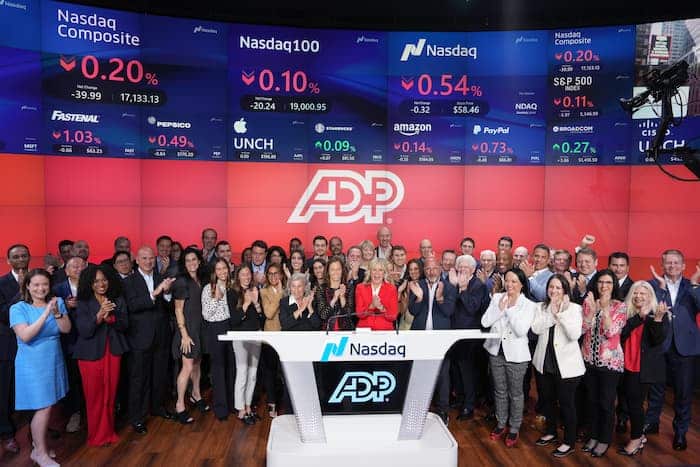
“Everybody thinks AI will affect their jobs, but the reality is they don’t know because it hasn’t happened yet,” said Nela Richardson, Ph.D., ADP’s chief economist and ESG officer, head of the ADPRI and co-author of the People at Work report. Richardson reviewed the findings at a June 10 panel discussion in New York City, held in conjunction with ADP leaders ringing the NASDAQ MarketSite Opening Bell to celebrate the organization’s 75th anniversary.
Unlike other forms of workplace tech, Richardson noted that many employees have already been exposed to AI, particularly through generative AI, outside of work. That is causing them to form preconceptions about its potential effect, but it is also creating a level of curiosity and interest that business leaders rarely see with other tools.
“That’s why change management—(led by) someone with an engineering and HR background—will be able to capture that curiosity and interest but also the ambivalence,” Richardson said, “and (understand) how to lead from consumption to productivity.”
Before a company rolls out an AI product, strategy or policy, leadership must understand what workers know about AI and what they think of its potential for their work. The ADPRI survey illustrates that differences in worker sentiment can be stark, says Ben Hanowell, director of people analytics research at ADPRI and co-author of the report.
“You want AI to work—and, in order for this tech to work, you need to understand things from the perspective of the folks who are going to use it,” Hanowell says.

“AI” has become an umbrella term that means different things, depending on workers’ experiences and industries. Those in a manufacturing plant, for instance, may think about robotics when they hear “AI,” while workers on a digital marketing team may presume generative AI.
“It’s a loaded term, in the sense that it has so many different meanings,” he says.
Demographic differences also should be considered: According to the ADPRI report, more than 20% of those over 55 said they don’t know enough about the technology to assess A’s impact on their future work, compared to just 3% of those 18-24.
“People are operating on different wavelengths in terms of awareness,” Hanowell says. “You have to be clear with workers about what you mean with ‘AI’.”
This represents a “huge” training opportunity, Richardson noted during the panel discussion—one that “doesn’t leave any generation behind.”
Workers should be comfortable answering questions like “What is AI? How does it affect my work? How can I make the most of my skills now? What skills should I acquire to capture the promise of AI?” she said.
When it comes to skills, worker confidence appears to play a significant role in shaping outlooks on AI’s impact. About 70% of those who think AI will help their work believe they possess the skills needed to advance their career in the next few years; just 45% of those who see AI replacing most of their job agree.
Just as leaders need to be specific and transparent when defining AI, they also need to be explicit about the skills it will take for their workforce to reap its benefits, Hanowell says, along with detailing the particular business problems that can be solved by workers’ use of AI.
As AI infuses workplaces, HR can be particularly influential in helping build a “culture of constant skills development,” Richardson said.
When she completed her Ph.D., Richardson joked, she thought at the time she’d be finished with tests—but AI and technology are changing the world of work now so quickly that workers must be ready for ongoing education.
“I envision a world where we have to learn new skills all the time,” she said. “As long as we have a workforce that is ready for that, we’re going to be OK.”
The future of work, beyond AI
Many workforces were “primed by the pandemic” for continuous learning in the face of change, Richardson said.
The pandemic also reshaped the employee-employer relationship, in a lasting way.
Flexible work is now considered “table stakes,” and employees are increasingly turning to their employers for support. For instance, even though inflation has slowed, prices haven’t dropped.
“Who’s going to solve that problem for [employees]? It’s back to the company,” Richardson said. “The company has now become an umbrella—for health benefits, for salary, for flexibility, for culture, for technology, for training, for career progression. The company has become, in a lot of workers’ lives, everything—and they want more of it.”
She said that as the future of work materializes, leaders will be challenged to meet those expectations while simultaneously moderating them in a way that is consistent with business goals.
“That’s going to be the hard part of rolling out this technology in a space where people want more of more,” she said.
And the pace of change isn’t going to slow.

Hanowell noted that ADPRI is particularly interested in exploring the rise of “cross-metro work,” as employees increasingly work in different geographic locations than their managers and leaders. Meanwhile, as Gen Z workers have been in the workforce for several years, some are entering management for the first time, creating shifts ripe for study.
“We are all seeing transformation happening at lightning speed, in real time,” Maria Black, president and CEO of ADP, said before last month’s panel discussion. With more than 1 million clients across 140 countries, Black said, ADP has a unique vantage point into today’s workplace shifts—and those that have happened across its 75 years in operation.
“It’s an exciting time for us,” Black said, “and an incredibly exciting time for the world of work.”
Credit: Source link