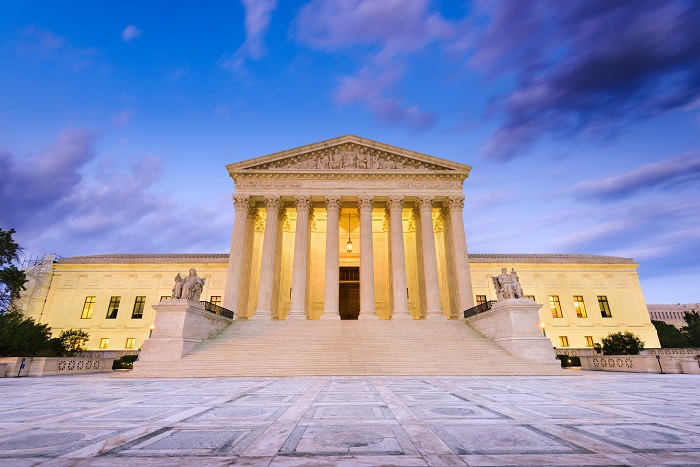
In a landmark decision Thursday, the U.S. Supreme Court banned affirmative action in college admissions—a move that could have significant reverberations across the corporate world.
The 6-3 decision, which stemmed from challenges to affirmative action policies at Harvard and the University of North Carolina-Chapel Hill, overturned decades of case law that permitted educational institutions to consider self-identified race in admissions decisions, as long as it wasn’t the only factor.
While the decision was limited to college admissions, it is expected to have vast implications for employers—particularly around recruitment, advancement and DEI strategies—and, as another win for conservatives on the court, it could be a precursor to future employer-focused decisions around diverse hiring.
“There’s no question the impact of this ruling will be felt far beyond the college classroom,” says Neeta Mehta, partner at executive search firm Bridge Partners. “The end of affirmative action sets our country back half a century when it comes to furthering diversity and inclusion in our universities, and I have no doubt it will set us back just as far when it comes to representation in companies and organizations, especially at the highest levels.”
The ruling, written by Chief Justice John Roberts, found that the two schools’ policies violate the 14th Amendment and Title VI, the latter of which prohibits discrimination by federally funded entities, including educational institutions.
Because the decision did not extend to Title VII—under which employment discrimination issues fall—it has no “direct legal bearing” on diversity policies in employment, says Greg Hoff, associate counsel of HR Policy Association, which represents CHROs at nearly 400 of the nation’s largest employers.
“Accordingly, HR leaders do not have any new or changing compliance obligations as a result of the ruling but should instead ensure they are continuing to be in compliance with Title VII,” he says.
Even though the ruling does not mandate employers make any changes, it should provide the impetus for HR and business leaders to closely examine their employment policies for any disparate impact, adds Stephen Paskoff, CEO of Employment Learning Innovations and former EEOC and employment law attorney.
“The bottom line is every employer is going to have to look at their recruitment, hiring, advancement and other systems,” he says, “to make sure they’re not discriminating on the base of race, gender and other characteristics—no matter how well-intentioned their efforts are.”
Employment decisions that factor in race are already federally prohibited; however, considering that the court is balanced in favor of conservative justices—who, at this time last year, overturned Roe v. Wade—specific targeting of DEI-related policies by employers could be possible in the future. Hoff notes there has already been an “uptick in litigation activity” from organizations like the plaintiffs in the affirmative action cases, and he suggests that could “incentivize” others to go after employer-sponsored DEI policies.
Given that, Paskoff adds, “it seems that the prudent approach is to make sure that the boundaries of what’s considered affirmative action are carefully set up and maintained” by employers.
New approaches needed for recruitment
DEI experts agree that affirmative action in college admissions paves the way for more diverse and equitable representation in student populations—and without it, incoming talent pools will be distinctly less diverse.
Take California’s 1996 ban on considering race and gender in college admissions and employment. A recent report in the L.A. Times found that major educational institutions in the state continue to struggle to graduate classes that reflect the demographic makeup of the region. California State University said in a statement that the ban “has made it more challenging to erase equity and opportunity gaps that exist.”
The SCOTUS decision could amplify that challenge.
In an amicus brief urging the court not to overturn affirmative action, the HR Policy Association noted that “the increasing demand of American companies for educated, trained, diverse talent necessitates a continuous pipeline of such talent from college campuses around the United States.” And creating this pool “requires admissions processes that provide opportunities for students of all backgrounds to achieve a higher education,” registering concern that backtracking on affirmative action could “diminish” that opportunity.
Janet Albert, partner at Bridge Partners, says the ruling means that there will “certainly” be fewer minorities on college campuses—creating an inherent challenge for HR leaders looking to attract diverse new grads.
“Organizations across all sectors of the economy that are committed to creating a diverse and inclusive work environment will find it more challenging in their recruitment efforts now and into the future,” Albert says.
However, that doesn’t mean corporate commitment to DEI should wane, says Melanie Naranjo, vice president of people at compliance training platform Ethena.
“For employers,” she says, “it means they’re going to have to work even harder to understand the systemic biases at play in the workplace and find new ways to counteract them.”

For instance, college degree requirements are increasingly being scrutinized for allowing pervasive bias; this week’s ruling provides more urgency to move away from such policies, she says.
See also: Requiring college degrees: A sign of a ‘lazy employer’?
While many HR teams will continue to source talent from colleges and universities, Hoff notes, they should consider looking outside of traditional college settings and can even offer upskilling and reskilling programs to train and advance diverse hires.
“Some HRPA members,” Hoff adds, “have already begun partnerships with other organizations to reach diverse talent prior to college, or to reach those without college degrees.”
Ultimately, Naranjo says, the onus will now be on HR to counteract the damage to DEI progress created by the dismantling of college affirmative action—an approach that, she says, was designed to “level the playing field.”
But, “with this struck down,” she says, “the playing field will now be even less level than it was before.”
Credit: Source link