Rebecca Curran,BBC Scotland and
Ken Banks,North east Scotland reporter
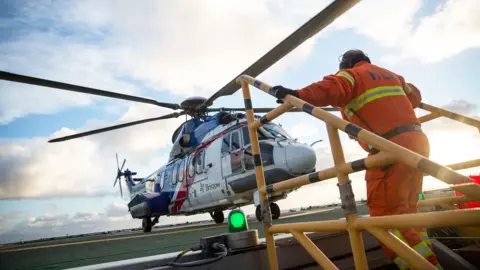 Getty Images
Thousands of North Sea oil workers are being told they must lose weight if they are to keep flying offshore – or face losing their jobs.
From November next year, industry body Offshore Energies UK (OEUK) said the maximum clothed weight for a worker heading offshore should be 124.7kg (19.5 st) – so they can be winched to safety in an emergency.
The 249kg (39st) maximum Coastguard rescue helicopter winch load is made up of that figure plus the average 90.3kg (14st) weight of a rescue worker, a 29kg (4.5st) stretcher and the 5kg (0.8st) kit.
OEUK said more than 2,200 workers were currently above the weight limit, and jobs could be lost in the worst case scenario.
One offshore worker, Phil Perry, told BBC Scotland News he was managing to lose weight – but was worried colleagues could lose their employment when the new rules come into force.


The new safe weight limit policy comes after the Maritime and Coastguard Agency (MCA) warned that rescue winches – which are critical during offshore emergencies – cannot safely lift heavier people.
OEUK said the average weight of offshore workers had risen by almost 10kg (1.5st) since 2008.
The decision to implement a safe weight limit for offshore workers follows a review by industry experts over the past two-and-a half years.
Rules about shoulder size were previously introduced for workers travelling to and from offshore installations by helicopter.
Passengers with a shoulder width of 22in (56cm) or more were classed as “extra broad” and had to sit next to a similarly large helicopter window, so they could escape.
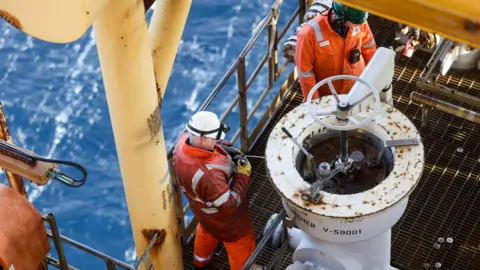 Getty Images
Phil Perry, 42, from Aberdeen, was 129kg (20st) at one stage – which would have been over the new limit.
He is now 118kg (18.5), and his target weight is 110kg (17st).
Mr Perry said the fear of losing his job was an added motivation to keep his weight down.
“There’s not a lot of people talking about it offshore yet,” he said.
“You’ve kind of got to understand that back in the 70s and the 80s the average person was about 70-odd kilos, it’s obviously going in an upward trend.
“I think you maybe have to do something about that, because you don’t want to be the one stranded there because you’re too heavy to be lifted out.”
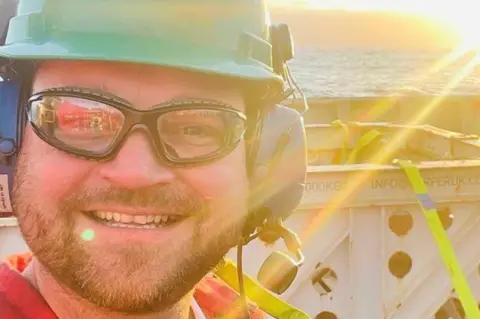 Phil Perry
Mr Perry said it was possible to be healthy while working on a platform in the North Sea.
“There are a lot of healthy people offshore, there are gyms, you can go for a walk round the helideck, you can be fit there, I think it just comes down to personal mindset of each individual.
“There’s a wide range of fruit and healthy options, but there’s also crisps and sweets which does not help.
“Everybody can lose weight, it’s keeping it off that’s the hard thing. I was one of these people that did these kind of crazy diets, but you can’t keep it off.”
He said he started eating the right foods at the right times, adding: “I started seeing the results.”
Mr Perry said he “definitely” feared the new rules would lead to job losses.
“It will affect the pool available to go offshore, there’s a lot of us out there, and sadly it’s just the way that it’s going to go, that people will start losing their jobs, which is not good for anybody,” he said.
Mr Perry added that the onus was on staff themselves, as well as employers, to make a difference.
Could jobs be lost?
Graham Skinner, the health and safety manager at OEUK, said it was hoped the new safety policy – as part of a “robust safety culture” – would not lead to job losses, but he could not rule it out.
“That would be the absolute worst-case scenario.
“Employers will have a duty to support their workers through this and try to find reasonable solutions for it, but in the very worst cases that would be the case for some people.”
Mr Skinner described it as “really important” that there was a clear message to the workforce that the new rules were going to come in.
“Hopefully that is the impetus for everyone to get behind the policy and lose weight in time for November next year,” he said.

“There are those who are going to have a real challenge over the next 12 months to lose weight to get under the weight limit.
“There is about 2,270 that are going to have to lose a little bit of weight to make sure they can continue working after November next year.
“At that point an offshore worker who weighs over 124kg will not get their medical and that will preclude them from getting on a helicopter.”
However, Mr Skinner said they were “really confident” that the “vast majority” of workers were going to get under the weight limit.
Some are extremely fit
He cited the support they would get from their employers, the offshore operators, and the offshore community itself.
“We have already heard of offshore workers who are offering circuit training and gym sessions for workers,” he added.
“So it’s a great opportunity for the community to come together.”
John Boland, the regional officer at the Unite union, said: “We would hope that nobody loses their job through this and there can be support put in to stop that from happening.
“The biggest concerns we have had are from individuals that are naturally larger built and in some cases are extremely fit but are above that actual weight limit.
“Those are discussions we need to have, how we can support those individuals as well.”
The mandatory implementation of the new policy will be from 1 November 2026.
Credit: Source link