
Author
Ahmed Barakat

Author

Share

Senator Cynthia Lummis has issued a direct warning: stall the CLARITY Act now, and the U.S. effectively forfeits comprehensive crypto regulation until 2030.
The logic is mechanical: if the bill fails to clear the Senate in the current legislative session, the 2026 election calendar compresses available floor time to near zero, and the next realistic window for a full market-structure framework doesn’t open until the following Congress at the earliest.
For institutional capital, that timeline is not a political abstraction. It is an operational constraint that compliance teams at major asset managers and trading desks are already pricing into deployment decisions, and increasingly resolving in favor of jurisdictions that already have answers.
The U.S. has governed digital assets primarily through regulatory enforcement, using SEC litigation, CFTC actions, and agency guidance rather than statutes to define what is and is not permissible in crypto markets.
The SEC’s enforcement docket has functioned as de facto rulemaking since at least 2017, from the DAO Report through ICO crackdowns to the Ripple and Coinbase litigation.
Enforcement-based precedent creates asymmetric uncertainty: firms know what has been penalized after the fact, but cannot get prospective clarity on what is permitted.
That asymmetry is tolerable for crypto-native firms operating at the margin; it is categorically unacceptable for compliance departments at BlackRock, Fidelity, or JPMorgan.
A four-to-five year extension of that regime, the operational meaning of a 2030 deadline, does not merely delay U.S. institutional adoption.
It hard-codes rival jurisdictions as the default venue for compliant tokenization, stablecoin issuance, and institutional DeFi infrastructure during the period when those markets are being built.
Discover: The Best Crypto to Diversify Your Portfolio
Institutional Capital Needs Legal Certainty Before It Moves
The transmission mechanism from regulatory freeze to capital migration is straightforward. Without a statutory framework resolving the SEC/CFTC jurisdictional split, compliance teams at institutional desks cannot approve crypto trading operations under existing bank-grade internal policy.
Without approved trading desks, custody arrangements cannot be structured to meet fiduciary standards. Without compliant custody, institutional liquidity، the kind that moves markets and anchors spread compression, does not flow into U.S. spot venues.
That liquidity goes somewhere. The EU’s MiCA (Markets in Crypto-Assets) regulation was adopted in 2023 and entered full force in 2024, with application to crypto-asset service providers and stablecoin issuers completed by 2025.
MiCA provides a passporting framework across all 27 EU member states، a single licensing path that gives institutional desks the prospective certainty that U.S. statute currently cannot.
Singapore’s MAS regime, operating under the 2019 Payment Services Act, has already attracted tokenization pilots with JPMorgan, DBS, and Temasek through Project Guardian, pulling institutional liquidity into Asia.
Dubai’s VARA regime has drawn Binance, OKX, and Bybit as those exchanges scaled back or restructured U.S. operations under enforcement pressure.
Polymarket and similar prediction platforms have assigned mid-50s to high-50s percentage odds that a federal market-structure bill like the CLARITY Act becomes law by end of 2026، a coin-flip probability that macro funds are actively hedging via CME bitcoin and ether futures and offshore perpetuals, shifting liquidity from U.S. spot venues to derivatives venues in Europe and Asia.
The CLARITY Act’s impact on liquidity markets is already being priced before the bill has passed.
What Stalling the CLARITY Act Actually Means Structurally
The CLARITY Act’s core architecture addresses the precise ambiguity that has made U.S. crypto compliance untenable for institutional actors.
The bill establishes a jurisdictional split between the SEC and CFTC based on whether a digital asset functions as a security or a commodity, creates a decentralization certification pathway that allows assets to graduate from securities treatment as their networks mature, and includes consumer protection provisions governing asset segregation in the event of exchange insolvency.
The bill cleared committee with a 15-9 vote، close enough to signal real opposition, but sufficient to advance.
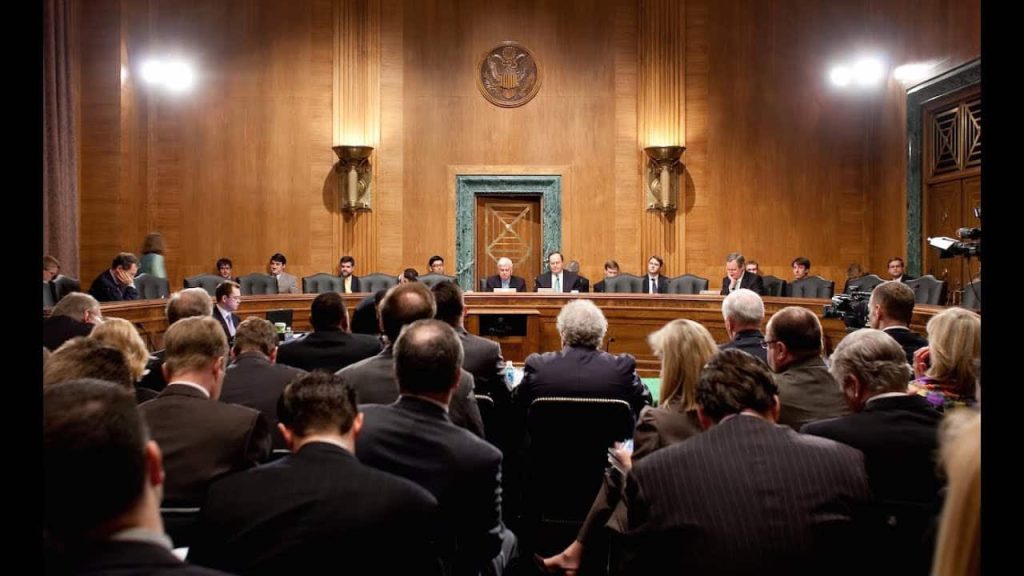
Lummis’s warning is that the committee’s result is irrelevant if floor time disappears. Without those statutory provisions, the operative question of whether a given token is a security remains resolved only through litigation outcome، meaning each institutional actor must either absorb legal risk or abstain. Most abstain.
Jamie Dimon has argued publicly for bank-like capital and AML standards for stablecoin issuers, warning that lighter treatment creates regulatory arbitrage with the banking system.
That concern is legitimate regardless of one’s view on the CLARITY Act، but it underscores that even TradFi actors who want tighter rules need a statutory vehicle to work from.
The Financial Stability Board finalized global crypto policy recommendations in 2023; the EU and Asian regulators are implementing them. U.S. Congress has not yet provided the equivalent foundation.
Discover: The Best Token Presales
Credit: Source link




