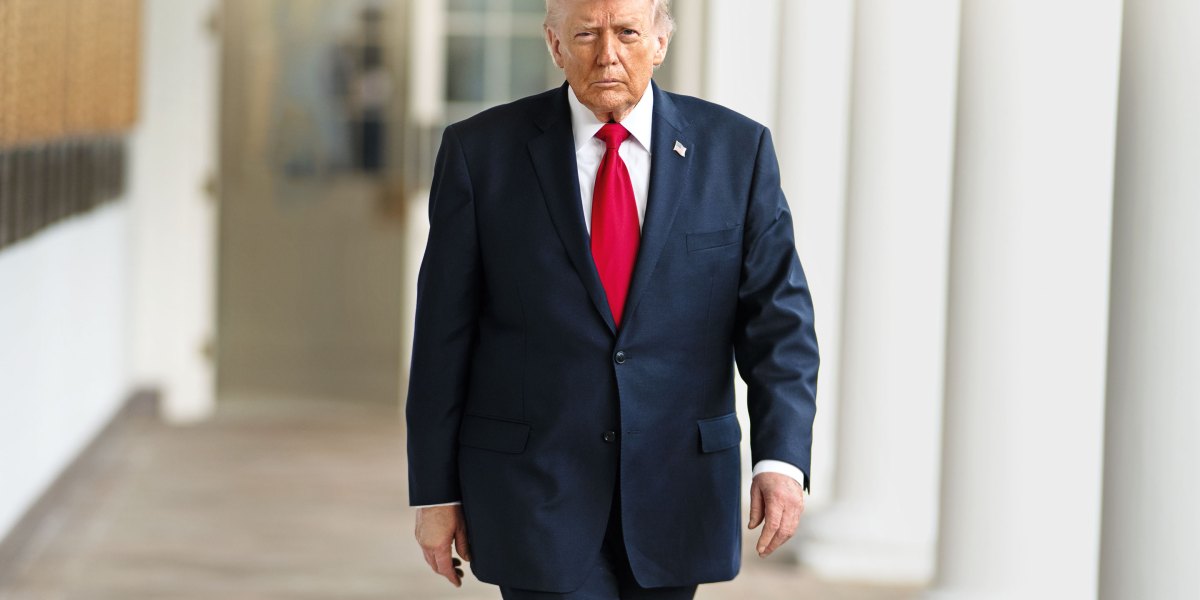
President Trump can’t believe Jensen Huang doesn’t own his own plane.
Hours before he departs for his highly anticipated China summit, the president has been arranging for the billionaire cofounder of Nvidia to join the who’s who of Fortune 500 CEOs preparing to travel to Beijing. Also in the group are Citigroup’s Jane Fraser, arguably the most powerful woman in finance, and Boeing CEO Kelly Ortberg, who recently gave the president an honorary (if slightly tongue-in-cheek) “Salesman of the Year” award for helping the jetmaker sell hundreds of planes.
Huang is a late but welcome addition to the party. For one of America’s most successful CEOs and the man whose company’s chips power the AI boom, the president is happy to make room, and Huang winds up hitching a ride aboard Air Force One, sharing the jet with Elon Musk, among others. The only reason Huang wasn’t included earlier is because he didn’t call to ask.
As I sit across the Resolute Desk from the president in the Oval Office while we talk about his upcoming trip, it’s clear that arrangements like this are exactly the kind of deal the president likes to make—quick, informal, and one in which he can declare himself a clear winner. He prides himself on his ability to get anyone on the phone and achieve measurable results, whether he’s talking with a world leader or an American company he wants to help.
In a wide-ranging conversation that spanned an hour—and covered topics from tariffs to AI data centers to the war in Iran—the president outlined the broader, top-down dealmaking mentality he’s using to try to reinvigorate the American economy. (A small group of Fortune Media executives joined us in Trump’s office; they did not take part in the interview.)
With the help of Wall Street–savvy cabinet members like Commerce Secretary Howard Lutnick and Treasury Secretary Scott Bessent, Trump has turned old economic norms on their head. The president has been an evangelist for a healthy mix of new revenue streams generated by global tariffs and strategic equity investments, alongside trade megadeals designed to lure foreign investment back into the U.S. Trump’s twin goals: ending the trade imbalances that he argues have weakened America, and offsetting the ever-rising national debt.
Brendan SMIALOWSKI—AFP/Getty Images
Past presidents and Congresses, stuck in partisan gridlock, haven’t been able to deliver on these fronts. Trump’s response has been, essentially, to either steamroll or outright ignore the politicos and regulators. It’s a fast-paced one-man show that thrills his fans and makes his detractors sound the alarm on the ethics and the legality of it all.
“I make one of those deals every day that no normal person would make,” Trump says, while telling me about a possible railroad merger that he would want the government to have equity in. Musing on stakes his administration has claimed in companies like Intel and U.S. Steel, he continues, “Some people actually think it’s un-American, what I do. They say, ‘You’re taking their company away.’ ” Those critics aren’t seeing the big picture, he implies; after all, “We have $38 trillion in debt.”
Where the chips fall as a result of all this unorthodoxy—including the long-term, geopolitical reshuffling of alliances and partnerships it’s invoking—is still very much in question. There are enough proof points to suggest that the strategy has some merit, at least under a leader as forceful as Trump. U.S. stocks and corporate profits are showing surprising resiliency, reaching new highs this year—despite the inflation-driving Iran war “detour,” as President Trump likes to call it. The broader public is less convinced: Consumer confidence hit an all-time low in April, and approval of Trump’s management of the economy has plummeted in polls.
Even the bulls, however, have to grapple with some questions about the future. As any executive knows, no sturdy business can be built on the shoulders of a single person. So what will happen when the CEO-in-chief, who’s literally and figuratively remaking the White House, no longer lives there?
Inside Trump’s dealmaking mindset, via the Lincoln Memorial
When our conversation begins, the deal President Trump is most excited to talk about isn’t with Iran, or even with Chinese President Xi Jinping. It involves the iconic Lincoln Memorial Reflecting Pool, which has been leaking and, he says, plaguing the otherwise beautiful National Mall.
“It’s been a disaster ever since it’s been built, because they put granite blocks there, and every stone is going to leak,” he tells me, saying the pool has become almost like a “garbage can.” The plan he says he was pitched to resurrect it would have cost roughly $350 million and taken four years to complete. Instead, Trump says, he found a fix that will cost significantly less. By treating the structure like one of his resort swimming pools—and using a contractor who worked on one of those pools—Trump figures he can keep the granite base, drop in a sturdy, leakproof shell, and voilà: problem solved.
Now, as Trump shows me a dozen images of the project underway, he’s on to which shade the shell should be—American flag blue? Or something darker to hide debris?
The president, of course, first established himself in real estate, and ideas about property keep popping up as we talk. A question about the AI race prompts Trump to recall visiting a vast data center with Meta CEO Mark Zuckerberg. “The Pentagon was always the biggest building ever built,” he marvels. “That’s like a toy by comparison. These are the biggest buildings that anybody’s ever even envisioned.” (Trump now calls Zuckerberg “a very good friend” while quipping, “What a difference between [my] first administration,” when Trump sparred with Facebook repeatedly and later threatened to throw Zuckerberg in jail.)
Even the country’s intractable debt crisis draws real estate analogies. The country’s mounting red ink, the president notes, really is not so terrible if you think of it like a real estate mogul would: What’s the total value of America and its natural assets, he suggests, like the Grand Canyon, or even its surrounding oceans? “If you put down the value of these things, it’s like hundreds of trillions of dollars,” Trump says, and by that measure, “if you kept [the national debt] at $40 trillion, you’re way under-levered.”
As Fortune’s Geoff Colvin recently wrote, a life in real estate has shaped Trump’s leadership and decision-making style. Many big real estate players, including the Trump Organization, are controlled by one person or one family; negotiations happen face-to-face; deals happen fast. And even after five-and-a-half years in office, Trump still gets frustrated when government and policymaking don’t work that way.
Tariffs, equity stakes, and the $38 trillion question
“It really pisses me off,” the president groans, as we delve into the Supreme Court’s recent ruling that roughly half of last year’s Liberation Day tariffs were unconstitutional.
It’s not the ruling per se that he’s upset about, although he’s certainly not happy about it. He can find another way to implement tariffs, he says, just more slowly and under different laws. Instead of the $600 billion a year he estimates the U.S. would have raked in from his tariffs (a figure that has been disputed by some economists as widely overstated), Trump figures the new sum will be chopped nearly in half.
But what has specifically ticked him off is the fact that the ruling didn’t come with an asterisk that would have allowed him to keep all of the tariff revenue collected prior to the ruling. “Can you imagine—to people who hate us, to countries that ripped us off for years, I’ve got to give them back $149 billion.” (Research—some of it disputed by the White House—indicates that most of the tariffs were paid either by U.S. companies that imported goods from abroad, or by the consumers who bought those goods; those companies are eligible to claim refunds.)
There’s something deeper at stake. For decades, President Trump has backed steep taxes on imports, more recently calling tariffs the “most beautiful word in the dictionary.” In his second term, he and Lutnick envisioned tariffs bringing in new, meaningful revenue—even floating the idea of an “External Revenue Service”—that wouldn’t require hitting up Americans for more hard-earned dollars every tax season, or cutting benefits from Social Security or Medicare.
Another tentpole of this revenue strategy, though one involving much smaller sums for now, is corporate equity. On multiple occasions over the past two years, the Trump administration has taken a stake in an American corporation instead of offering a bailout, a tax subsidy, or a grant.
The Trump/Lutnick camp frames this as a smart way to help American businesses that find themselves in dire straits, while also allowing for potential return on investment. If the Treasury could get the kind of returns top venture capitalists and their limited partners make, it could eventually scale up to dent America’s deficit. If a company goes from bankrupt to billions, couldn’t it help Americans to share a piece of the pie?
The bear case: Truly free markets—a foundation of democracy—require the government not to meddle in corporate governance. Government equity stakes could make it highly tempting for a future administration to cross that line. (What’s more, most venture investments flop.)
For Trump, the decision to interject the government into a struggling American business seems to come down to both the opportunity and the ability of its leader to win him over personally. The textbook example of the equity strategy is Intel, in which Trump negotiated a 9.9% stake last summer worth about $10 billion.
The legendary chipmaker was struggling last year with problems including declining market share and a worrisome debt load. “[Intel CEO Lip-Bu Tan] came in to see me,” Trump recalls. “I liked him, I thought he was good.” Trump also had leverage: substantial federal grants for chipmaking that had been earmarked, but not yet delivered, to Intel.
“I said, ‘Give the country 10% ownership for free in Intel,’ ” the president recalls. “He said, ‘You have a deal.’ I said, ‘Shit, I should have asked for more.’ ” The grants were converted into equity in August.
As Trump recounts the story, one of his aides whisks over with a computer printout of Intel’s stock performance chart and drops it into my lap. In just eight months, the government’s Intel position has grown to be worth more than $50 billion, Trump says. “Do I get credit for it? Does anybody even know I did that?”
When I ask what the government’s exit strategy could be, Trump doesn’t seem concerned. He thinks he could sell shares slowly over time without tanking the stock if he communicated his intentions properly to the market upfront.
Intel is a story where Trump’s equity strategy and his obsession with foreign competition intersect. “Intel should be the biggest company in the world right now,” Trump says. “If I had been president when all these companies started sending their chips in from China, I would have put a tariff on that would have protected Intel.” Referring to Taiwan Semiconductor Manufacturing Co. (TSMC), currently the world’s dominant chipmaker, he adds, “Intel would have all that business now, and there would be no Taiwan.”
Another American company experiencing the Trump dealmaker effect is Boeing. Aerospace is the industry in which the U.S. consistently runs a huge trade surplus (about $100 billion in 2024), and Boeing is by far that sector’s biggest exporter. In his flurry of trade diplomacy over the past two years, Trump has frequently nudged allies to commit to buying more jets. Lutnick told the All-In podcast that Boeing executives “follow me around like puppies” because Trump adds 50 to 100 planes to every big overseas deal.
Trump cheerfully tells me about being dubbed “Salesman of the Year” by Boeing CEO Ortberg, saying he’s far exceeded the number of planes sold by the best salesman Boeing itself ever employed. Indeed, three days after I meet with the president, Trump will announce in Beijing that China has agreed to buy 200 Boeing planes.
When I ask Trump what motivates him to moonlight as a Boeing-dealer-in-chief, he replies, “I want to help American companies. There’s nothing in it for me other than I want companies to do well.”
Inflation, war, and the limits of dealmaking
The morning of our meeting, the U.S. Senate approved a procedural vote that cleared the way for Kevin Warsh to be confirmed as the new Federal Reserve chair. That same day, the Bureau of Labor Statistics dropped the latest consumer price index, reporting that inflation had risen to 3.8%, up from just 3.3% the month prior.
The twin events are a reminder both of what the president wants to control, and what he can’t.
Warsh, of course, was vetted and nominated by Trump and shares the president’s general philosophy: Interest rates in America should be lower. Doing so, Trump argues, would not only boost the economy but would greatly reduce a major cost on America’s balance sheet: the roughly $3 billion per day it spends at the current rates to service the $38 trillion debt. (The Fed doesn’t control the interest rates paid on longer-term government debt—lots of factors, including the health of the economy and prevailing inflation, factor into the rates that investors demand when buying bonds—but a Fed chair committed to rate-cutting could presumably help at the margins.)
In the typical Fed playbook, of course, the need to combat inflation and the desire to cut rates are at odds. And with rising oil costs from the Iran war driving up inflation, the president seems resigned to the fact that he may have to wait for more cuts. “You can’t really look at the figures until the war is over,” he concedes.
Inflation, interest rates, and Iran have something in common: They’re problems that can’t be easily solved with personal dealmaking. The complex forces driving the Iran conflict include everything from a global nuclear-arms race to the forces of the energy markets to a seven-decade history of Iranian suspicion of U.S. hegemony. But even in the midst of war, Trump frames Iran’s leadership as though they’re more like a stubborn business rival.
“They scream all the time,” he says of the Iranians. “I can tell you one thing—they’re dying to sign [a deal]. But they make a deal, and then they send you a paper that has no relationship to the deal you made. I say, ‘Are you people crazy?’ ”
‘It’s not going to happen again’
Despite the Iran war and high oil prices, U.S. stocks are reeling off record after record. When I ask the president what he feels is behind the resilience, he replies, “We’re just strong.”
One source of that strength is capital expenditures by major tech companies: Amazon, Meta, and Alphabet, for example, are each pouring over $100 billion this year largely into AI-infrastructure-related expenses that are boosting the tech sector to mind-boggling heights.
Most Americans are not as bullish about AI as the markets are. Studies show the American public, fearing job losses and more social disruption, is significantly more pessimistic than China is about the technology, and some of the president’s AI advisors, like venture capitalist David Sacks, are worried the sentiment could cause America to lose the AI race.
When I ask the president about that anxiety, he doesn’t acknowledge the job fears but merely says that the power of AI can go both ways, and we need to be careful with it. “There’s power for good,” he says. “With medicine, I’ve already seen it.”
He notes that the deal he’s most proud of in AI is helping tech companies like Meta figure out how to build plants that can power their computing needs. “They need two times more electricity than we have right now,” he says. “We are beating China by a lot [in AI] because I allowed these plants to be built. These companies build their own electric units now, they don’t use the grid at all. Otherwise, we wouldn’t be able to compete … It’s important that we win.”
Courtesy of The White House
With all this talk of winning, I have to point out the obvious: None of these America-first deals the president is so proud of seem possible without him at the center. After all, can anyone really say no to the man who has said his power is only limited by his own morality? I ask how the dealmaking flow can be sustained once his term is up.
“Can’t answer that question,” Trump says. “I don’t know. I mean, it’s not going to happen again.”
It’s an answer no CEO could get away with giving—a business built on one person loses most of its underlying value once they leave. Apple, an American innovator turned dominant global success story, shows the value of strong succession plans: If it hadn’t had executive talent like John Ternus to lean on when Tim Cook retires, or if Steve Jobs hadn’t had Cook, the company would have spiraled.
Which tees up my final question: Who does the president feel can best carry on his dealmaking legacy? Don Jr., Marco Rubio, JD Vance? After I pose my question, I realize the vice president has quietly slipped into the back of the room and will catch Trump’s answer.
“Whoever gets this [job] is going to be very important,” the president says. “And if you get the wrong person: disaster.”
Credit: Source link