For as long as accounting has existed, the principle of backup documentation has anchored financial integrity. Every expenditure requires evidence that proves a legitimate purchase occurred. In employee expense reporting, that evidence has long been the receipt.
For decades, receipts were paper artifacts that auditors and approvers could inspect and trust. Even as receipts went digital, from scanned copies to smartphone photos, one assumption remained: If you can see it, you can believe it.
That assumption no longer holds true.
AI has broken the chain of trust
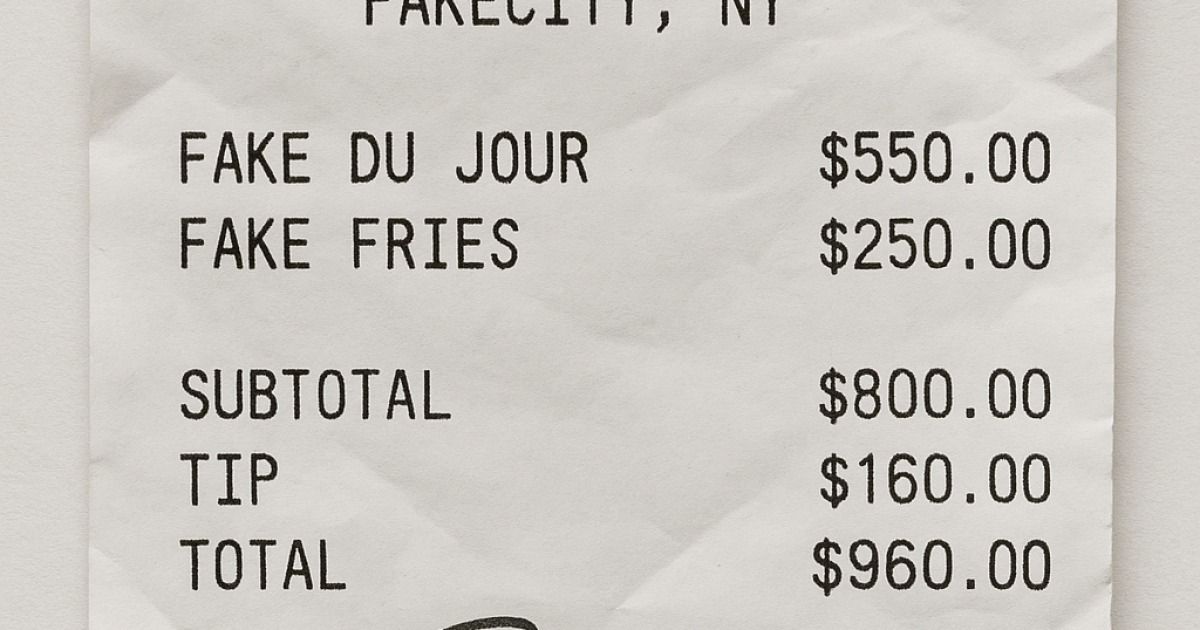
Generative AI has created a new category of fraud risk for accounting and finance teams. What once required a color printer and Photoshop can now be done with a simple text prompt. AI tools can generate receipts that are indistinguishable from authentic ones, complete with accurate logos, barcodes and subtotal math.
Some apps are purpose-built to generate authentic-appearing receipt images. They exist for legitimate reasons such as creating receipts for software demonstration or testing OCR receipt capture. But the same technology makes it trivial for a fraudster to fabricate convincing receipts in seconds.
During my research using one of these apps, I created a fraudulent Home Depot receipt in a few minutes. It was perfect with the correct layout, logo and font, believable line items and a timestamp formatted exactly like a real one. No human reviewer or OCR engine could tell the difference.
The breakdown of image-based controls
This development poses a fundamental challenge to longstanding internal controls. For decades, companies have relied on receipt images to validate purchases and satisfy auditors. Most accounting systems and nearly all expense management platforms still depend on the receipt image as the definitive record of proof.
But if images can no longer be trusted, what remains?
AI has effectively destroyed the evidentiary value of receipt images. A fraudulent image can now pass every conventional test. It looks authentic, the totals match and the metadata can be spoofed. The entire control framework built around seeing and approving has been rendered unreliable.
Finance leaders now face a new reality. The most trusted form of purchase evidence can no longer be verified.
The path forward is modernization, not fear.
What works today
The best way to reduce the risk of AI-enabled receipt fraud is to limit dependence on receipts altogether. That begins with company-paid cards.
When employees use company-paid credit cards, every purchase flows through a controlled channel. Each transaction includes verified data such as merchant name, purchase date and amount. This information cannot be altered by AI and provides finance teams with a trusted record.
Organizations can further limit exposure by allowing out-of-pocket reimbursements only for small incidental purchases under $25, which minimizes fraud and simplifies reconciliation.
Virtual cards build on this foundation. They are a type of company-paid card with stronger internal controls. Virtual cards can be issued for specific purposes such as a project, vendor or purchase type. They can also be configured with strict limits for merchant category, purchase amount and active date range.
For example, if a foreman for a construction company has a virtual card tied to merchants that sell construction materials and tools, the foreman can’t use this card to purchase a television at an electronics store.
Virtual cards extend the fraud protection of company-paid cards. They reduce misuse, improve accountability and simplify reconciliation by enforcing compliance automatically.
Another remedy available today
Modern expense management systems now use data analytics and AI to identify potential fraud. These systems analyze transactions to highlight purchases that are most likely to be questionable. By focusing on the riskiest purchases, automated fraud detection can look for patterns that suggest possible misuse.
While these systems can flag suspicious transactions, they cannot always confirm fraud. In many cases, the only way to prove whether a purchase is legitimate is by reviewing the receipt itself. This limitation points directly to the need for the next stage of fraud prevention.
What comes next
The ultimate solution is verified digital receipts. These are receipts that come directly from the merchant, supplier or point-of-sale system and are authenticated at the source.
A prime example is Amazon Business, which provides digital receipts through integration. Each transaction can be pulled directly from Amazon’s API, ensuring the details itemized — SKUs, quantities, prices and timestamps — are accurate and untampered.
When data comes directly from the source system of record, it carries digital trust. Fraudulent receipts, even AI-generated ones, become irrelevant because they’re excluded from the process entirely.
Verifiable purchase data authenticated at the point of sale is the model accounting teams should pursue.
A shift in verification philosophy
The implications of AI-generated receipts extend beyond expense management. They expose a broader vulnerability in accounting and audit processes that rely on static artifacts rather than verified digital data.
In the coming years, we’ll see a shift from document validation to data provenance, the ability to verify where data originated, when it was created, and by whom.
Eventually, technologies such as blockchain may underpin universal transaction verification, allowing suppliers and POS systems to write immutable purchase records directly to public ledgers.
For now, the key is to recognize that fraud prevention in the AI era is a layered defense built on control, traceability and source authenticity and not on human review of images that can be faked.
The path forward
AI-generated receipts represent a new kind of challenge for accounting and finance teams. The issue is not outdated systems or careless employees. The issue is that a new threat has emerged faster than the technology to defend against it.
As history shows, innovation often outpaces control. Fraud detection, policy design and internal controls are now catching up to a world where images can be fabricated with perfect realism. The systems we have today are not obsolete. They are simply operating in a time when the next generation of verification technology has not yet arrived.
Until verified digital receipts become widespread, organizations can strengthen their defenses by using company-paid cards, issuing scenario-based virtual cards and applying AI-driven fraud detection. These measures create a layered defense that makes fraudulent purchases harder to execute and easier to detect.
The future of expense verification lies in data that is digitally verified at the source. Until that future becomes reality, the goal for finance leaders is to modernize carefully, layer intelligently and recognize that integrity depends not on images but on information that can be trusted.
Credit: Source link