
Technology Reporter
 Fermentalg
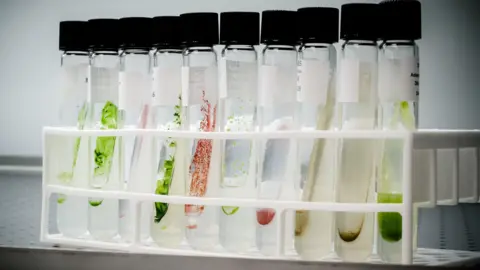
French firm Fermentalg has been all over the planet in its search for useful microalgae.
“One of our lucky scientists got to go and climb the volcanoes in the Caribbean for example, and I have to restrain myself from collecting more every time I go home to New Zealand,” says Hywel Griffiths, chief scientific officer at Fermentalg.
There are hundreds of thousands of species of microalgae – microscopic organisms, which mostly live in water. They are essential to the aquatic food chain and also produce half the oxygen we breathe.
Some are already used commercially, to make food, animal feed and fertiliser.
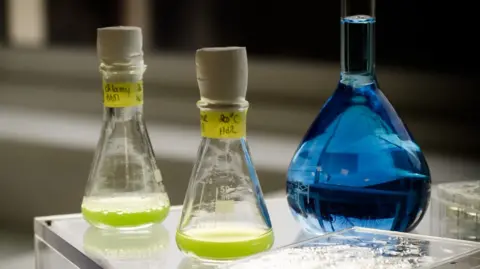
But for Fermantalg one particular type, Galdieria sulphuraria, has a very useful trait. It can be used to produce a pigment, suitable for use in food, called Galdieria blue.
“We grow the algae and make a lot of it under conditions which make a lot of this particular molecule – the blue,” says Mr Griffiths.
The pigment can be used for any food and drinks and Mr Griffiths expects the first products using Galdieiria blue will be on shop shelves early next year.
Galdieria blue was approved by the US Food and Drug Administration (FDA) in May, along with Butterfly pea flower extract (also a blue colour) and calcium phosphate (white).
The FDA also approved Gardenia blue earlier this month.

 Fermentalg
New sources of colour for food are needed as artificial food dyes are on their way out.
In January, the FDA announced the banning of Red Dye No. 3 in food products.
In addition, the FDA is looking to phase out petroleum-based synthetic dyes such as Yellow Dye 5 and 6 by the end of next year as part of the government’s mission to “Make America Healthy Again”.
“For the last 50 years, American children have increasingly been living in a toxic soup of synthetic chemicals,” FDA commissioner Marty Makary said at a press conference in April.
Though not an outright ban, the FDA is hoping the food industry voluntarily complies to eliminate artificial food dyes by 2026.
It comes after years of pressure from parents and campaigners for the FDA to revoke approval for dyes or educate consumers more about the risks.
In recent times, many US states have made their own moves to pass laws to remove artificial food colouring dyes.
Countries differ on the restrictions they have in place. Historically, the UK and the European Union have been stricter than the US.
The EU has been phasing out artificial colourings over the last 20 years and also introducing warnings on foods with other colours.
 Sensient
So, these are good times for firms developing natural alternatives.
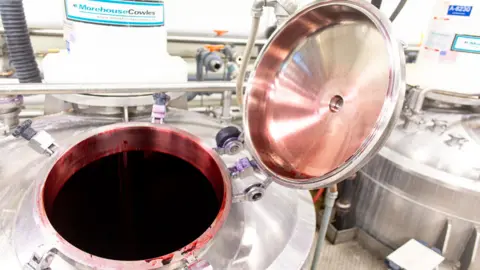
US-based Sensient creates natural colours by sourcing raw materials that are grown specifically for their colour content. For example, some red and purple colours are derived from carrots and potatoes.
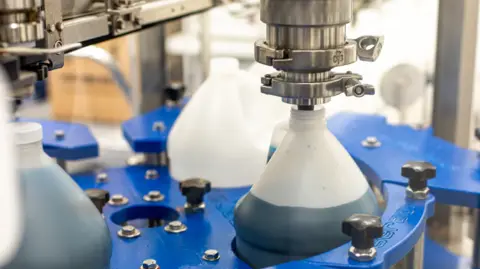
“These crops are harvested, washed, processed into a juice, and the colour is extracted with water or other solvents,” says Paul Manning, chief executive officer at Sensient.
“The resulting colour is further processed to stabilise the concentrate and refine it to the specific shade desired by the customer.”
But the hard work will be trying to match the synthetic colour. “It must be equally vivid,” says Mr Manning.
“There are plenty of examples of brands converting to natural colours with less vivid and vibrant shades where the product does poorly in the market and customers complain about both the colour and the flavour.”
Getting a stable, bright colour also involved much work for Fermantalg.
“To our surprise we found that the process of growing the algae and the process of extracting the colour can actually have a fairly significant impact on the stability of the product at the end, even though it’s fairly heavily purified,” says Griffiths.
“But something that we’ve done upstream is having an impact on how stable it is at the end.”
Will these new colours cost more?
“They are more expensive, but in actual contribution to the end product, they’re not actually that big an impact because these things are used at a fraction of a percentage in the final product,” says Mr Griffiths.
“If you had a nosebleed and stood over the sink… you know that a little bit of colour goes a long way.”
 Sensient
For the brands that have long relied on artificial colourings, it’s an upheaval.
“We are reformulating our cereals served in schools to not include FD&C colours by the 2026-27 school year,” says a spokesperson for WK Kellogg, the company behind Kellogg’s.
FD&C refers to certain certified synthetic colour additives regulated by the FDA, and approved by the Federal Food, Drug, and Cosmetic Act.
Last year protesters gathered outside the company headquarters in Michigan, calling on it to remove artificial dyes from cereals such as Froot Loops.
“We will not be launching any new products with FD&C colours, beginning in January 2026,” the spokesperson said.
This year food giants including Nestle, Kraft Heinz, General Mills and Conagra have all pledged to phase out artificial food colourings.
One of the challenges for food brands reliant on artificial colouring is that many natural food dyes don’t necessarily have a long shelf life, says Institute of Food Technologists food scientist Renee Leber.
“Whereas synthetic dyes will outlive the shelf life of pretty much any product.”
She also says that as many brands rush to make the switch it’s going to lead to a “bottleneck” in production.
“We don’t necessarily have all these colours available. But we have 10 months to get that right.”
Given this isn’t an outright ban, is it still expected to lead to sweeping change in the US food industry?
“If you are a cereal company and you have a brightly coloured cereal and all of your competitors switch from synthetics to natural colours, then you don’t necessarily want to be the last one,” says Ms Leber.
“It’s a tight timeframe but companies are doing their best to comply.”
Credit: Source link