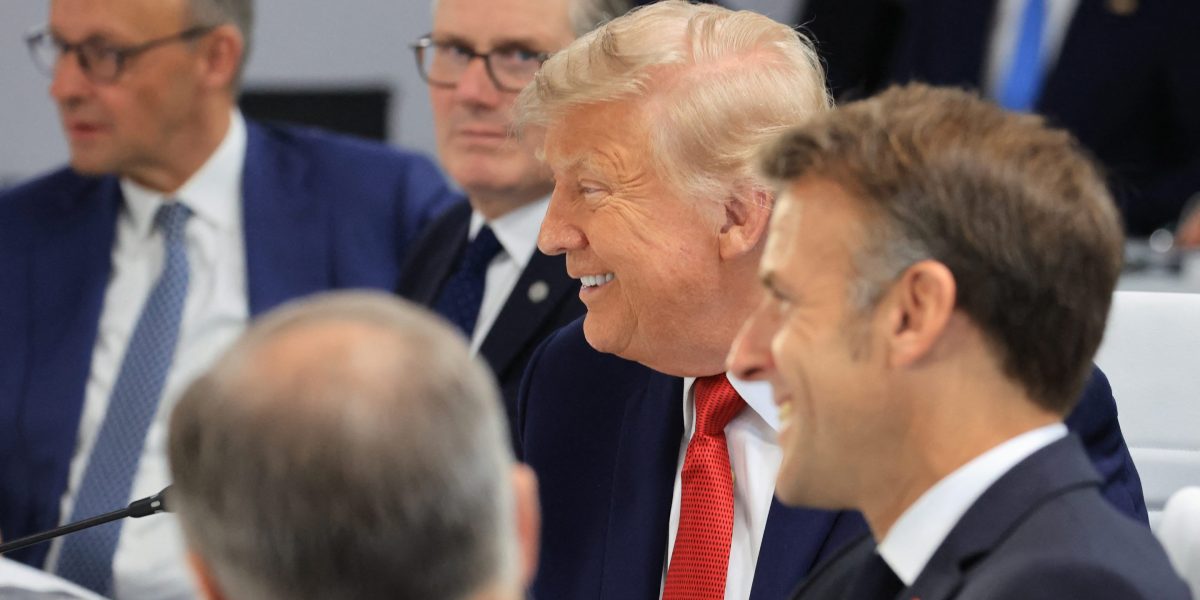
The U.S. and six of its allies are tackling their dependence on China and its effective chokehold on rare earth minerals. At the Group of Seven summit in France on Wednesday, the countries pledged to ensure that no single nation can supply more than 60% of rare earth imports by 2030.
Issued by the G7 in a joint statement, the pledge looks to reduce the countries’ dependence on China for the raw materials behind military technology. The leaders of the U.K., Canada, France, Germany, Japan, Italy and the U.S. said they plan to get to 50% “as soon as possible,” according to the statement. As of last year, China accounted for nearly 70% of rare earth production.
“It’s definitely a bold target,” said Cirba Solutions CEO David Klanecky, an expert with more than 30 years of experience in critical minerals. “If you don’t set a goal on a target for people to achieve, then nothing will happen,” he told Fortune.
The urgency stems from the fact that China is set to reinstate its initially postponed export controls on rare earths critical to defense systems on Nov. 10 – put in place in a yearlong truce with the Trump administration after his worldwide reciprocal tariffs set off a global trade war. Since another moment of global trade being reshaped in 1973, the G7 group of liberal democracies has met annually to set policy, and this year clearly has China on the agenda.
G7 summit participants Japan, the EU and the U.S. account for over half of global rare earth magnet imports, with China acting as the main supplier, according to a United Nations critical minerals trade report published in June. While rare earths themselves are just a group of 17 naturally occurring chemicals, rare earth permanent magnets–what the G7 explicitly named because China accounts for 95% of permanent magnet production–are made from separating and then recombining specific elements that let manufacturers build lighter and stronger motors and electronics.
These magnets are then embedded in drones and precision weapons, making them a national security chokepoint, according to Goldman Sachs. They’re also vital for the electric vehicles and wind turbines powering Europe’s energy transition goals.
The UN’s critical minerals report found that China has issued 16 trade restrictions on those critical energy transition materials since 2020, cutting off the supply to the United States and some of its allies. Most famously, this happened last year in response to U.S. tariffs. If China’s export controls were “fully implemented,” up to $6.5 trillion of economic activity outside China could be at risk annually, an 2026 International Energy Agency report found.
“The worst-case scenario would be that no new supply from China comes online within the next four years—we’re looking at a China that is increasingly aggressive in the Taiwan Strait—and that we continue to be dependent for building military technologies on Chinese imports,” Meredith Schwartz, an associate fellow for the Critical Minerals Security Program at the Center for Strategic and International Studies, told Fortune. “China can continue to use that economic chokepoint to cut off our industries from those necessary materials.”
Opportunity for the United States to help
China dominates rare earth refining, creating a “critical bottleneck” and “high barriers to entry for new players” because of how energy and capital intensive the process is, per the UN report.
But some of the few non-Chinese rare earth refiners are based in the United States and are specifically targeting the G7’s magnet needs.
For instance, USA Rare Earth extracts, processes and manufactures rare earth elements and permanent magnets in an attempt to make the country’s first “mine to magnet” supply chain. The CHIPS and Science Act gave the company $277 million in federal incentives to build production capability for up to 10,000 tons per annum of rare earth metal alloy.
A spokesperson for USA Rare Earth told Fortune that the company is “pleased to see the continued focus of the G7 on creating a Western value chain of rare earth elements” and wants to be the “partner of choice” in the endeavor.
“We believe USA Rare Earth is well positioned to produce sintered neodymium-iron-boron (NdFeB) permanent magnets commercially and is actively building a value chain to scale production,” the spokesperson said over email.
Another company, MP Materials, has rare earths processing facilities in Fort Worth, Texas and Mountain Pass, California. Mountain Pass is the only commercial-scale rare earths mine in the country, and MP recently received a $150 million loan from the Department of Defense to enhance Mountain Pass’s rare earths separation capabilities.
When reached for comment by Fortune for the company’s reaction to the G7 pledge, spokesperson Matt Sloustcher confirmed that MP Materials “is playing, and will continue to play, a leading role in the rapid diversification of the global supply chain.”
MP is also building a second Texas-based facility that, combined with the Fort Worth one, can produce 10,000 metric tons of rare earth magnets, Sloustcher stated.
But critical minerals expert Schwartz cautioned against getting too excited about developments in the U.S. space because China still dominates heavy rare-earth mining, while the U.S. is mostly dealing with light rare-earths. She pointed to Japan, where “it’s taken over 15 years” for it to “make a significant dent in its dependence on Chinese rare earth materials”.
“There isn’t really large-scale production of those heavy rare earths currently, and we will need to increase production of those materials specifically in order to have a rare earth magnet supply chain that is really cutting dependence on China,” Schwartz said.
Credit: Source link