In the 1993 blockbuster film Jurassic Park, Jeff Goldblum’s character, Dr. Ian Malcolm, explains chaos theory—commonly known as the butterfly effect—the concept that even the smallest events, like a butterfly’s wing flap, could set off a chain reaction with wide-ranging repercussions. “If there’s anything the history of evolution has taught us, it’s that life will not be contained,” he said. “Life breaks free, it expands to new territories and crashes through barriers, painfully, maybe even dangerously.”
In a recent Economic Compass outlook report, KPMG chief economist Diane Swonk references Goldblum’s lines from the classic sci-fi to illustrate how the war in Iran could send a ripple effect across the global economy, and ultimately weigh on American households amid an already-dire economic landscape.
Swonk lays out two possible scenarios for the war. The first, Swonk calls the “base case.” It imagines a world where the war continues for several weeks, keeping the Strait of Hormuz closed for that period. Yet in that scenario, President Donald Trump ultimately relents near the end of March and oil prices ease, but a “risk premium” remains assuming some oil production sites are damaged. The second scenario imagines a war extending for three to six months, with significant damage to regional oil production and infrastructure, sending oil prices north of $130 per barrel. In this scenario, oil prices would remain above pre-conflict levels for almost a year.
In the scenario where the war continues for months and oil production is severely hindered, Swonk predicts core inflation could rise 4.1% by the end of the year, a rate not seen since May 2023. But even in the base case, Swonk predicts a spike in inflation in the fourth quarter of 2026, rising 3.3% year over year.
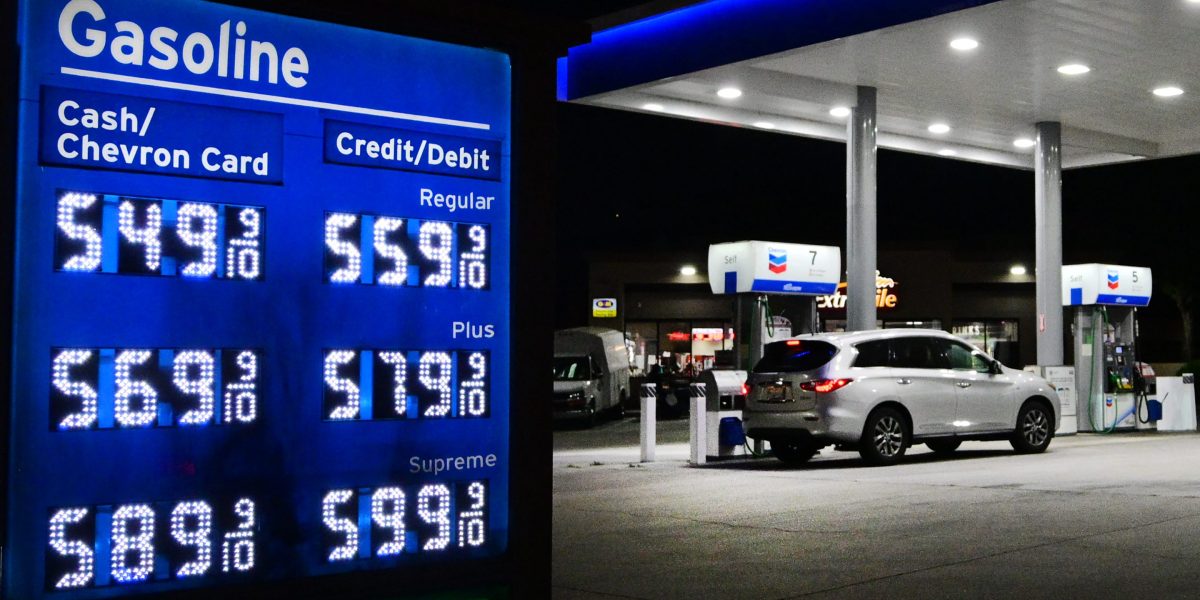
The conflict in Iran piles another level of uncertainty on top of an already fragile U.S. economy. Oil prices briefly shot up to almost $120 per barrel Monday, their highest since 2022, a day after the hardline Ayatollah Mojtaba Khamenei was chosen as the successor to his late father, Ali Khamenei, as Iran’s supreme leader.
Aside from oil, the labor market has cooled, posting dismal numbers in February, with signs that even the most reliable sector for hiring, health care, is wavering. Inflation has also proved hard to bring down to pre-pandemic levels. And consumers are spending more cautiously (save for the ultrawealthy) constrained by rising food and energy costs. But even as Americans prepare to receive higher-than-average tax refunds, Swonk said it’s uncertain what route the U.S. economy will take in the near future.
“An oil shock against the backdrop of fiscal stimulus adds another layer of complexity,” Swonk wrote. “Much like we saw in the wake of the pandemic, those changes could trigger a longer-lasting bout of inflation, like the one which is still with us five years after it started.”
The butterfly effect
Oil production can’t simply be turned off and on like a light, as Swonk highlights. “The problem is that oil production in the Gulf states is shutting down,” she wrote. “It is easier to turn off that production than to ramp it up; the latter takes time and that is assuming only minor damage.”
The baseline scenario assumes the war could wrap up by the end of March. Though even with that timeline, oil prices could remain elevated for weeks as it takes significant time to ramp up idled production and address infrastructure damage. If the war continues for months, they could remain above pre-conflict levels until late 2026 or early 2027, according to the analysis.
It’s unclear when exactly the war will end, as Trump has offered conflicting messages as to his planned endgame. The president said Wednesday the war would end “soon,” telling Axios there is “practically nothing left” to target. But Iran has said it’s ready to fight a “long-term war of attrition,” signaling the war could extend beyond the framework Trump has suggested. On Monday, Trump said, ‘We’ve already won in many ways, but we haven’t won enough.”
Those repercussions would flutter out to other parts of the economy. Higher inflation would most likely sideline the Fed for longer, delaying further rate cuts until the beginning of 2027 if the war continues for months, according to the analysis. Elevated oil prices would also hinder growth, according to Swonk’s assessment. In the first scenario, the economist predicts GDP growth could dip below 2% in the last two quarters of 2026. That dip would be even more extreme given a longer war, growing at a rate of just 1% in the third quarter of 2026 and 1.4% in the fourth quarter, though paired with a modest rebound of growth in the third quarter of 2027, at 2.9% at an annualized rate.
Whatever ultimately plays out, Swonk cautions that the Middle East conflict is sure to impact the U.S. on one scale or another given the fragility of the current economy. “The butterfly effect offers a useful reminder: in fragile systems, small shifts can generate outsized and unpredictable consequences,” she wrote.
Credit: Source link