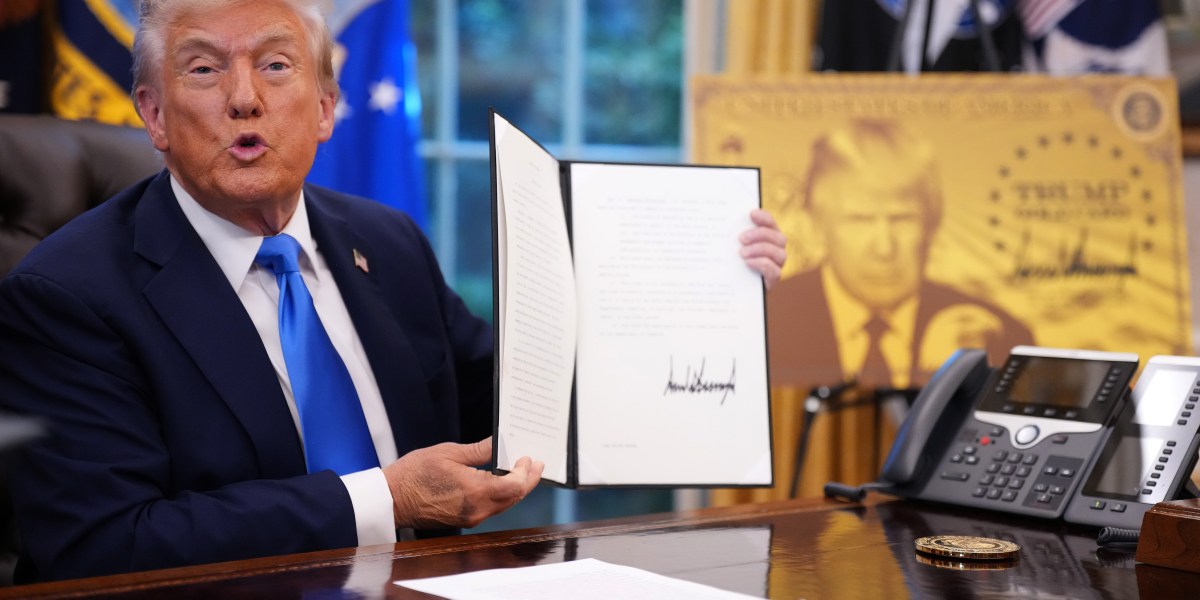
As the global AI arms race heats up, the Trump administration has introduced a new obstacle for U.S. startups: a $100,000 H-1B visa fee.
The move, which is part of a wider immigration crackdown from the Trump administration, could be a blow to the U.S. tech sector, which relies heavily on skilled workers from India and China, and could put pressure on the already-strained AI talent pool.
The new fee could make it especially hard for startups to hire elite engineers, which could slow wider innovation and experimentation. It also risks inadvertently concentrating top talent within Big Tech firms, which can afford to pay the new fees, and pushing skilled workers overseas, weakening the U.S. AI ecosystem and reducing diversity in research and development.
Tech companies, including leading AI firms like Microsoft, Google, and Meta, make up nine out of the top ten companies that most frequently use the visa. Just under half of all H-1B visas in 2025 were designated for the professional, scientific, and technical services industry, according to data from the U.S. Department of Labor.
“I don’t see how these changes will help American workers, and it will for sure hurt the American tech ecosystem, which is powering our economy,” Greg Morrisett, the Dean and Vice Provost of Cornell Tech, said. “The U.S. leads in tech innovation because it has attracted the very best talent from around the world.”
The global war for tech talent, especially AI talent, is already fierce, with some of the biggest companies offering all-star athlete-level salaries for the most desirable candidates, leaving startups struggling to recruit and hold onto talented staff.
Gary Tan, the CEO of Y Combinator, said the new fee “won’t bother big tech,” but it would “kneecap startups and bodyshops the same.” Companies like Meta, which are already reportedly paying some of their top AI talent compensation packages that exceed $100 million, will likely shrug off the new fees, but more cash-strapped startups will struggle to foot the extra cost.
Catherine Betancourt, a partner at a US visa law firm in London, told Fortune that while large tech firms could be very affected if they rely heavily on H-1B workers, “smaller employers are likely to be more severely affected than large tech firms as the fee for even one H-1B employee could be impossible to pay.”
Managing to secure a few H-1B visas can have a serious impact on a startup’s overall success. An NBER paper from 2020 found that startups with higher rates of H-1B visas are more likely to secure top VC funding, generate more patents, and achieve an IPO or acquisition. Gaining just one extra high-skilled worker raises the probability of an IPO within five years by 23%, according to the research.
“Early teams can’t swallow that tax,” Tan wrote in a post on LinkedIn. “Bodyshops who abuse H1B should be stopped. There are ways to do that without entrenching big tech and throttling startups.”
AI talent could flow overseas
There’s also concern that U.S. companies could start offshoring talent in response to the new fees.
A 2023 research paper from Britta Glennon, an assistant professor of Management at the Wharton School, found that restrictions on skilled immigration (like H-1B visa limits) can push U.S. multinationals to shift jobs abroad, especially to China, India, and Canada. Indian workers received the bulk of H-1B visas in 2024, accounting for 71% of the total approved H-1B beneficiaries in 2024 (just over 280,000 visas). Chinese workers were the next largest group, with 12%.
On average, Glennon found that each visa rejection leads to 0.4 new foreign hires, rising to 0.9 for the most globalized firms. This means that overseas AI hubs, such as neighboring Canada, could also see benefit from a hiring boom if talent starts to flow elsewhere. Tan called the new fee a “massive gift to every overseas tech hub,” adding that tech hubs like Vancouver or Toronto will thrive instead of American cities.
“In the middle of an AI arms race, we’re telling builders to build elsewhere. We need American Little Tech to win—not $100K toll booths,” he said.
European countries could also benefit, especially the UK, where tech giants such as Microsoft and Google DeepMind already have large AI hubs.
“With many global tech firms already established in Britain, and advantages like the English language and proximity to Europe, the UK is well-placed to attract a surge in high-skilled visa applications,” Chetal Patel, head of immigration at Bates Wells, told Fortune. “The UK, despite its own immigration cost, suddenly looks like a better deal.”
“While the UK’s Immigration Skills Charge already places a financial burden on employers, it pales in comparison to the punitive US fee hikes announced under the H-1B visa,” she added.
Credit: Source link