The U.S. leads the world in both crude oil and natural gas production, but the top exporters are already shipping near their capacities, allowing them to reap larger profits but not fill the supply gaps caused by the temporary loss of 20% of global oil and liquefied natural gas (LNG) volumes triggered by the effective closure of the Strait of Hormuz near Iran.
President Donald Trump’s pledge late on March 3 to insure and protect oil and LNG tankers in the effectively shuttered waterway helped stop the surge in oil and gas prices. Energy analysts have pointed to expensive or unavailable insurance coverage as a key reason for the lack of traffic, in addition to the threat of attacks. But the unprecedented explosion of a Russia-flagged LNG tanker in the Mediterranean added more unease to global energy markets. Reuters reported that Ukraine was suspected of a drone attack on the vessel.
Oil, natural gas, and retail gasoline prices in the U.S. all continued to rise on March 3, but not nearly to the extent of natural gas prices in Asia and Europe, which rely much more on the oil and Qatari LNG volumes that make up nearly 20% of global supplies.
“The European [gas] benchmark soared 90% in the past two days, and Asia’s [benchmark] also jumped,” said Pavel Molchanov, Raymond James investment strategy analyst. “These economies rely on imported LNG, so they are affected by the disruption in Qatar’s LNG exports. As the world’s largest LNG producer, the U.S. doesn’t have the same worry as Europe or Asia—in fact, it could benefit.”
The narrow, 104-mile Strait of Hormuz is the main choke point separating the Persian Gulf—and the daily flow of nearly 20 million barrels of oil—from global energy markets. Qatar took its LNG production offline March 2 as embattled Iran launched more strikes on its neighbors.
Without providing details, Trump said on social media March 3 that the U.S. would begin offering “political risk insurance and guarantees for the Financial Security of ALL Maritime Trade, especially Energy, traveling through the Gulf.”
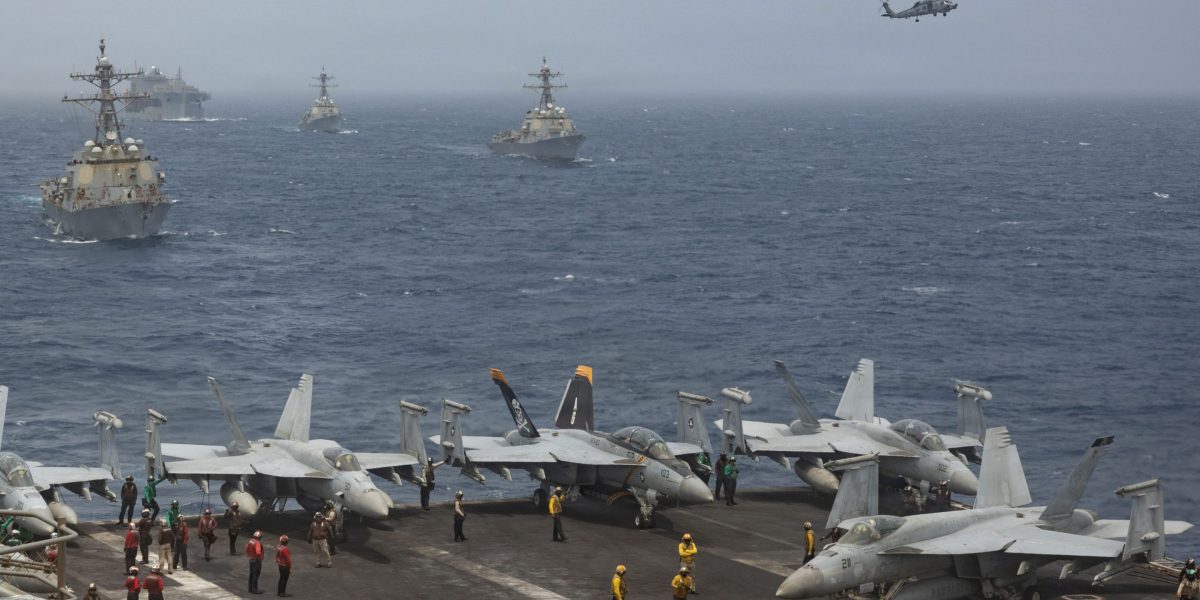
“If necessary, the United States Navy will begin escorting tankers through the Strait of Hormuz, as soon as possible,” Trump added. “No matter what, the United States will ensure the FREE FLOW of ENERGY to the WORLD.”
That announcement came soon after the Russian-flagged tanker Arctic Metagaz was on fire off the coast of Malta. The vessel was under U.S. and U.K. sanctions.
Mathieu Utting, global gas and LNG analyst for Rystad Energy, told Fortune the massive Middle Eastern energy disruption would have been much worse at the beginning of winter when gas heating demand was rising.
Because China is the leading importer of both Middle Eastern oil and Qatari natural gas, it should only be a matter of time before China pressures Iran to let volumes flow through the strait, Utting said.
In the meantime, U.S. exporters will “definitely profit more,” Utting said. Nearly 15% of U.S. LNG volumes are uncontracted and can be sold on spot markets at higher prices. Also, many of the LNG buyers are Big Oil giants or global commodity trading houses that can redirect the volumes as needed. They just can’t increase the volumes much at all.
Mike Sabel, CEO of Venture Global, a leading U.S. LNG exporter, said on a March 2 earnings call that his company has the “most available cargoes” to sell on the spot market. And because Venture Global owns a lot of its tanker fleet, it doesn’t need to cover higher tanker costs.
“There are markets in Asia that are also heavily reliant on Qatar supply. Every day that ships can’t flow through, that creates a lot of backup and incremental demand,” Sabel said. “We’re uniquely able to move cargoes with our own vessels in this market.”
Any day now, the new Golden Pass LNG facility—owned by Qatar and Exxon Mobil—could come online along the Texas Gulf Coast to export more volumes. Exxon chairman and CEO Darren Woods recently said the first LNG production should begin “in very early March.”
Exxon declined further comment, but its senior vice president Jack Williams spoke March 3 at the Morgan Stanley Energy & Power Conference about its ability to move oil and gas worldwide.
“We have a big trading operation that we operate, and a large, long-term charter fleet, so we can move feed, and we can move products around the world to optimize around this situation,” Williams said.
He added that the U.S. is much more insulated that the rest of the world because of its world-leading production. Still, that hasn’t stopped the U.S. oil benchmark from rising almost 30% since the beginning of the year because of the Iranian conflict.
Nikolas Kokovlis—NurPhoto/Getty Images
View in the Middle East
In the meantime, energy companies operating in the Middle East are largely implementing shelter-in-place situations for their employees or even beginning to evacuate families.
Exxon’s Williams said the company has employees in Saudi Arabia, Qatar, and the United Arab Emirates. “We’re focused on their safety as our top priority,” he said.
French Big Oil giant TotalEnergies said it is taking a step further to start evacuating the families of employees as needed.
“Considering the crisis in the Middle East, TotalEnergies has decided to organize the return of employees’ families present in several countries in the region,” the company said in a statement. “To this end, TotalEnergies has mobilized logistical resources and is coordinating its actions with local authorities.”
OPEC top producers, including the Saudis and the UAE, are pledging to ramp up their oil volumes to help solve the growing energy crisis, but they can only do so much without tankers moving through the Strait of Hormuz.
Still, they’re not completely blocked. Saudi Arabia, for instance, can move more volumes on its East-West Crude Oil Pipeline and export more shipments through the Red Sea and Suez Canal, said Matt Reed, vice president of geopolitical and energy consultancy Foreign Reports.
“I think the market is still taking a wait-and-see approach. Prices have jumped, but not nearly as much as they could,” Reed told Fortune.
Iran has targeted energy assets in some countries, including Saudi Arabia, Qatar, and Kuwait, but those are moderated, seemingly calculated attacks thus far, Reed said. If Iran and its proxies—Hezbollah and the Houthis—launch a barrage of attacks on energy production and exporting facilities, then the worst-case scenario could unfold.
“That is the path of no return. There’s no off-ramp there,” Reed said, noting that’s when oil prices would surge well above $100 per barrel.
Reed asked, how much is Iran restraining its attacks thus far? And how quickly will Iran’s military capabilities be weakened to the point that it can’t seriously lash out?
“Those are the two questions that will determine whether this gets much worse.”
Credit: Source link