
In a report from May 2023, Google states that “with Consent Mode in place, Air France’s visible conversions rose by 9% across Europe” after experiencing a 20% drop in conversions due to recent cookie guidance compliance.
![Free Resource: Website Optimization Checklist [Download Now]](https://no-cache.hubspot.com/cta/default/53/00d9cc96-eff7-4cea-8ff3-583374c3dcd5.png)
How can a company benefit from more accurate measurement as privacy regulations become increasingly strict? Consent Mode is the solution proposed by Google to continue providing valuable insights in a privacy-first digital world.
This guide has everything you need to know about Consent Mode, including what it is, why it should matter to website owners or advertisers, and how to activate it in no time. Let’s dive in.
Table of Contents
What is Google Consent Mode?
Google Consent Mode is a solution designed by Google to help businesses cover for measurement gaps when users decline to share their data, typically via the “Reject” button on the website’s cookie banner.
For visitors who do not grant their consent, companies are still able to get some crucial trends using existing data from consenting users. More on “how” later.
In a nutshell, we can say that Consent Mode helps advertisers, publishers, or website owners comply with the consent requirements set by data protection laws (like the GDPR) while still leveraging Google services (such as Analytics and Ads).
Who is Google Consent Mode for?
Consent Mode is a solution developed by Google for customers who use audience features for the following products:
- Google Analytics
- Google Ads
- Floodlight
- Conversion Linker
If you’re an advertiser, publisher, developer, or website owner with a presence in Europe, consent is usually required to carry out marketing activities. These include serving personalized ads or collecting analytics via trackers.
If that’s your case, I’d recommend looking into Consent Mode.
How does Google Consent Mode work?
Consent Mode strikes the perfect balance between respecting user privacy and collecting valuable data insights.
To respect user consent, it adjusts how Google tags behave based on the consent status for advertising or analytics trackers given on the website’s banner. When consent is denied, tags aren’t loaded and trackers aren’t used. No data is collected on the user.
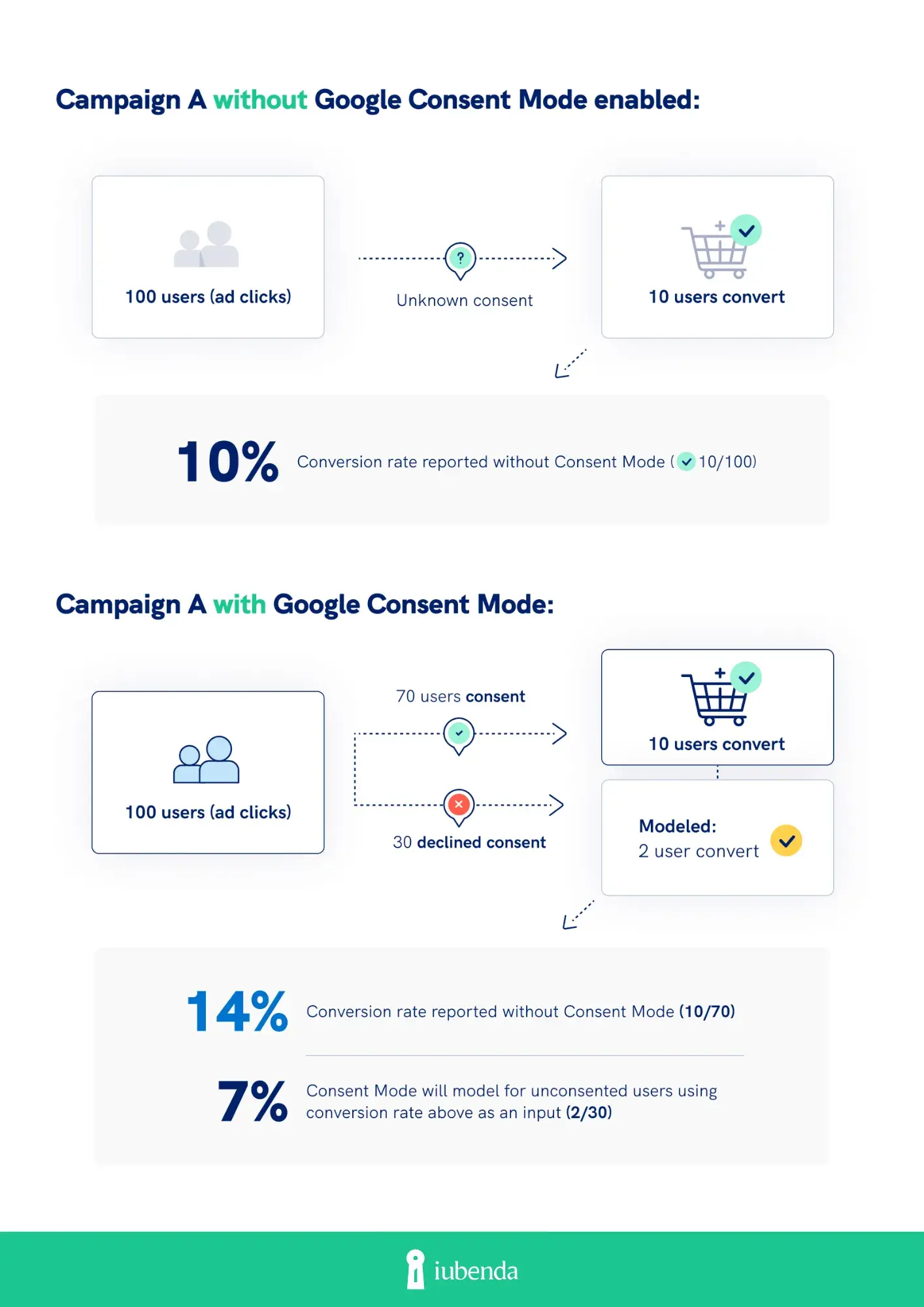
To add value for Google users, it uses a technology called conversion modeling to recover lost conversion data for users who didn’t consent and to get an improved view of performance.
More on Conversion Modeling
Without getting too much into the technical details, conversion modeling uses AI, probability, and machine learning to analyze observable data and trends from users who gave their consent.
It then models paths and quantifies the relationship between consented and unconsented users to report conversion data for all visitors.
The key takeaway here is that conversion modeling measures a significantly more accurate conversion rate without using any identifying information — so it doesn’t violate privacy.
What are the benefits of Google Consent Mode?
Let’s start with a practical example.
Example: Volkswagen Belgium
This 2024 case study of Volkswagen Belgium is probably the best way to demonstrate the significant impact Google Consent Mode can have on your business.
As a car company, Volkswagen gathers data on potential car buyers through cookies to understand how they interact with their website.
This is crucial for them as “the more insights [they] have […], the more effective and efficient [their] campaigns can be.”
What they realized is that in the past years, users became more privacy-conscious. This led many to opt out of analytical cookies.
“For some brands, the consent acceptance rates dropped 20% in just two years,” cites the article. What did this mean? A loss of valuable data and a distorted view of reality since user activity could not be tracked.
They implemented Consent Mode and have been able to recover nearly all 20% of data lost from the drop in cookie acceptance.
In turn, this gave them a more accurate view of performance and helped with optimization, allocation, and ROI calculation of media campaigns.
Why Google Consent Mode Is Worth Using
Here are the reasons why I believe Consent Mode can become a game-changer for you:
- With a legally-required consent banner in place on your site, users can deny consent to tracking.
- For you, this means losing the opportunity to collect precious data on these users since you can’t track them.
- This results in gaps in measurement and fewer insights from existing campaigns.
- With Consent Mode activated, you respect user consent AND continue reporting conversions.
- That means you’re learning more about your ad spend, and you can effectively attribute conversions to the right campaigns.
- You can also leverage bids better, reallocate budget to your best-performing campaigns, or target specific audiences.
The bottom line: Google Consent Mode can allow you to better optimize your marketing efforts and boost your revenue.
How To Activate Google Consent Mode
There are various ways to implement Consent Mode, some more technical than others. That’s why I’ve decided to focus on the one method that was recommended by Google in their main user guide.
Best Practice: Use a Consent Management Platform.
A Consent Management Platform (CMP) is a software solution designed to collect, store and manage user consent for specific data collection activities (i.e., analytics, advertising, retargeting) via a consent banner on a website or app.
To simplify the Consent Mode activation process, Google has specifically selected a list of CMP Partners that can support this.
These Google-certified CMPs can help you install a banner on your website with Consent Mode built in. Some leading tools include iubenda, Didomi, consentmanager, or Osano.
These solutions are the key to a quick, simple, and reliable activation. They allow for a full banner customization that complies with major consent regulations like the GDPR and Cookie Law, as well as Google’s EUUCP policy.
When using a CMP, Consent Mode is usually enabled by default. It can also be configured via Google Tag Manager.
New Implications for 2024: Google Consent Mode Version Two
Initially introduced in 2020, Google Consent Mode was revised at a pivotal moment in the digital industry.
With a growing need for transparency and fairness online, the enforcement of a new EU law called the Digital Markets Act, and the new opportunities provided by AI, Google introduced an updated version of Consent Mode in March 2024.
What’s New in V2
The solution now runs with two new tags for better control and respect of user consent. This makes four in total:
- analytics_storage: cookies installed for analytics purposes
- ad_storage: cookies installed for advertising purposes
- [New in V2] ad_personalization: defining whether personalized advertising can be enabled (e.g., for remarketing)
- [New in V2] ad_user_data: defining whether user data can be sent to Google for advertising purposes
Now, Google also offers two levels of implementation to choose from when consent is denied:
- Basic: Relevant tags stay entirely blocked, and no user data is collected.
- Advanced: Relevant tags adjust their behavior, and conversion data is recovered through modeling.
The Latest Requirements
Consent Mode version two came along with new requirements for Google users in an effort to meet higher standards for consent throughout 2024.
Starting March 2024, you must do the following to keep using audience measurement and personalization features for European users within Google services:
You need to set up Consent Mode on your website to carry out activities like remarketing and conversion tracking in Google Ads and Google Analytics in Europe. If not, your access to these features will be limited.
What happens if you don’t implement Google Consent Mode?
Advertisers who don’t use Consent Mode will lose the ability to capture new European users in audience lists within Google products. In other words, you won’t be able to use audience functionalities for users in this region.
This is likely crucial to your marketing strategy and your overall performance, whether you’re serving ads or collecting analytics on your website.
You’ll also miss out on invaluable data that could be reported using conversion modeling for users who reject consent on your banner. Wouldn’t you want a more accurate view of your performance while respecting user consent?
Preserve and Enhance Your Marketing Efforts with Google Consent Mode
If you use Google services, like Google Ads or Google Analytics, it’s in your best interest to activate Consent Mode.
In fact, the release of Consent Mode version two and its new requirements have made waves in the advertising industry. This makes it major news for Google users.
As mentioned throughout this guide, its impact is a no brainer. Without it, you could lose access to audience features and miss out on valuable insights for informed decision-making.
While it is mandatory when targeting European users, every website owner, publisher, or advertiser should consider using Consent Mode.
It not only ensures compliance with privacy laws and Google’s latest requirements — it provides a more accurate view of marketing performance.
Credit: Source link