U.S. employers have announced 1,170,821 job cuts through November, a 54% increase from the same period last year and the highest level since 2020, according to data released by Challenger, Gray & Christmas.
For HR leaders facing pressure to reduce headcount, understanding what’s really driving cuts at other organizations provides critical context for those difficult conversations with leadership peers.
Job cuts aren’t dominated by AI
The top reasons companies cite for workforce reductions reveal that traditional business decisions far outweigh technology displacement. Artificial intelligence was cited for 54,694 layoff plans through November. While that represents a concrete data point on AI’s workforce impact, it accounts for less than 5% of total job cuts this year. This ranks far behind economic conditions, restructuring and government policy impacts.
Restructuring accounted for 128,255 cuts this year, while physical closings of stores, units or departments represented 178,531 reductions, according to the Challenger report. Translation: Companies are consolidating operations, closing underperforming locations and reorganizing business units. These are decisions that would be happening regardless of technology needs.
Yet November 2025 saw 71,321 job cuts, up 24% from November 2024 and the highest November total since 2022.
“Layoff plans fell last month, certainly a positive sign. That said, job cuts in November have risen above 70,000 only twice since 2008: in 2022 and in 2008,” said Andy Challenger, workplace expert and chief revenue officer for Challenger, Gray & Christmas.
Economic uncertainty drives the largest share
Market and economic conditions were cited for 245,086 job cuts through November, representing the single largest driver of workforce reductions. When executives cite “market headwinds” or “economic uncertainty,” they’re often responding to softening demand, tariff concerns (which account for 7,908 cuts this year) or investor pressure to improve margins.
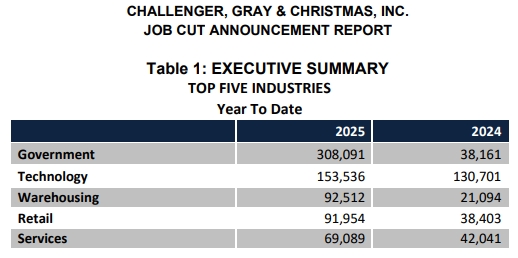
The retail sector illustrates this dynamic clearly, with 91,954 job cuts announced year to date, up 139% from the same period in 2024, as companies adjust workforce levels amid softening demand, tariff uncertainty and changing consumer preferences.
Government policy creates ripple effects
The Department of Government Efficiency impact remains the leading single reason for job cut announcements in 2025, cited in 293,753 planned layoffs. This includes direct reductions to the federal workforce and its contractors, according to the report.
DOGE’s downstream impact caused an additional 20,976 cuts, reflecting the loss of federal funding to private and non-profit entities. The non-profit sector suffered particularly hard, announcing 28,696 cuts this year, which represents an increase of 409% from the same period in 2024.
The context HR leaders need
When facing pressure to cut headcount, this data enables HR leaders to address more strategic questions: Are we restructuring inefficient operations? Are specific business units underperforming? Are we responding to real demand changes or preemptive fear?
The hiring picture reinforces the cautious environment. Through November, U.S. employers have announced 497,151 planned hires, according to the report. This is down 35% from the same point in 2024 and the lowest year-to-date total since 2010. Seasonal hiring announcements reached their lowest level since Challenger began tracking them in 2012, at 372,520 positions.
“The increased spending over the Black Friday and the Thanksgiving weekend may give rise to hires in December right before the holiday. It’s unclear, however, if those positions will last into the New Year,” said Challenger.
Credit: Source link