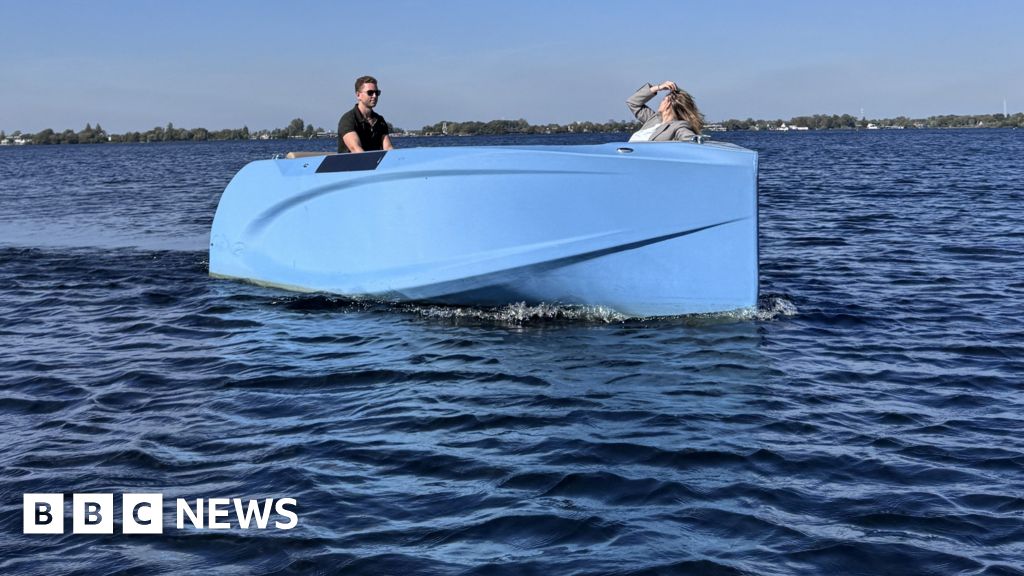
Matthew KenyonTechnology Reporter, Delft, Netherlands
The final test was a blunt one. Maarten Logtenberg wielded a sledgehammer, which simply bounced off the sample, barely leaving a scratch.
After two years of experimentation, the material was finally right: a particular mix of thermoplastics and fibreglass that is strong, has no need of extra coating to protect it from sunlight, and is resistant to fouling and marine growth.
The perfect base, says Mr Logtenberg, from which to 3D print a boat.
Boats need to withstand the unforgiving nature of the marine environment. It’s one of the reasons why boatbuilding is a notoriously labour-intensive business.
But after months of tweaking the chemistry, it took just four days for the first hull to roll off the printer at the new factory that Mr Logtenberg and his colleagues run.
“We’re automating almost 90% of the boat-building process, and in superfast time,” he says.
“Normally it takes weeks to build a hull. We print one now every week.”
It’s the kind of story that 3D printing has long promised. A quick, labour-saving production process that drastically reduces costs.
Those promises haven’t always been fulfilled – but Mr Logtenberg is convinced that the maritime sector is one where 3D printing, also known as additive manufacturing, can play a transformational role.
Mr Logtenberg is the co-founder of CEAD, a company that designs and builds large-format 3D printers at its base in the Dutch town of Delft.
Until now, its business has been to provide the printers for others to use, but with boatbuilding CEAD decided to get involved in production as well.
“3D printed boats still need to be accepted by the market,” says Mr Logtenberg.
“People are not going to invest and then just hope that the market will develop. They would rather buy in capacity first. [So] instead of just building machines, we’re going to do it ourselves.”
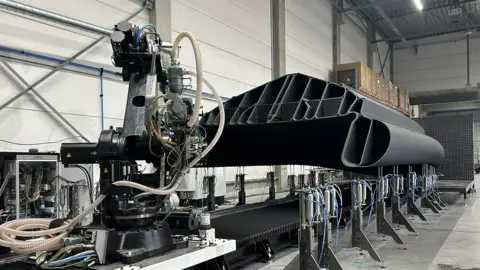 CEAD
CEADTraditional fibreglass boat building requires a mould and considerable manual work to make sure the vessel is of the required strength.
In additive manufacturing, the work has already been done at the design stage, in creating the software and the printer itself (which is labour intensive).
3D printers work by building up tiny layers of the basic material, to a predetermined digital design.
Each layer then bonds to the previous one to allow the creation of a single, seamless object.
In the production phase, as long as there is a supply of the base material, there is little or no need for human intervention.
The design can also be adjusted without the need for major changes in the build process.
Much 3D printing operates on a relatively small scale – dentistry is one area where it has made a major impact. To create a boat capable of operating in real world conditions is a different challenge.
CEAD’s largest 3D printer is nearly 40m (131ft) long, and has been used by a customer in Abu Dhabi to print an electric ferry.
And in the 12 months since they have been operating the Marine Application Centre in Delft, they have already built a prototype 12m fast boat, similar to a RIB, for the Dutch Navy.
“Normally when the Navy buys a boat, it takes them years before they receive it and they pay quite some money,” says Mr Logtenberg.
“We did it in six weeks and for a very limited budget. And we can learn from it and build another one in six weeks and even recycle the first one.”
Another fast growth area is the use of unmanned vessels – nautical drones. CEAD recently took part in a test with Nato Special Forces in which drones were built on site in a matter of hours, with designs changing according to operational requirements.
The ability to relocate production makes 3D printing incredibly flexible, according to Mr Logtenberg.
Even a substantial printer can be carried in a shipping container and taken much closer to the end user.
“It doesn’t matter whether it’s a 6m small work boat or a 12m military boat. The machine just takes it all as long as we have the design.
“The only transport we need to do is the base material, which comes in big bags and it’s very transport efficient, compared to a boat.”

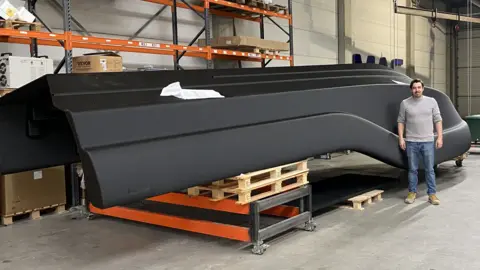 Matthew Kenyon
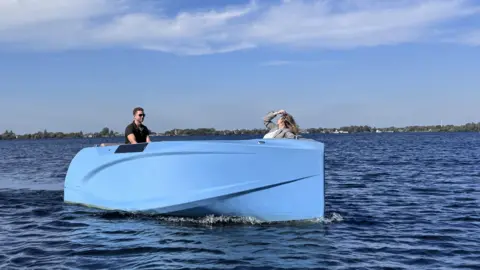 Raw Idea
Not far from CEAD, in the port city of Rotterdam, a company called Raw Idea and their ‘Tanaruz’ brand are looking at making a similar impact in the leisure market, especially rentals.
“Consumers are hesitant [because of the novelty], but the rental market is really keen,” says Joyce Pont, Raw Idea’s managing director.
“It’s marketing, you can go to the socials and say, ‘we’ve got a 3D printed boat’, and everybody wants to look at and touch that boat.”
Another selling point is that Raw Idea uses a mix of glass fibre and recycled consumer plastics (fizzy drinks bottles and so on).
That’s one reason why the price is currently comparable to a traditionally-built boat, because recycled material costs more to buy.
But Ms Pont says scale and flexibility will bring costs down significantly.
“I’m convinced that in five years from now, 3D printed boats will take over the market for the fast-driving boat, like work boats, like speed boats,” she tells me.
The marine industry is intensely regulated but the certification authorities are having to keep pace with innovation.
Both RAW Idea and CEAD are engaging with European regulators almost in real time, as they use new materials and new ideas to produce vessels that cannot be compared to what has come before.
3D printing has often been hailed as a revolutionary technology but hasn’t always delivered on those hopes.
Mr Logtenberg says that’s because the technique is used in multiple different contexts.
“It’s all being seen as one thing, but you have metal printing, you have polymer or large-scale printing, all these different applications.
“There are many applications that didn’t succeed because it was not competitive enough, but there are a few where it actually happened and is being used.”
Additive manufacturing is being used more frequently in the shipping industry, but in technical niches, rather than entire hulls.
How far could 3D printing go in the maritime world? We are a long way from entire ships being printed in one go.
Joyce Pont is sceptical whether that moment will arrive in the foreseeable future – she sees the building of superyachts and other such vessels as a ‘craft’ which will resist automation.
But Mr Logtenberg is more optimistic.
“Building a 12-meter boat, I never expected that a year ago,” he says.
“Traditional shipbuilding is done in modules. It’s going to take maybe a decade or two before we are going to completely print [a ship’s hull], because there will be more need of material research.
“But thermal plastics are being developed and improved all the time. Of course, the machines, everything needs to be scaled up, but why not?”
Credit: Source link