
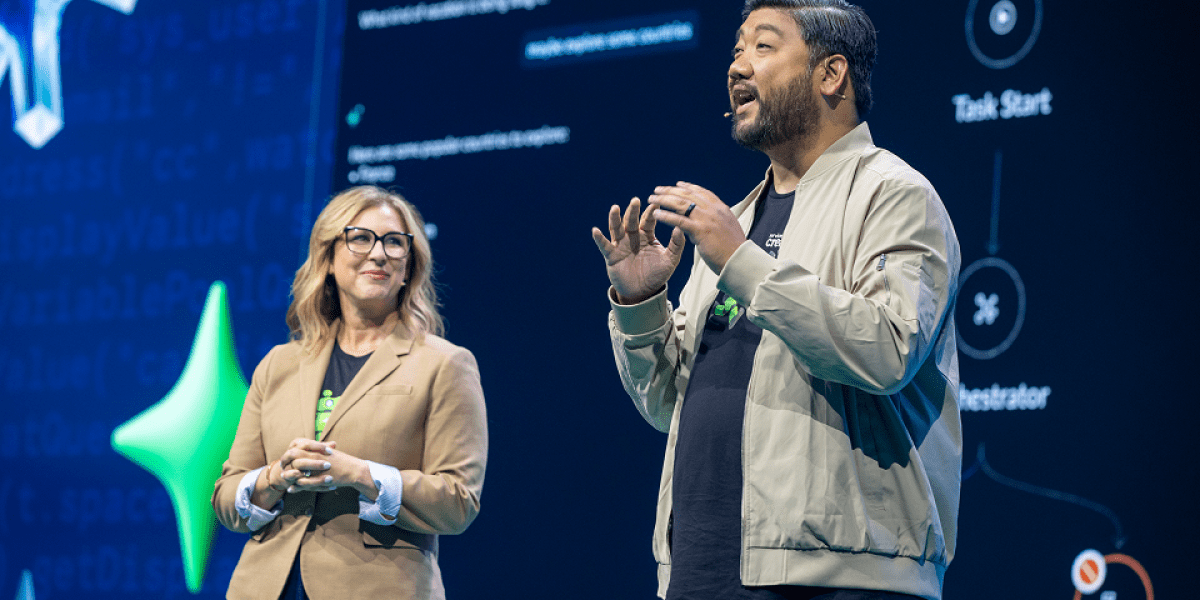
ServiceNow used its biggest annual stage to make one sweeping argument: the era of AI as a helper is over. The era of AI as a worker has begun.
At Knowledge 2026, held this week at the Venetian Expo Center in Las Vegas, the enterprise software company—valued at roughly $95 billion and increasingly positioning itself as the operating system of the AI-powered enterprise—unveiled a wave of announcements designed to move AI from the margins of business operations to the center of them. Taken together, they represent what ServiceNow considers the most ambitious product moment in the company’s history.
An AI workforce across every business function
The centerpiece announcement was a major expansion of ServiceNow’s Autonomous Workforce: a suite of AI “specialists” that don’t just assist human workers but complete entire business processes from start to finish, without human intervention.
The new AI specialists span IT operations, customer relationship management, HR, finance, legal, procurement, as well as security and risk. Unlike task-based AI tools or chatbots, ServiceNow says these specialists are role-scoped, governed, and embedded in proven enterprise workflows—meaning they can triage a security incident, resolve an employee HR case, or close a sales quote autonomously, while leaving a full audit trail behind.
Early results include ServiceNow’s internal AI specialist resolving IT service desk cases 99% faster than human agents. Docusign is targeting autonomous resolution of 90% of all IT tickets. Honeywell says its AI assistant has eliminated the majority of service desk conversations. The city of Raleigh reports a 98% deflection rate on employee requests, saving the equivalent of a full month of staff time.
“Advisory AI has run its course,” said Amit Zavery, ServiceNow’s president and chief product officer. “Enterprises need AI that senses, decides, and securely acts.”
The scale of the existing platform gives the pitch real weight: 23 million employees use ServiceNow’s employee portal every month, generating an estimated 40 million-plus cases annually. The company says AI specialists across its customer base already resolve 91% of cases without reassignment. Each month, its CRM platform resolves over 100 million customer cases and configures more than 7 million quotes.
Governing the AI agents nobody can see
The more enterprises deploy AI agents, the more urgent a second problem becomes: nobody knows where all those agents are, what they’re doing, or who approved them.
ServiceNow’s answer was introduced at Knowledge 2025: the AI Control Tower. This year, the company announced that all AI Control Tower capabilities are now included across every product and package on its platform, built in by default rather than sold as an add-on. The Control Tower continuously discovers AI agents as they appear, risk-scores them, enforces least-privilege access, and measures their business impact against governance standards.
The company also deepened its partnership with Microsoft to extend AI Control Tower governance across the Microsoft Agent 365 ecosystem. The integration gives IT administrators visibility into AI agents operating across both ServiceNow and Microsoft environments—regardless of where those agents were built—and allows ServiceNow’s AI specialists to operate inside Microsoft 365 tools like Outlook, Word, and PowerPoint with metered usage tracked across both platforms.
“One of the most important things we can do for enterprises is bring intelligence and action together in a secure, connected way,” said Charles Lamanna, Microsoft’s EVP of Business Industry Copilot.
A $1 billion security business gets a major upgrade
ServiceNow’s security and risk division crossed $1 billion in annual contract value last year—one of the fastest-growing segments on its platform—and the company is doubling down with a new product called Autonomous Security & Risk.
The launch integrates two recent acquisitions: Armis, which delivers continuous asset intelligence across IT, operational technology, IoT, and connected devices; and Veza, which maps every human and non-human identity and permission across an enterprise environment in real time. The combination gives security teams—for the first time—a unified picture of what exists in their environment and who or what is permitted to interact with it.
The business case is urgent. As companies deploy more AI agents, those agents multiply the number of non-human identities operating inside enterprise systems, each with access to data and the ability to take consequential actions. Most enterprises cannot answer basic questions about those identities, such as who approved that access, why it exists, and whether it remains valid.
Early customer results are striking. ServiceNow said a global energy company operating across 70 countries cut threat containment time by 97% and saved 1.2 million hours by automating security operations. A major U.S. financial services institution eliminated 96% of dormant non-human identities. A Fortune 100 aerospace manufacturer reduced control attestation time by 75%.
Nvidia, a new learning platform, and the infrastructure layer
ServiceNow also announced an expanded partnership with Nvidia, integrating Nvidia’s accelerated computing infrastructure with the ServiceNow AI Platform, a move designed to give enterprises faster, more efficient AI agent deployment at scale.
On the workforce development front, ServiceNow University—the company’s free learning platform—has grown to nearly 2 million learners, up 80% year over year since its launch at Knowledge 2025. Two new tools debuted: AI Learning Guide, a conversational coaching companion that builds personalized learning paths, and SimStudio, a hands-on simulation environment where employees practice real ServiceNow tasks before going live. The World Economic Forum projects a net gain of 78 million jobs by 2030, with AI and big data topping the list of fastest-growing skills, and ServiceNow is clearly angling to be the training ground for the workers who fill them.
Finally, a deepened partnership with Lenovo integrates its real-time device intelligence platform with ServiceNow’s workflows, enabling enterprises to resolve up to 40% of IT issues proactively—before users even notice a problem—while cutting IT support costs by as much as 30%.
The bigger picture
Taken together, the announcements reflect a company that has made a definitive strategic bet: that the enterprise of the near future runs on autonomous AI workflows, governed by a central platform, and that ServiceNow intends to be that platform.
The bet is well-timed. Enterprises are moving fast—sometimes faster than their security, compliance, and governance infrastructure can keep pace. ServiceNow’s argument is that it uniquely solves both sides of that equation: deploying AI at scale and governing it at scale, on the same platform, with the same data.
Whether customers agree—and whether autonomous AI specialists deliver on their promise at the scale ServiceNow is projecting—will become clearer as the year unfolds. The security and risk AI specialists don’t hit general availability until September. The IT specialists arrive in June. For now, ServiceNow is betting its next decade on the idea that AI agents will be our colleagues.
For this story, Fortune journalists used generative AI as a research tool. An editor verified the accuracy of the information before publishing. ServiceNow is a partner with Fortune.
Credit: Source link




